Furlan Natalia Eduarda, Luvizutto Gustavo José, Hamamoto Filho Pedro Tadao, Zanati Bazan Silmeia Garcia, Modolo Gabriel Pinheiro, Ferreira Natalia Cristina, Miranda Luana Aparecida, de Souza Juli Thomaz, Winckler Fernanda Cristina, Vidal Edison Iglesias de Oliveira, de Freitas Carlos Clayton Macedo, Martin Luis Cuadrado, Bazan Rodrigo
Department of Neurology, Psychology and Psychiatry, Botucatu Medical School (UNESP), Botucatu, Brazil.
Department of Applied Physical Therapy, Federal University of Triângulo Mineiro, Uberaba, Brazil.
Front Surg. 2022 Feb 25;9:799485. doi: 10.3389/fsurg.2022.799485. eCollection 2022.
Cerebral reperfusion therapy is recommended for the treatment of acute ischemic stroke. However, the outcomes of patients receiving this therapy in middle- and low-income countries should be better defined. This study aimed to evaluate the clinical and functional outcomes of cerebral reperfusion therapy in patients with ischemic stroke.
This retrospective study included patients with ischemic stroke treated with cerebral reperfusion therapy, including intravenous thrombolysis (IVT), mechanical thrombectomy (MT), and IVT with MT. The primary outcomes were death and disability, assessed using the modified Rankin scale (mRS), and stroke severity, assessed using the National Institutes of Health Stroke Scale (NIHSS), after intervention and 90 days after ictus. The association between the type of treatment and the primary outcome was assessed using binary logistic regression after adjusting for confounding variables. Furthermore, receiver operating characteristic (ROC) curves were generated to identify the cutoff point of the NIHSS score that could best discriminate the mRS score in all types of treatments.
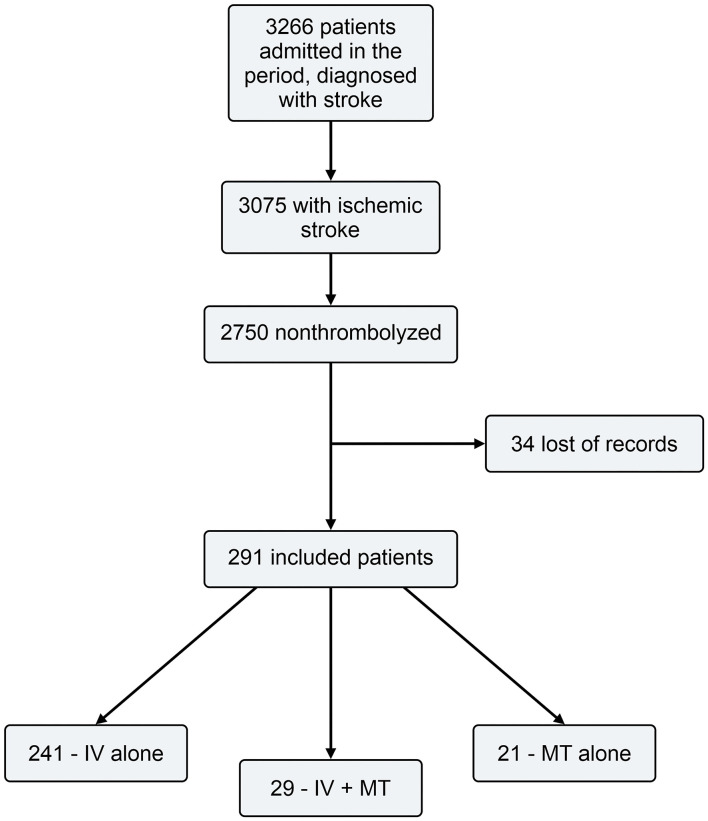
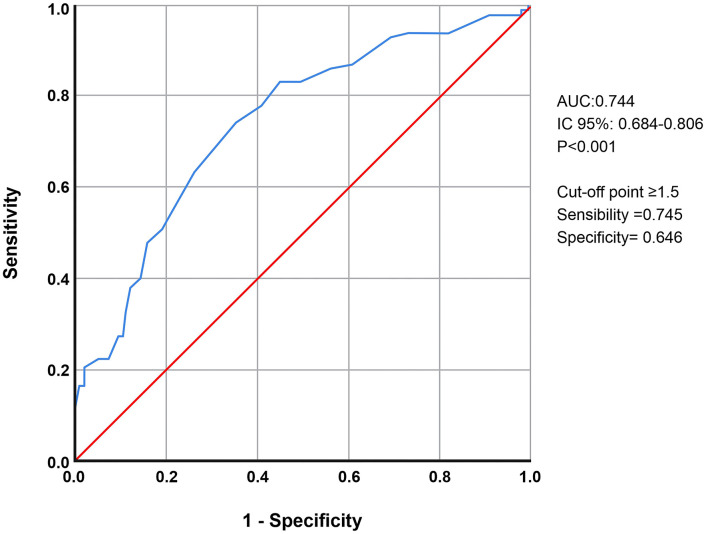
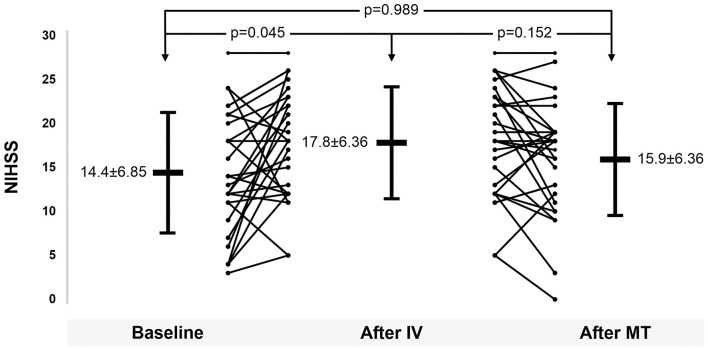
Patients ( = 291) underwent IVT only ( = 241), MT ( = 21), or IVT with MT ( = 29). In the IVT with MT group, the incidence of death within 90 days increased by five times (OR, 5.192; 95% CI, 2.069-13.027; = 0.000), prevalence of disability increased by three times (OR, 3.530; 95% CI, 1.376-9.055; = 0.009) and NIHSS score increased after IVT (from 14.4 ± 6.85 to 17.8 ± 6.36; = 0.045). There was no significant difference between the initial NIHSS score and that after MT ( = 0.989). Patients' NIHSS score that increased or decreased by 2.5 points had a sensitivity of 0.74 and specificity of 0.65, indicating severe disability or death in these patients.
Altogether, a 2.5-point variation in NIHSS score after reperfusion is an indicator of worse outcomes. In our particular context, patients receiving the combination of IVT and MT had inferior results, which probably reflects challenges to optimize MT in LMIC.
脑再灌注治疗被推荐用于急性缺血性卒中的治疗。然而,中低收入国家接受该治疗的患者的预后需要更明确地界定。本研究旨在评估缺血性卒中患者脑再灌注治疗的临床和功能预后。
这项回顾性研究纳入了接受脑再灌注治疗的缺血性卒中患者,包括静脉溶栓(IVT)、机械取栓(MT)以及IVT联合MT。主要结局为死亡和残疾,分别在干预后及发病90天后使用改良Rankin量表(mRS)进行评估,卒中严重程度则使用美国国立卫生研究院卒中量表(NIHSS)进行评估。在对混杂变量进行校正后,使用二元逻辑回归评估治疗类型与主要结局之间的关联。此外,绘制受试者工作特征(ROC)曲线以确定在所有类型治疗中最能区分mRS评分的NIHSS评分的截断点。
患者(n = 291)仅接受IVT(n = 241)、MT(n = 21)或IVT联合MT(n = 29)。在IVT联合MT组中,90天内的死亡发生率增加了5倍(OR,5.192;95%CI,2.069 - 13.027;P = 0.000),残疾患病率增加了3倍(OR,3.530;95%CI,1.376 - 9.055;P = 0.009),且IVT后NIHSS评分升高(从14.4 ± 6.85升至17.8 ± 6.36;P = 0.045)。MT前后的初始NIHSS评分无显著差异(P = 0.989)。NIHSS评分升高或降低2.5分的患者的敏感性为0.74,特异性为0.65,表明这些患者存在严重残疾或死亡。
总体而言,再灌注后NIHSS评分变化2.5分是预后较差的一个指标。在我们的特定背景下,接受IVT联合MT治疗的患者结果较差,这可能反映了在中低收入国家优化MT存在挑战。