Félix María L, Muñoz-Leal Sebastián, Carvalho Luis A, Queirolo Diego, Remesar Alonso Susana, Nava Santiago, Armúa-Fernández María T, Venzal José M
Laboratorio de Vectores y Enfermedades Transmitidas, Departamento de Ciencias Biológicas, CENUR Litoral Norte - Salto, Universidad de la República, Rivera 1350, CP 50000 Salto, Uruguay.
Departamento de Patología y Medicina Preventiva, Facultad de Ciencias Veterinarias, Universidad de Concepción, Av. Vicente Méndez 595, Casilla 537, Chillán, Ñuble, Chile.
Curr Res Parasitol Vector Borne Dis. 2021 Apr 13;1:100022. doi: 10.1016/j.crpvbd.2021.100022. eCollection 2021.
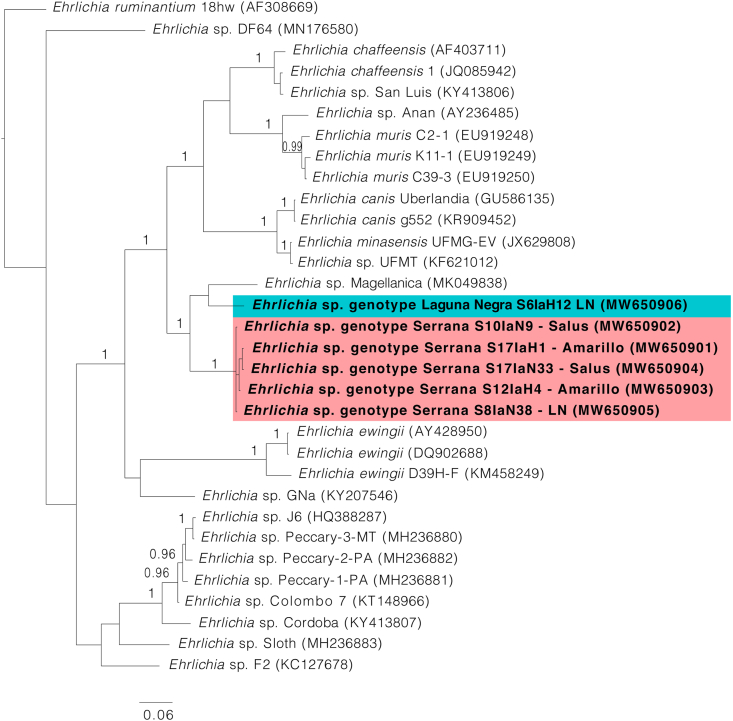
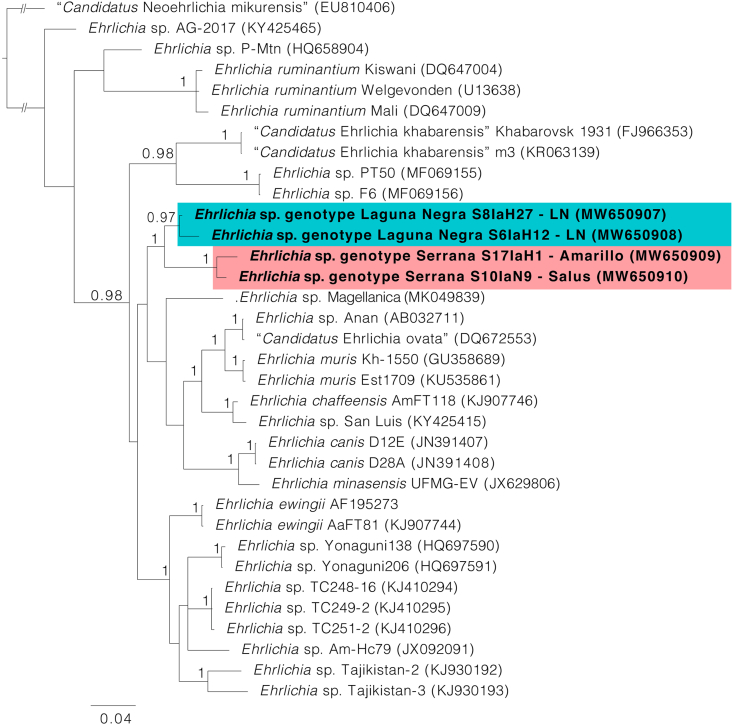
are small intracellular Gram-negative bacteria transmitted by ticks. These microorganisms cause ehrlichiosis, a complex of life-threatening emerging zoonoses and diseases of global veterinary relevance. The aim of this study was to investigate the presence of in free-living collected in Uruguay. Ticks were collected from vegetation in five localities from the southeast and northeast of the country between 2014 and 2017. Detection of DNA was performed in pools of adults or nymphs grouped according to the collection site and date. A total of 1,548 ticks were collected in four of the five locations sampled. Fragments of three loci ( rRNA, and ) were obtained by PCR, and phylogenies inferred using Bayesian inference analysis for each gene independently. DNA of spp. was found in 15 out of 42 tick pools. Based on the topology of the phylogenetic trees, our sequences represent two novel genotypes for the genus named as sp. Serrana and sp. Laguna Negra. Both genotypes were closely related to sp. Magellanica, a species detected in and Magellanic penguins. Considering that all stages of and are parasites of birds, their phylogenetic relationships, and common eco-epidemiological profiles, it is reasonable to state that these genotypes of spp. may represent a natural group likely associated with birds. Our results constitute the first characterization of spp. in Uruguay. Future studies on birds reported as hosts for are needed to further understand the epidemiological cycles of both genotypes in the country. Finally, does not feed on humans, so the two species reported herein might have no implications in human health.
是由蜱传播的小型细胞内革兰氏阴性菌。这些微生物会引起埃立克体病,这是一组危及生命的新发人畜共患病以及具有全球兽医相关性的疾病。本研究的目的是调查在乌拉圭采集的自由生活的蜱中是否存在该菌。2014年至2017年期间,从该国东南部和东北部的五个地点的植被中采集蜱。对根据采集地点和日期分组的成年蜱或若蜱池进行该菌DNA检测。在采样的五个地点中的四个地点共采集到1548只蜱。通过聚合酶链反应(PCR)获得三个基因座(核糖体RNA、和)的片段,并分别对每个基因使用贝叶斯推断分析来推断系统发育。在42个蜱池中,有15个检测到该菌属的DNA。根据系统发育树的拓扑结构,我们的序列代表该属的两个新基因型,命名为Serrana菌属和Laguna Negra菌属。这两个基因型都与Magellanica菌属密切相关,Magellanica菌属是在和麦哲伦企鹅中检测到的一个物种。考虑到该菌属和麦哲伦菌属的所有阶段都是鸟类的寄生虫,它们的系统发育关系以及共同的生态流行病学特征,可以合理地认为这些菌属基因型可能代表一个可能与鸟类相关的自然群体。我们的结果构成了乌拉圭该菌属的首次特征描述。需要对被报告为该菌宿主的鸟类进行进一步研究,以更好地了解该国这两种基因型的流行病学循环。最后,该菌不以人类为食,因此本文报道的这两个菌属物种可能对人类健康没有影响。