Department of Biomedical Engineering, University of Virginia, Charlottesville, Virginia, USA.
Inova Children's Hospital, Falls Church, Virginia, USA.
JPEN J Parenter Enteral Nutr. 2022 Nov;46(8):1903-1913. doi: 10.1002/jpen.2374. Epub 2022 Apr 7.
Parenteral nutrition-associated cholestasis (PNAC) in the neonatal intensive care unit (NICU) causes significant morbidity and associated healthcare costs. Laboratory detection of PNAC currently relies on elevated serum conjugated bilirubin levels in the aftermath of impaired bile flow. Here, we sought to identify fecal biomarkers, which when integrated with clinical data, would better predict risk for developing PNAC.
Using untargeted metabolomics in 200 serial stool samples from 60 infants, we applied statistical and machine learning approaches to identify clinical features and metabolic biomarkers with the greatest associative potential for risk of developing PNAC. Stools were collected prospectively from infants receiving PN with soybean oil-based lipid emulsion at a level IV NICU.
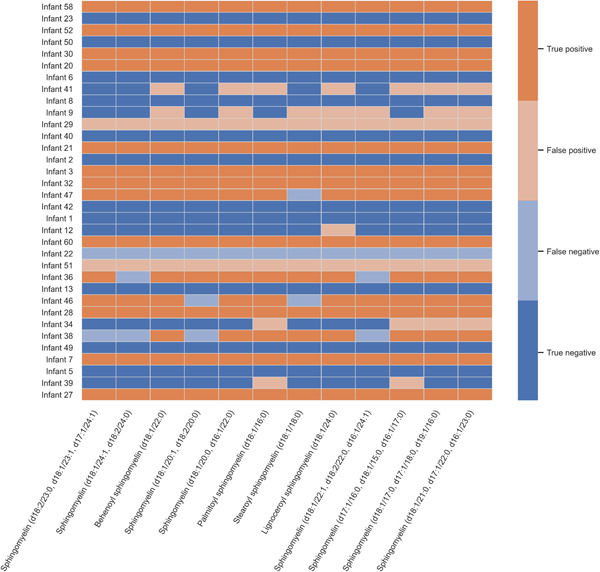
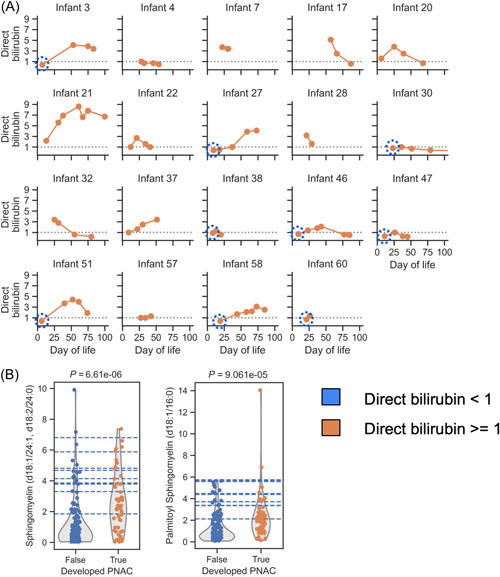
Low birth weight, extreme prematurity, longer duration of PN, and greater number of antibiotic courses were all risk factors for PNAC (P < 0.05). We identified 78 stool biomarkers with early predictive potential (P < 0.05). From these 78 biomarkers, we further identified 12 sphingomyelin lipids with high association for the development of PNAC in precholestasis stool samples when combined with birth anthropometry.
We demonstrate the potential for stool metabolomics to enhance early identification of PNAC risk. Earlier detection of high-risk infants would empower proactive mitigation with alterations to PN for at-risk infants and optimization of energy nutrition with PN for infants at lower risk.
新生儿重症监护病房(NICU)中的肠外营养相关性胆汁淤积症(PNAC)会导致严重的发病率,并带来相关的医疗保健费用。目前,实验室检测 PNAC 依赖于胆汁流动受损后血清结合胆红素水平的升高。在这里,我们试图确定粪便生物标志物,将其与临床数据相结合,可更好地预测发生 PNAC 的风险。
我们对 60 名接受大豆油基脂肪乳剂肠外营养的婴儿的 200 份连续粪便样本进行了非靶向代谢组学研究,应用统计和机器学习方法来确定与发生 PNAC 的风险具有最大关联潜力的临床特征和代谢生物标志物。前瞻性收集来自在 IV 级 NICU 接受肠外营养的婴儿的粪便。
低出生体重、极早产、肠外营养时间更长以及使用抗生素的疗程更多都是 PNAC 的危险因素(P<0.05)。我们鉴定出了 78 种具有早期预测潜力的粪便生物标志物(P<0.05)。在这 78 种生物标志物中,我们进一步在胆汁淤积前的粪便样本中发现了 12 种与 PNAC 发生高度相关的神经鞘磷脂脂质,当与出生人体测量值结合使用时。
我们证明了粪便代谢组学在增强对 PNAC 风险的早期识别方面具有潜力。更早地发现高危婴儿,可以为高危婴儿主动调整肠外营养,为低危婴儿优化肠外营养的能量营养提供依据。