Los Angeles Medical Center, Department of Neurology, Southern California Permanente Medical Group, Los Angeles, California.
Kaiser Foundation Health Plan, Drug Use Management, Downey, California.
Ann Neurol. 2022 Aug;92(2):164-172. doi: 10.1002/ana.26352. Epub 2022 Mar 30.
This study was undertaken to evaluate a multicomponent health system intervention designed to reduce escalating disease-modifying treatment (DMT) expenditures and improve multiple sclerosis (MS) outcomes by increasing use of preferred formulary and highly effective DMTs (HETs).
We conducted a trend study of treatment utilization and expenditure outcomes prior to (2009-2011) and during (2012-2018) MS Treatment Optimization Program (MSTOP) implementation in Kaiser Permanente Southern California (KPSC) compared to a Kaiser Permanente region of similar size. Annual relapse rates (ARRs) were obtained from KPSC's electronic health records.
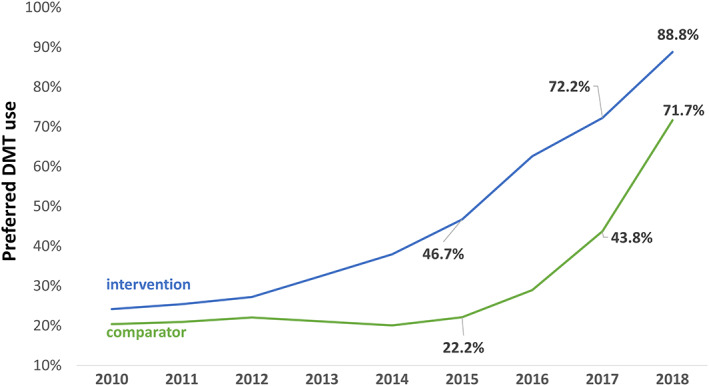
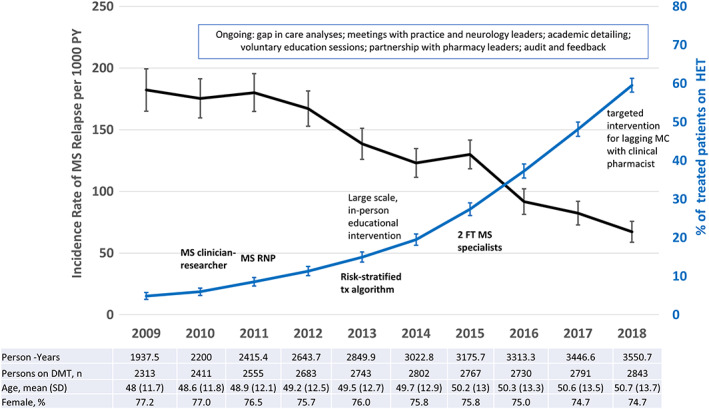
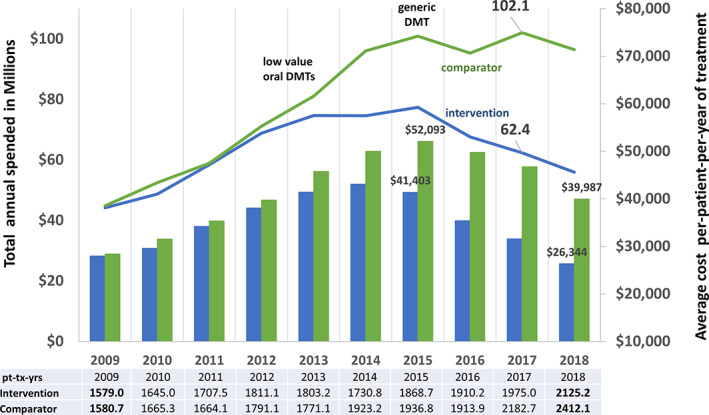
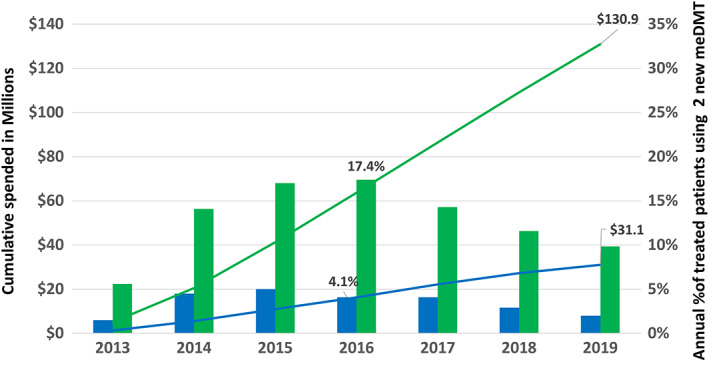
Adherence to preferred formulary DMTs increased from 25.4% in 2011 to 72.2% in 2017 following MSTOP implementation in KPSC and 22.1% to 43.8%, respectively, in the comparator. KPSC's annual DMT expenditures in 2018 were less than in 2011 despite an 11.3% increase in DMT-treated members. The decline in average per patient per year of treatment expenditures from a peak of $43.1 K in 2014 to $26.3 K in 2018 in KPSC was greater than the comparator, which peaked at $52.1 K and declined to $40.0 K in 2018. Over the 7 years following initiation of MSTOP, cumulative MS DMT expenditures were $161.6 million less than the comparator. HET use increased to 62.5% of per patient treatment-years versus 32.4% in the comparator. This corresponded to a 69% decline in adjusted ARR (95% confidence interval = 64.1-73.2%; p < 0.0001) among DMT-treated patients in KPSC.
A novel, expert-led health system intervention reduced MS DMT expenditures despite rising prices while simultaneously reducing MS relapse rates. Our focus on health system progress toward meaningful, measurable targets could serve as a model to improve quality and affordability of MS care in other settings. ANN NEUROL 2022;92:164-172.
本研究旨在评估一种多组分卫生系统干预措施,该措施旨在通过增加首选处方和高效疾病修正治疗(DMT)的使用来降低不断升级的疾病修正治疗(DMT)支出并改善多发性硬化症(MS)的预后,从而减少支出并改善多发性硬化症的预后。
我们对 Kaiser Permanente Southern California(KPSC)实施多发性硬化症治疗优化计划(MSTOP)之前(2009-2011 年)和期间(2012-2018 年)的治疗利用和支出结果进行了趋势研究,并与规模相似的 Kaiser Permanente 地区进行了比较。年度复发率(ARR)来自 KPSC 的电子健康记录。
在 KPSC 实施 MSTOP 后,首选处方 DMT 的依从性从 2011 年的 25.4%增加到 2017 年的 72.2%,而对照地区分别从 22.1%增加到 43.8%。尽管接受 DMT 治疗的成员增加了 11.3%,但 KPSC 在 2018 年的 DMT 支出仍低于 2011 年。从 2014 年的 43.1 千美元的高峰到 2018 年的 26.3 千美元,KPSC 每位患者每年的治疗支出平均每年下降超过对照地区,该地区的支出峰值为 52.1 千美元,2018 年下降至 40.0 千美元。在启动 MSTOP 后的 7 年中,KPSC 的 MS DMT 支出累计减少了 1.616 亿美元,而对照地区则增加了 62.5%。这相当于 DMT 治疗患者的调整ARR 下降了 69%(95%置信区间为 64.1-73.2%;p<0.0001)。
一种新颖的、由专家主导的卫生系统干预措施,在药物价格不断上涨的情况下降低了多发性硬化症的 DMT 支出,同时降低了多发性硬化症的复发率。我们对朝着有意义的、可衡量的目标的卫生系统进展的关注,可以作为在其他环境中提高多发性硬化症护理质量和可负担性的模型。