Gliske Kate, Welsh Justine W, Braughton Jacqueline E, Waller Lance A, Ngo Quyen M
Butler Center for Research, Hazelden Betty Ford Foundation, Center City, MN, United States.
Department of Psychiatry and Behavioral Services, Emory University School of Medicine, Emory University, Atlanta, GA, United States.
JMIR Ment Health. 2022 Mar 14;9(3):e36263. doi: 10.2196/36263.
The onset of the COVID-19 pandemic necessitated the rapid transition of many types of substance use disorder (SUD) treatments to telehealth formats, despite limited information about what makes treatment effective in this novel format.
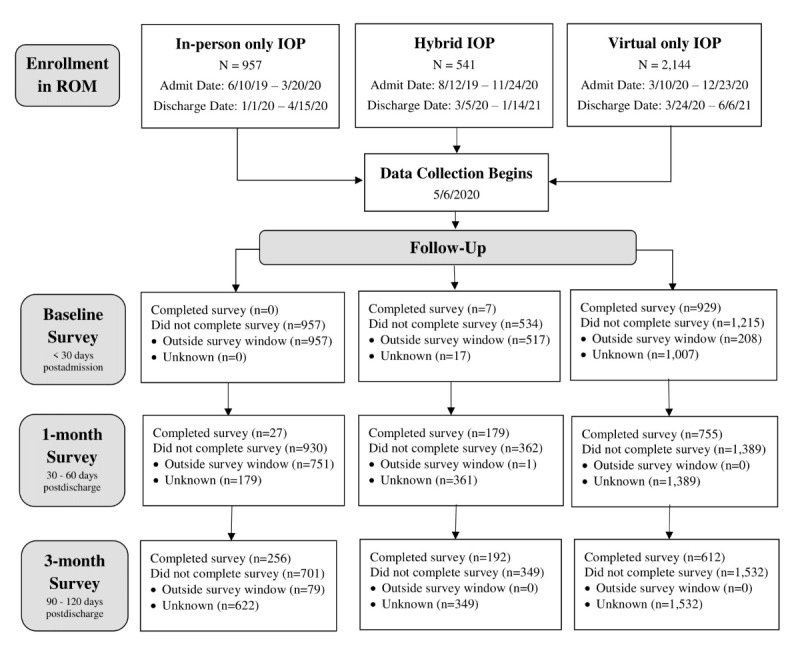
This study aims to examine the feasibility and effectiveness of virtual intensive outpatient programming (IOP) treatment for SUD in the context of a global pandemic, while considering the unique challenges posed to data collection during an unprecedented public health crisis.
The study is based on a longitudinal study with a baseline sample of 3642 patients who enrolled in intensive outpatient addiction treatment (in-person, hybrid, or virtual care) from January 2020 to March 2021 at a large substance use treatment center in the United States. The analytical sample consisted of patients who completed the 3-month postdischarge outcome survey as part of routine outcome monitoring (n=1060, 29.1% response rate).
No significant differences were detected by delivery format in continuous abstinence (χ=0.4, P=.81), overall quality of life (F=2.06, P=.13), financial well-being (F=2.30, P=.10), psychological well-being (F=0.72, P=.49), and confidence in one's ability to stay sober (F=0.21, P=.81). Individuals in hybrid programming were more likely to report a higher level of general health than those in virtual IOP (F=4.19, P=.01).
Virtual outpatient care for the treatment of SUD is a feasible alternative to in-person-only programming, leading to similar self-reported outcomes at 3 months postdischarge. Given the many obstacles presented throughout data collection during a pandemic, further research is needed to better understand under what conditions telehealth is an acceptable alternative to in-person care.
2019冠状病毒病疫情的爆发使得许多类型的物质使用障碍(SUD)治疗迅速转向远程医疗模式,尽管对于何种因素能使这种新型模式下的治疗有效,相关信息有限。
本研究旨在考察在全球大流行背景下,虚拟强化门诊治疗方案(IOP)对SUD治疗的可行性和有效性,同时考虑前所未有的公共卫生危机期间数据收集所面临的独特挑战。
该研究基于一项纵向研究,基线样本为2020年1月至2021年3月在美国一家大型物质使用治疗中心登记接受强化门诊成瘾治疗(面对面、混合或虚拟护理)的3642名患者。分析样本包括作为常规结果监测一部分完成出院后3个月结果调查的患者(n = 1060,应答率29.1%)。
在持续戒酒(χ = 0.4,P = 0.81)、总体生活质量(F = 2.06,P = 0.13)、财务状况(F = 2.30,P = 0.10)、心理健康(F = 0.72,P = 0.49)以及对保持清醒能力的信心(F = 0.21,P = 0.81)方面,未发现不同治疗模式之间存在显著差异。混合治疗方案中的个体比虚拟IOP中的个体更有可能报告更高的总体健康水平(F = 4.19,P = 0.01)。
虚拟门诊护理治疗SUD是仅面对面治疗方案的可行替代方案,在出院后3个月时可带来相似的自我报告结果。鉴于大流行期间数据收集过程中存在诸多障碍,需要进一步研究以更好地了解在何种条件下远程医疗是面对面护理的可接受替代方案。