Department of Biomedical Sciences for Health, Università Degli Studi Di Milano, via Fratelli Cervi 93, 20090, Segrate, Milano, Italy.
Department of Nutritional Sciences, College of Human Sciences, Texas Tech University, Lubbock, TX, USA.
J Mol Med (Berl). 2022 May;100(5):665-676. doi: 10.1007/s00109-022-02183-6. Epub 2022 Mar 14.
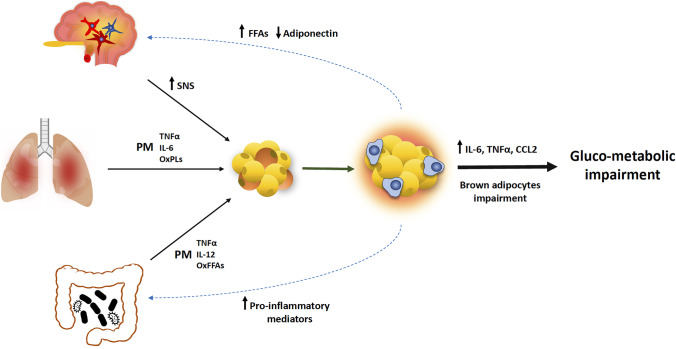
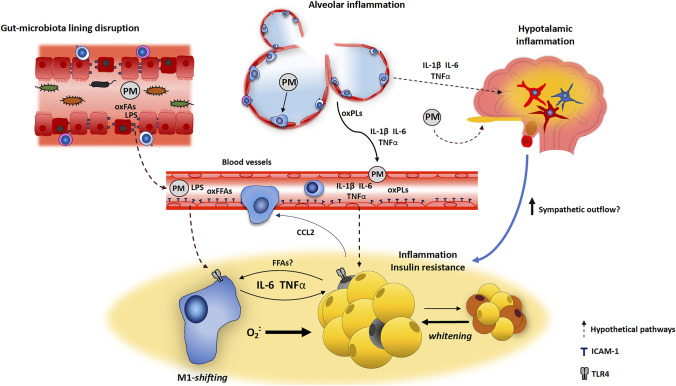
Chronic exposure to high levels of particulate matter (PM) is correlated to a higher prevalence of cardio-metabolic disturbances. Adipose tissue represents a pivotal regulator of metabolic homeostasis, and its dysfunction is associated with health issues in PM-exposed models. This review discusses the adaptive changes of white (WAT) and brown (BAT) adipose tissue in response to fine particulate matter (PM), investigating the underlying pathophysiology. In exposed models, PM increases oxidative stress and impairs mitochondria functionality and biogenesis in WAT and BAT. Chronic exposure also upregulates the main apoptotic/pro-inflammatory pathways and promotes the infiltration of monocytes and the accumulation of activated macrophages. Oxidative stress and inflammation are responsible for the inhibition of insulin signal transduction and glucose uptake in both the adipose tissues. The increased inflammatory status also suppresses the metabolic activity of brown adipocytes, promoting the whitening. Altogether, this evidence suggests the shift of WAT and BAT toward an inflammatory and metabolic dysfunctional phenotype. Although the underlying mechanisms remain to be clarified, the development of inflammation in lungs, gut, and hypothalamus seems to have a pivotal role in the alteration of adipose tissue homeostasis. The potential consequences on systemic cardio-metabolic health render the relationship PM-adipose tissue a key issue to investigate.
慢性暴露于高水平的颗粒物(PM)与更高的代谢紊乱发生率相关。脂肪组织是代谢稳态的关键调节者,其功能障碍与 PM 暴露模型中的健康问题有关。本综述讨论了白色(WAT)和棕色(BAT)脂肪组织对细颗粒物(PM)的适应性变化,研究了潜在的病理生理学机制。在暴露模型中,PM 增加了氧化应激,并损害了 WAT 和 BAT 中线粒体的功能和生物发生。慢性暴露还上调了主要的凋亡/促炎途径,并促进了单核细胞的浸润和活化巨噬细胞的积累。氧化应激和炎症导致脂肪组织中胰岛素信号转导和葡萄糖摄取的抑制。炎症状态的增加也抑制了棕色脂肪细胞的代谢活性,促进了脂肪的白化。总之,这些证据表明 WAT 和 BAT 向炎症和代谢功能障碍表型的转变。尽管潜在的机制仍有待阐明,但肺部、肠道和下丘脑的炎症发展似乎在脂肪组织稳态的改变中起着关键作用。对全身心血管代谢健康的潜在影响使得 PM-脂肪组织之间的关系成为一个需要研究的关键问题。