Gräf Julia Katharina, Lüdtke Kerstin, Wollesen Bettina
Institut für Bewegungswissenschaft, Arbeitsbereich Bewegungs- und Trainingswissenschaft, Universität Hamburg, Hamburg, Deutschland.
Institut für Gesundheitswissenschaften, Fachbereich Physiotherapie, Universität zu Lübeck, Lübeck, Deutschland.
Schmerz. 2022 Aug;36(4):256-265. doi: 10.1007/s00482-022-00637-x. Epub 2022 Mar 14.
The treatment of carpal tunnel syndrome (CTS) usually involves surgical decompression of the nerve or splinting and additional medication. Physiotherapy and sports therapy could be non-invasive and alternative treatment approaches with a simultaneous low risk of side effects.
The review systematically summarizes the current studies on the effectiveness of physiotherapy and sports therapeutic interventions for treatment of CTS and focuses on the reduction of symptoms and, as a secondary outcome, improvement of hand function.
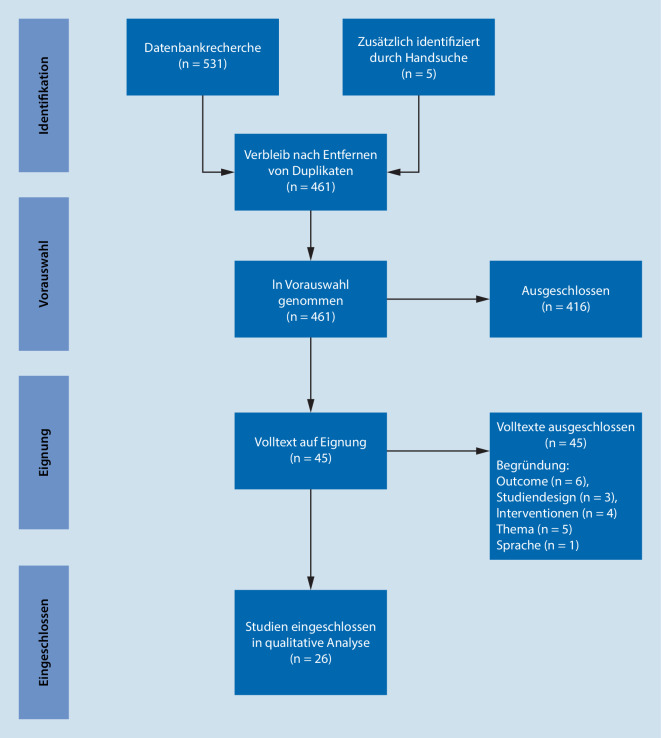
The systematic review includes randomized controlled trials reporting on physiotherapy or sports therapy interventions published prior to February 2021 in the electronic databases PubMed, CINAHL and Web of Science. Following the guidelines of preferred reporting items for systematic reviews and meta-analyses (PRISMA) and the Cochrane Collaboration, a systematic search of the literature, data extraction and evaluation of the risk of bias using the Cochrane risk of bias tool were conducted by two independent researchers.
Out of 461 identified studies 26 were included in the qualitative analysis. The risk of bias in the individual studies was graded as moderate to low. Potential bias might arise due to inadequate blinding of patients and study personnel in some cases as well as due to selective reporting of study results and procedures. Manual therapy proved to be faster and equally effective in reducing pain and improving function in the long term compared to surgery. Mobilization techniques, massage techniques, kinesiotaping and yoga as therapeutic interventions also showed positive effects on symptoms.
For the management of mild to moderate CTS, physiotherapy and sports therapeutic interventions are characterized primarily by success after as little as 2 weeks of treatment as well as comparable success to surgery and 3 months of postoperative treatment. In addition, patients are not exposed to surgical risks. The protocol was registered in the International Prospective Register of Systematic Reviews (PROSPERO) with the number 42017073839.
腕管综合征(CTS)的治疗通常包括对神经进行手术减压、使用夹板固定以及辅助药物治疗。物理治疗和运动疗法可能是非侵入性的替代治疗方法,同时副作用风险较低。
本综述系统总结了目前关于物理治疗和运动治疗干预措施对CTS治疗效果的研究,并重点关注症状的减轻,以及作为次要结果的手部功能改善。
本系统综述纳入了2021年2月之前在电子数据库PubMed、CINAHL和Web of Science上发表的关于物理治疗或运动治疗干预措施的随机对照试验。按照系统评价和Meta分析的首选报告项目(PRISMA)指南以及Cochrane协作网的要求,由两名独立研究人员对文献进行系统检索、数据提取,并使用Cochrane偏倚风险工具评估偏倚风险。
在461项已识别的研究中,26项被纳入定性分析。个别研究的偏倚风险被评为中度至低度。在某些情况下,由于患者和研究人员的盲法不足,以及研究结果和程序的选择性报告,可能会产生潜在偏倚。与手术相比,手法治疗在减轻疼痛和长期改善功能方面被证明更快且同样有效。松动技术、按摩技术、肌内效贴扎和瑜伽作为治疗干预措施,对症状也显示出积极影响。
对于轻至中度CTS的管理,物理治疗和运动治疗干预措施的主要特点是治疗仅2周后即可取得成功,且与手术及术后3个月的治疗效果相当。此外,患者无需承担手术风险。该方案已在国际前瞻性系统评价注册库(PROSPERO)注册,注册号为42017073839。