Brain Science Institute, Korea Institute of Science and Technology (KIST), Seoul, 02792, Republic of Korea.
School of Mechanical Engineering, Yonsei University, Seoul, 03722, Republic of Korea.
Adv Healthc Mater. 2022 Jun;11(12):e2102581. doi: 10.1002/adhm.202102581. Epub 2022 Mar 21.
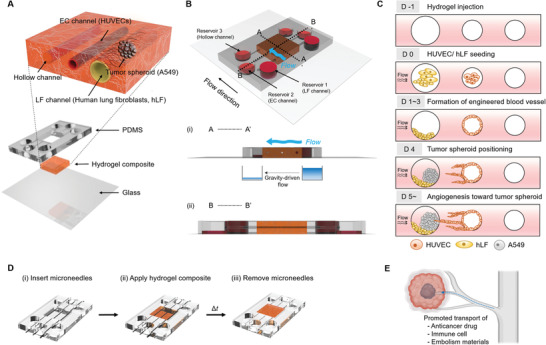
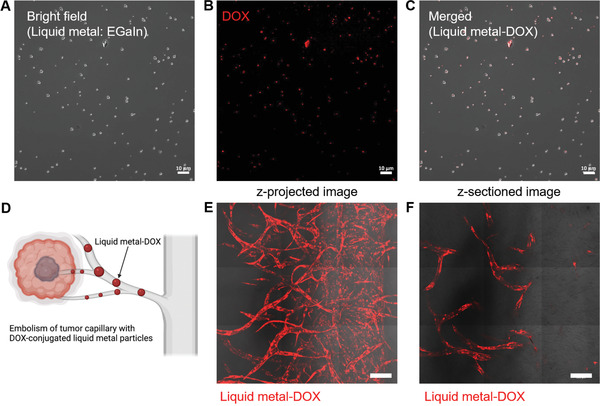
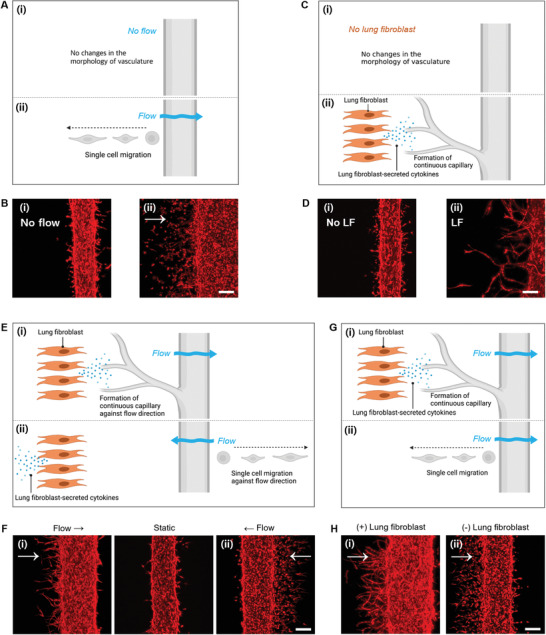
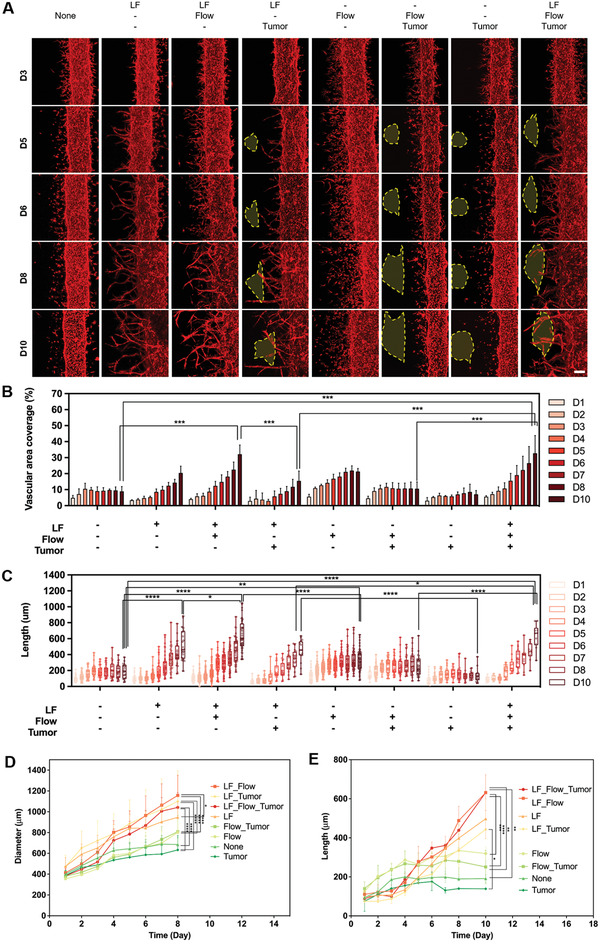
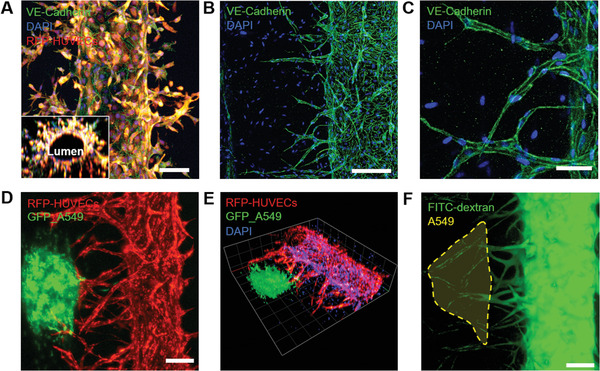
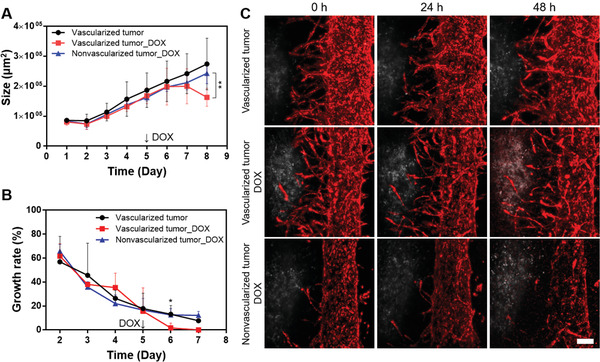
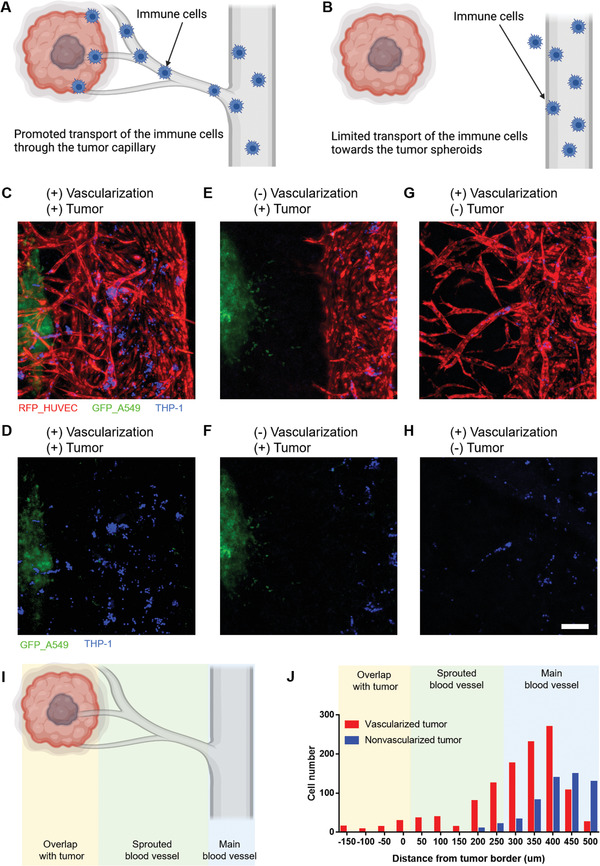
The tumor microenvironment (TME) is the environment around the tumor, including blood vessels, immune cells, fibroblasts, signaling molecules, and the extracellular matrix (ECM). Owing to its component interactions, the TME influences tumor growth and drug delivery in a highly complex manner. Although several vascularized cancer models are developed to mimic the TME in vitro, these models cannot comprehensively reflect blood vessel-tumor spheroid interactions. Here, a method for inducing controlled tumor angiogenesis by engineering the microenvironment is presented. The interstitial flow direction regulates the direction of capillary sprouting, showing that angiogenesis occurs in the opposite direction of flow, while the existence of lung fibroblasts affects the continuity and lumen formation of sprouted capillaries. The vascularized tumor model shows enhanced delivery of anticancer drugs and immune cells to the tumor spheroids because of the perfusable vascular networks. The possibility of capillary embolism using anticancer drug-conjugated liquid metal nanoparticles is investigated using the vascularized tumor model. This vascularized tumor platform can aid in the development of effective anticancer drugs and cancer immunotherapy.
肿瘤微环境(TME)是指肿瘤周围的环境,包括血管、免疫细胞、成纤维细胞、信号分子和细胞外基质(ECM)。由于其组成成分的相互作用,TME 以高度复杂的方式影响肿瘤生长和药物传递。尽管已经开发了几种血管化的癌症模型来模拟体外的 TME,但这些模型不能全面反映血管-肿瘤球体的相互作用。在这里,提出了一种通过工程微环境诱导受控肿瘤血管生成的方法。间质流的方向调节毛细血管发芽的方向,表明血管生成发生在血流相反的方向,而肺成纤维细胞的存在影响发芽毛细血管的连续性和管腔形成。由于可灌注的血管网络,血管化肿瘤模型显示出增强的抗癌药物和免疫细胞向肿瘤球体的传递。使用血管化肿瘤模型研究了使用抗癌药物偶联的液态金属纳米颗粒进行毛细管栓塞的可能性。这种血管化肿瘤平台有助于开发有效的抗癌药物和癌症免疫疗法。