Neagu Anca-Narcisa, Whitham Danielle, Bruno Pathea, Versaci Nicholas, Biggers Peter, Darie Costel C
Laboratory of Animal Histology, Faculty of Biology, "Alexandru Ioan Cuza" University of Iași, Iasi, Romania.
Biochemistry & Proteomics Laboratories, Department of Chemistry and Biochemistry, Clarkson University, Potsdam, NY, United States.
Front Bioeng Biotechnol. 2024 Oct 2;12:1436393. doi: 10.3389/fbioe.2024.1436393. eCollection 2024.
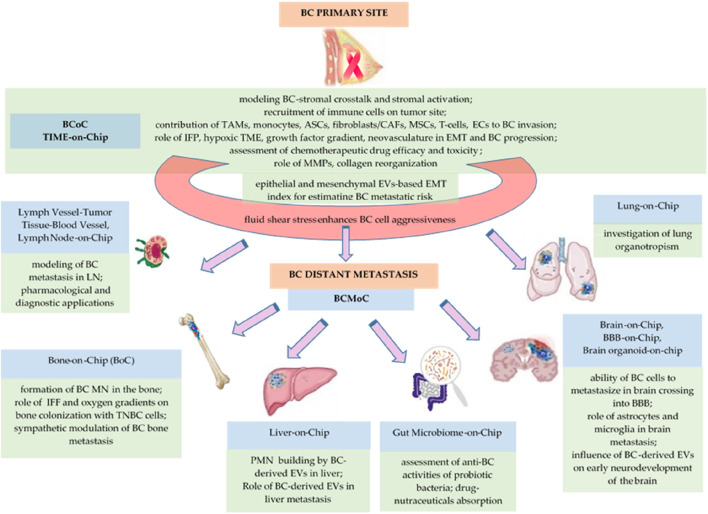
Our previous article entitled "Proteomics and its applications in breast cancer", proposed a Breast Cancer Continuum Concept (BCCC), including a Breast Cancer Cell Continuum Concept as well as a Breast Cancer Proteomic Continuum Concept. Breast cancer-on-chip (BCoC), breast cancer liquid biopsy-on-chip (BCLBoC), and breast cancer metastasis-on-chip (BCMoC) models successfully recapitulate and reproduce the principal mechanisms and events involved in BCCC. Thus, BCoC, BCLBoC, and BCMoC platforms allow for multiple cell lines co-cultivation to reproduce BC hallmark features, recapitulating cell proliferation, cell-to-cell communication, BC cell-stromal crosstalk and stromal activation, effects of local microenvironmental conditions on BC progression, invasion/epithelial-mesenchymal transition (EMT)/migration, intravasation, dissemination through blood and lymphatic circulation, extravasation, distant tissues colonization, and immune escape of cancer cells. Moreover, tumor-on-chip platforms are used for studying the efficacy and toxicity of chemotherapeutic drugs/nano-drugs or nutraceuticals. Therefore, the aim of this review is to summarize and analyse the main bio-medical roles of on-chip platforms that can be used as powerful tools to study the metastatic cascade in BC. As future direction, integration of tumor-on-chip platforms and proteomics-based specific approaches can offer important cues about molecular profile of the metastatic cascade, alowing for novel biomarker discovery. Novel microfluidics-based platforms integrating specific proteomic landscape of human milk, urine, and saliva could be useful for early and non-invasive BC detection. Also, risk-on-chip models may improve BC risk assessment and prevention based on the identification of biomarkers of risk. Moreover, multi-organ-on-chip systems integrating patient-derived BC cells and patient-derived scaffolds have a great potential to study BC at integrative level, due to the systemic nature of BC, for personalized and precision medicine. We also emphasized the strengths and weaknesses of BCoC and BCMoC platforms.
我们之前发表的题为《蛋白质组学及其在乳腺癌中的应用》的文章提出了乳腺癌连续体概念(BCCC),其中包括乳腺癌细胞连续体概念以及乳腺癌蛋白质组连续体概念。乳腺癌芯片(BCoC)、乳腺癌液体活检芯片(BCLBoC)和乳腺癌转移芯片(BCMoC)模型成功地概括和再现了BCCC中涉及的主要机制和事件。因此,BCoC、BCLBoC和BCMoC平台允许多种细胞系共培养,以再现乳腺癌的标志性特征,概括细胞增殖、细胞间通讯、乳腺癌细胞与基质的相互作用及基质激活、局部微环境条件对乳腺癌进展的影响、侵袭/上皮-间质转化(EMT)/迁移、血管内渗、通过血液和淋巴循环扩散、血管外渗、远处组织定植以及癌细胞的免疫逃逸。此外,芯片肿瘤平台用于研究化疗药物/纳米药物或营养保健品的疗效和毒性。因此,本综述的目的是总结和分析芯片平台的主要生物医学作用,这些平台可作为研究乳腺癌转移级联的有力工具。作为未来的方向,芯片肿瘤平台与基于蛋白质组学的特定方法的整合可以提供有关转移级联分子特征的重要线索,从而发现新的生物标志物。整合人乳、尿液和唾液特定蛋白质组图谱的新型微流控平台可能有助于早期和非侵入性乳腺癌检测。此外,芯片风险模型可能基于风险生物标志物的识别来改善乳腺癌风险评估和预防。此外,整合患者来源的乳腺癌细胞和患者来源支架的多器官芯片系统具有很大的潜力,由于乳腺癌的系统性,可在整合水平上研究乳腺癌,以实现个性化和精准医学。我们还强调了BCoC和BCMoC平台的优缺点。