College of Medicine, Imam Mohammed Ibn Saud Islamic University, Riyadh, Saudi Arabia.
Department of Otolaryngology, Imam Mohammad Ibn Saud Islamic University, Riyadh, Saudi Arabia.
BMC Med Educ. 2022 Mar 14;22(1):174. doi: 10.1186/s12909-022-03224-x.
The COVID-19 pandemic has had a devastating effect on people across the globe. Its impact on medical students' education has also been profound. Here, we aimed to comprehensively determine the nature of this impact on their choice of specialty.
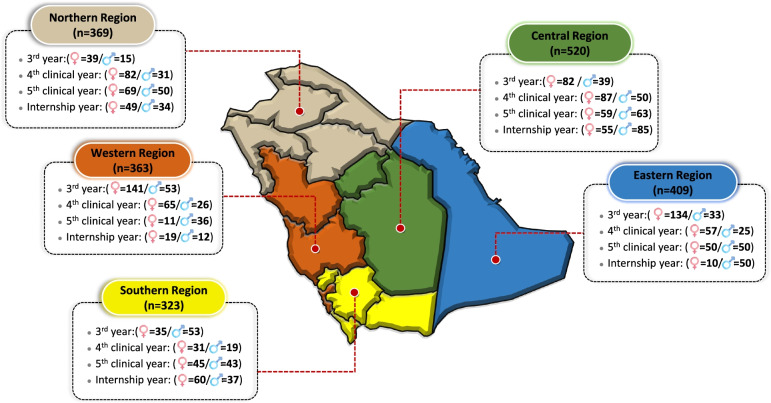
A cross-sectional study was conducted among medical students in Saudi Arabia during the pandemic from May to June 2021. Data collected from 1984 medical students were analyzed.
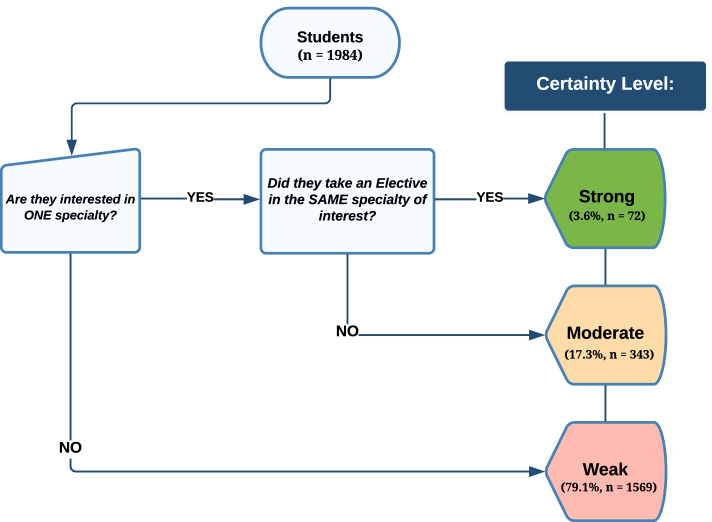
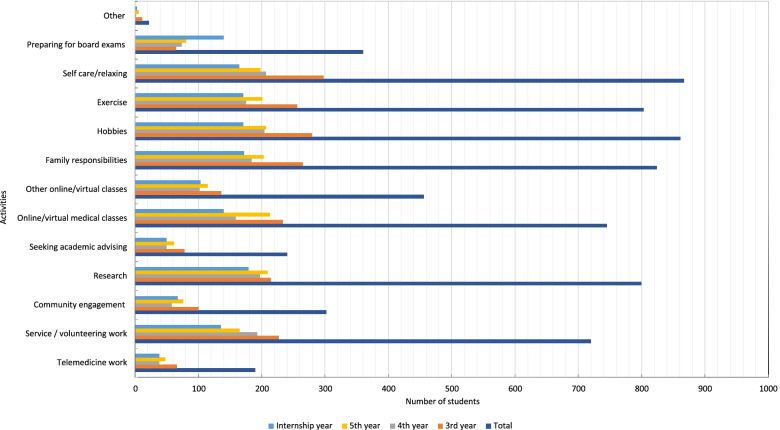
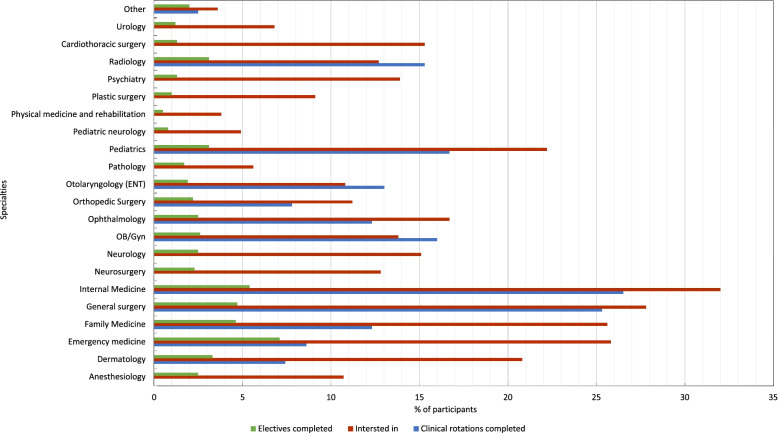
Of the total sample, 810 (40.8%) respondents reported that the pandemic could affect their choice of specialty, with the majority being in the third year (n = 235). Across all class-years, the most common reason chosen was the inability to explore specialties of interest (n = 539, 66.5%). Another reason cited was the inability to support residency application (n = 175, 21.6%). A majority expressed concerns regarding enrollment in research activities. As high as 17.9% (n = 356) of the respondents admitted that they were trying to avoid specialty with frontline exposure to COVID-19, while 353 students (17.8%) were considering local training programs only. While examining certainty levels, of the 1174 (59.2%) students who reported not being affected by the pandemic, 924 (78.7%) had a weak certainty level. The majority were in the third (54.8%, n = 342) and fourth years (44.8%, n = 212).
This study is the first attempt to thoroughly examine the effect of COVID-19 on medical students' choice of specialty. This effect unfurled in 4 out of 10 surveyed students. Many students reported concerns regarding the inability to explore medical specialties and the inadequacy of obtained clinical knowledge. However, a subsidiary effect was observed among students who were assertive about their choice of specialty. These findings shed new light on the exigency of establishing a career counseling framework designed to meet individual learner needs, thereby galvanizing their morale. Further research could explore the long-term implications of the Saudi Commission for Health Specialties Matching System.
新冠疫情对全球人民造成了毁灭性的影响。它对医学生教育的影响也同样深远。在这里,我们旨在全面了解疫情对他们专业选择的影响。
这是一项在 2021 年 5 月至 6 月期间在沙特阿拉伯进行的针对医学生的横断面研究。对 1984 名医学生的数据进行了分析。
在总样本中,有 810 名(40.8%)受访者表示疫情可能会影响他们的专业选择,其中大部分人在三年级(n=235)。在所有年级中,选择最多的原因是无法探索感兴趣的专业(n=539,66.5%)。另一个原因是无法支持住院医师申请(n=175,21.6%)。大多数人表示担心参与研究活动。多达 17.9%(n=356)的受访者承认他们试图避免与新冠病毒有一线接触的专业,而 353 名学生(17.8%)只考虑当地培训计划。在检查确定性水平时,在 1174 名(59.2%)报告未受疫情影响的学生中,有 924 名(78.7%)的确定性水平较弱。大多数人在三年级(54.8%,n=342)和四年级(44.8%,n=212)。
这项研究首次尝试全面检查新冠疫情对医学生专业选择的影响。这种影响在调查的 10 名学生中有 4 名学生中出现。许多学生报告说,他们担心无法探索医学专业,以及获得的临床知识不足。然而,在对自己的专业选择有信心的学生中观察到了一个次要影响。这些发现为建立一个旨在满足个体学习者需求的职业咨询框架提供了新的视角,从而激发他们的士气。进一步的研究可以探索沙特卫生专业人员匹配系统的长期影响。