Cardiovascular Program ICCC, Research Institute Hospital Santa Creu i Sant Pau, IIB Sant Pau, c/Sant Antoni Mª Claret 167, 08025, Barcelona, Spain.
CIBERCV Instituto de Salud Carlos III, Madrid, Spain.
Cell Mol Life Sci. 2022 Mar 14;79(3):190. doi: 10.1007/s00018-022-04222-4.
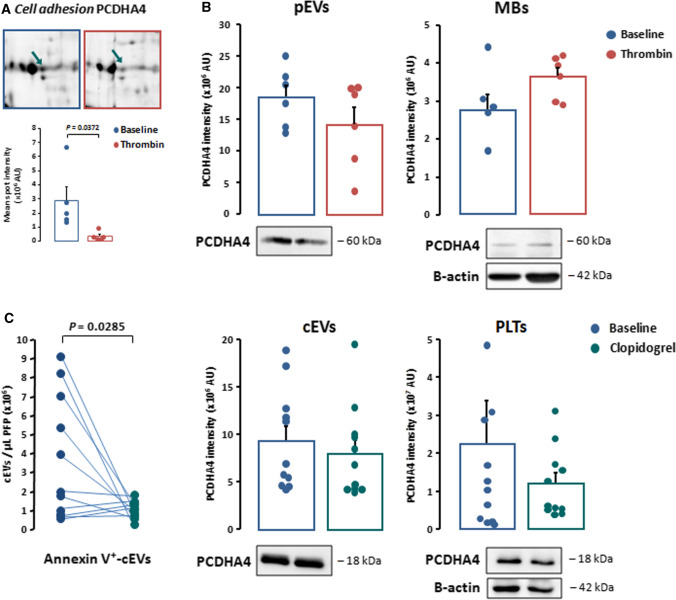
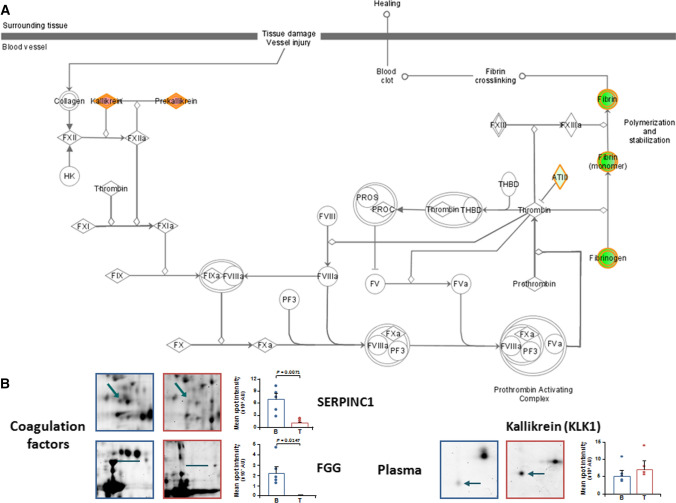
Platelets exert fundamental roles in thrombosis, inflammation, and angiogenesis, contributing to different pathologies from cardiovascular diseases to cancer. We previously reported that platelets release extracellular vesicles (pEVs) which contribute to thrombus formation. However, pEV composition remains poorly defined. Indeed, pEV quality and type, rather than quantity, may be relevant in intravascular cross-talk with either circulating or vascular cells. We aimed to define the phenotypic characteristics of pEVs released spontaneously and those induced by thrombin activation to better understand their role in disease dissemination. pEVs obtained from washed platelets from healthy donor blood were characterized by flow cytometry. pEVs from thrombin-activated platelets (T-pEVs) showed higher levels of P-selectin and active form of glycoprotein IIb/IIIa than baseline non-activated platelets (B-pEVs). Following mass spectrometry-based differential proteomic analysis, significant changes in the abundance of proteins secreted in T-pEVs compared to B-pEVs were found. These differential proteins were involved in coagulation, adhesion, cytoskeleton, signal transduction, metabolism, and vesicle-mediated transport. Interestingly, release of proteins relevant for cell adhesion, intrinsic pathway coagulation, and platelet activation signalling was significantly modified by thrombin stimulation. A novel pEV-associated protein (protocadherin-α4) was found to be significantly reduced in T-pEVs showing a shift towards increased expression in the membranes of activated platelets. In summary, platelet activation induced by thrombin triggers the shedding of pEVs with a complex proteomic pattern rich in procoagulant and proadhesive proteins. Crosstalk with other vascular and blood cells in a paracrine regulatory mode could extend the prothrombotic signalling as well as promote proteostasic changes in other cellular types.
血小板在血栓形成、炎症和血管生成中发挥着基本作用,导致从心血管疾病到癌症等不同的病理变化。我们之前报道过,血小板释放细胞外囊泡(pEVs),这有助于血栓形成。然而,pEV 的组成仍然定义不明确。事实上,pEV 的质量和类型,而不是数量,可能与循环或血管细胞的血管内相互作用有关。我们旨在确定自发性释放的 pEVs 和被凝血酶激活诱导的 pEVs 的表型特征,以更好地了解它们在疾病传播中的作用。通过流式细胞术对来自健康供体血液的血小板的 pEVs 进行了表征。与基础非激活血小板(B-pEVs)相比,来自凝血酶激活血小板(T-pEVs)的 pEVs 显示出更高水平的 P-选择素和糖蛋白 IIb/IIIa 的活性形式。在基于质谱的差异蛋白质组学分析后,发现 T-pEVs 中分泌蛋白的丰度与 B-pEVs 相比有显著变化。这些差异蛋白参与了凝血、粘附、细胞骨架、信号转导、代谢和囊泡介导的运输。有趣的是,与细胞粘附、内在途径凝血和血小板激活信号转导相关的蛋白质的释放在凝血酶刺激下显著改变。发现一种新的 pEV 相关蛋白(原钙粘蛋白-α4)在 T-pEVs 中显著减少,而在激活血小板的膜中表达增加。总之,凝血酶诱导的血小板激活触发了具有丰富促凝和促黏附蛋白的 pEVs 的脱落,其蛋白质组模式复杂。旁分泌调节模式与其他血管和血细胞的相互作用可以扩展促血栓信号,并促进其他细胞类型的蛋白稳态变化。