Fux Daniela, Metzner Moritz, Brandl Johanna, Feist Melanie, Behrendt-Wippermann Magdalena, von Thaden Anne, Baumgartner Christine
Institute of Pharmacology and Toxicology, Clinical Pharmacology, University of Veterinary Medicine, Vienna, Austria.
Clinic for Ruminants with Ambulatory and Herd Health Services, Center for Clinical Veterinary Medicine, Ludwig-Maximilians-University of Munich, Oberschleißheim, Bavaria, Germany.
PLoS One. 2022 Mar 15;17(3):e0265305. doi: 10.1371/journal.pone.0265305. eCollection 2022.
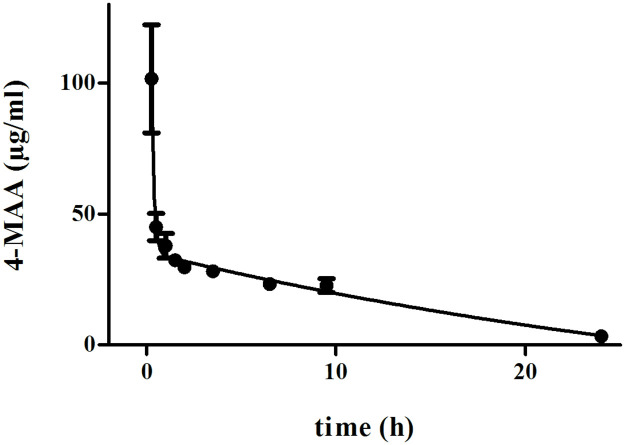
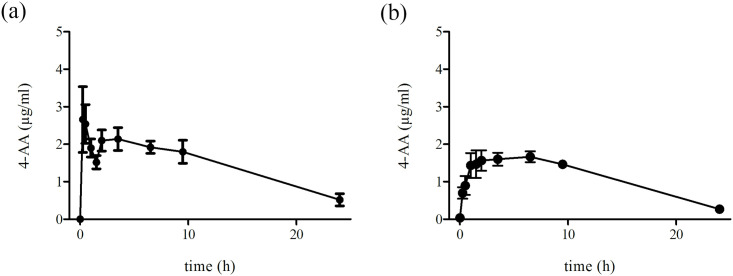
This preliminary clinical investigation of the pharmacokinetic behavior of the main metamizole (dipyrone) metabolites 4-methylaminoantipyrine (4-MAA) and 4-aminoantipyrine (4-AA) in calves undergoing umbilical surgery is part of an already published main study. A single intravenous dose of metamizole was added to ketamine/xylazine/isoflurane anesthesia. Eight Simmental calves weighing 90 ± 10.8 kg and aged 47.6 ± 10.4 days received 40 mg/kg metamizole intravenously 10 minutes prior to general anesthesia. Blood samples were collected over 24 hours and analyzed for 4-MAA and 4-AA. Meloxicam was additionally given twice: 2.5 hours pre- and 20.5 hours postsurgically. The pharmacokinetic profile of 4-MAA was best fitted to a two-compartment model and was characterized by a fast distribution half-life and slow elimination half-life (t½alpha = 5.29 minutes, t½beta = 9.49 hours). The maximum concentration (Cmax 101.63 μg/mL) was detected at the first measurement time point 15 minutes after administration. In contrast, 4-AA showed fast, high and biphasic plasma peak concentration behavior in five calves (2.54-2.66 μg/mL after 15-30 minutes, and 2.10-2.14 μg/mL after 2-3.5 hours) with a t½beta of 8.87 hours, indicating a rapid distribution and subsequent redistribution from well-perfused organs. Alternatively, three calves exhibited a slower and lower monophasic plasma peak concentration (1.66 μg/mL after 6.5 hours) with a t½beta of 6.23 hours, indicating slow accumulation in the intravascular compartment. The maximum concentration and area under the plasma concentration curve (AUC) of 4-AA were lower than those of 4-MAA. This metabolic behavior supports our already published data on clinical monitoring and plasma cortisol concentrations (PCCs). Compared to those of saline controls, lower PCCs correspond to the t½alpha of 4-MAA. Data on Tmax and t½beta also match these clinical observations. However, further studies are required to assess the exact analgesic mechanism and potency of the metamizole metabolites in calves.
这项关于接受脐部手术的犊牛体内主要安乃近(双氯芬酸钠)代谢物4-甲基氨基安替比林(4-MAA)和4-氨基安替比林(4-AA)药代动力学行为的初步临床研究是已发表的一项主要研究的一部分。在氯胺酮/赛拉嗪/异氟烷麻醉中加入单次静脉注射剂量的安乃近。八头体重90±10.8千克、年龄47.6±10.4天的西门塔尔犊牛在全身麻醉前10分钟静脉注射40毫克/千克安乃近。在24小时内采集血样并分析其中的4-MAA和4-AA。美洛昔康额外给药两次:手术前2.5小时和手术后20.5小时。4-MAA的药代动力学特征最符合二室模型,其特点是分布半衰期快而消除半衰期慢(t½α = 5.29分钟,t½β = 9.49小时)。给药后15分钟的第一个测量时间点检测到最大浓度(Cmax 101.63微克/毫升)。相比之下,4-AA在五头犊牛中表现出快速、高且双相的血浆峰浓度行为(15 - 30分钟后为2.54 - 2.66微克/毫升,2 - 3.5小时后为2.10 - 2.14微克/毫升),t½β为8.87小时,表明从灌注良好的器官快速分布并随后再分布。另外,三头犊牛表现出较慢且较低的单相血浆峰浓度(6.5小时后为1.66微克/毫升),t½β为6.23小时,表明在血管内隔室中缓慢蓄积。4-AA的最大浓度和血浆浓度曲线下面积(AUC)低于4-MAA。这种代谢行为支持了我们已发表的关于临床监测和血浆皮质醇浓度(PCCs)的数据。与生理盐水对照组相比,较低的PCCs与4-MAA的t½α相对应。关于Tmax和t½β的数据也与这些临床观察结果相符。然而,需要进一步研究来评估安乃近代谢物在犊牛体内的确切镇痛机制和效力。