Chowdhury Mohammad Mihrab, Islam Md Rafiul, Hossain Md Sakhawat, Tabassum Nusrat, Peace Angela
Department of Mathematics and Statistics, Texas Tech University, Lubbock, TX, USA.
Department of Mathematics, Iowa State University, Ames, IA, USA.
Infect Dis Model. 2022 Jun;7(2):75-82. doi: 10.1016/j.idm.2022.02.003. Epub 2022 Mar 11.
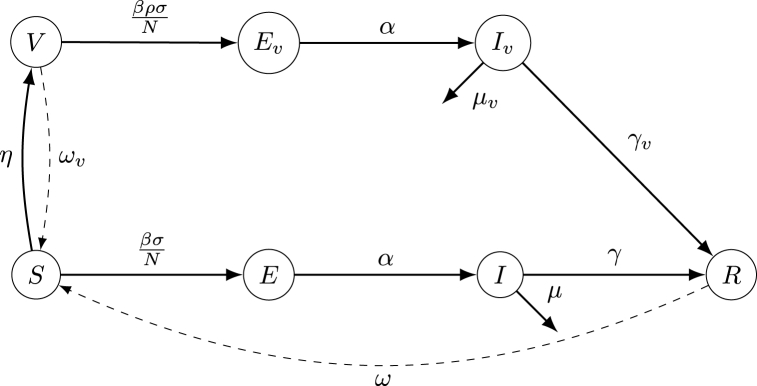
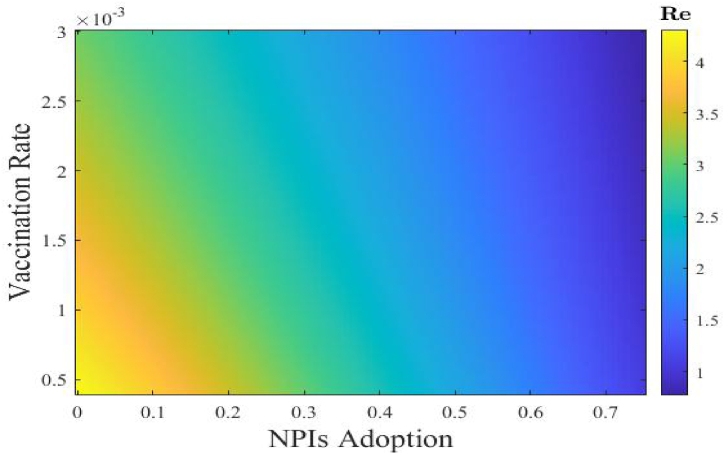
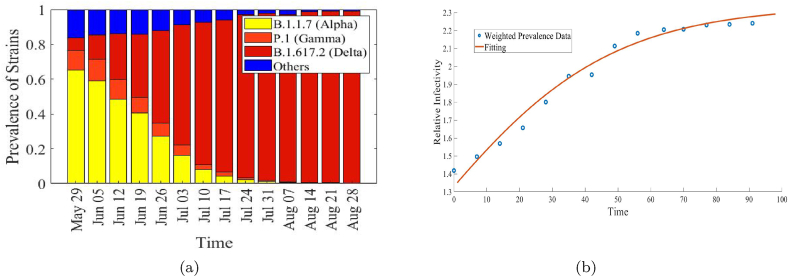
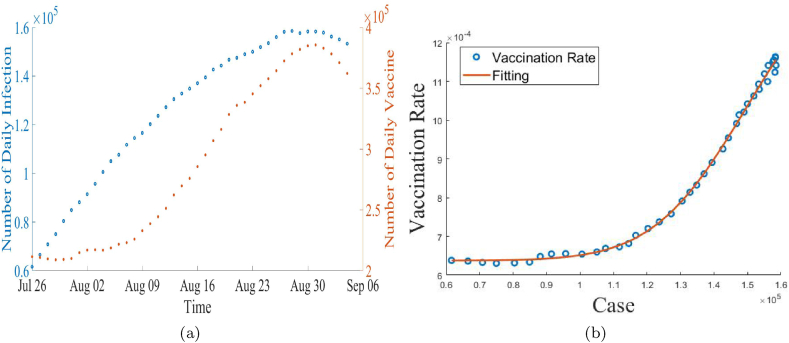
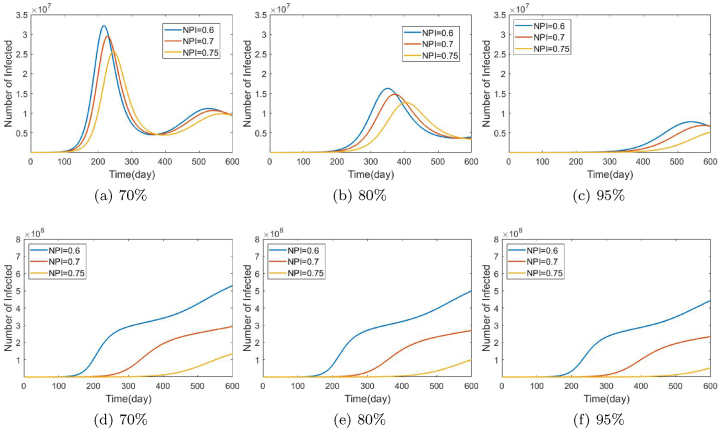
Coronavirus Disease (COVID-19), which began as a small outbreak in Wuhan, China, in December 2019, became a global pandemic within months due to its high transmissibility. In the absence of pharmaceutical treatment, various non-pharmaceutical interventions (NPIs) to contain the spread of COVID-19 brought the entire world to a halt. After almost a year of seemingly returning to normalcy with the world's quickest vaccine development, the emergence of more infectious and vaccine resistant coronavirus variants is bringing the situation back to where it was a year ago. In the light of this new situation, we conducted a study to portray the possible scenarios based on the three key factors: impact of interventions (pharmaceutical and NPIs), vaccination rate, and vaccine efficacy. In our study, we assessed two of the most crucial factors, transmissibility and vaccination rate, in order to reduce the spreading of COVID-19 in a simple but effective manner. In order to incorporate the time-varying mutational landscape of COVID-19 variants, we estimated a weighted transmissibility composed of the proportion of existing strains that naturally vary over time. Additionally, we consider time varying vaccination rates based on the number of daily new cases. Our method for calculating the vaccination rate from past active cases is an effective approach in forecasting probable future scenarios as it actively tracks people's attitudes toward immunization as active case changes. Our simulations show that if a large number of individuals cannot be vaccinated by ensuring high efficacy in a short period of time, adopting NPIs is the best approach to manage disease transmission with the emergence of new vaccine breakthrough and more infectious variants.
冠状病毒病(COVID-19)于2019年12月在中国武汉开始小规模爆发,由于其高传播性,在数月内便成为全球大流行病。在缺乏药物治疗的情况下,为遏制COVID-19传播而采取的各种非药物干预措施(NPIs)使整个世界陷入停滞。在经过近一年看似恢复正常的状态后,随着世界上最快的疫苗研发成功,更具传染性且对疫苗耐药的冠状病毒变种的出现又使情况回到了一年前。鉴于这种新情况,我们开展了一项研究,以基于三个关键因素描绘可能出现的情景:干预措施(药物和非药物干预)的影响、疫苗接种率和疫苗效力。在我们的研究中,我们评估了两个最关键的因素,即传播性和疫苗接种率,以便以简单而有效的方式减少COVID-19的传播。为了纳入COVID-19变种随时间变化的突变情况,我们估计了一种加权传播性,它由随时间自然变化的现有毒株比例组成。此外,我们根据每日新增病例数考虑随时间变化的疫苗接种率。我们从过去的活跃病例计算疫苗接种率的方法是预测未来可能情景的一种有效方法,因为它会随着活跃病例的变化积极跟踪人们对免疫接种的态度。我们的模拟表明,如果在短时间内无法通过确保高效力来使大量个体接种疫苗,那么在出现新的疫苗突破和更具传染性的变种时,采用非药物干预措施是控制疾病传播的最佳方法。