• 文献检索
  • 文档翻译
  • 深度研究
  • 学术资讯
  • Suppr Zotero 插件Zotero 插件
  • 邀请有礼
  • 套餐&价格
  • 历史记录
应用&插件
Suppr Zotero 插件Zotero 插件浏览器插件Mac 客户端Windows 客户端微信小程序
定价
高级版会员购买积分包购买API积分包
服务
文献检索文档翻译深度研究API 文档MCP 服务
关于我们
关于 Suppr公司介绍联系我们用户协议隐私条款
关注我们

Suppr 超能文献

核心技术专利:CN118964589B侵权必究
粤ICP备2023148730 号-1Suppr @ 2026

文献检索

告别复杂PubMed语法,用中文像聊天一样搜索,搜遍4000万医学文献。AI智能推荐,让科研检索更轻松。

立即免费搜索

文件翻译

保留排版,准确专业,支持PDF/Word/PPT等文件格式,支持 12+语言互译。

免费翻译文档

深度研究

AI帮你快速写综述,25分钟生成高质量综述,智能提取关键信息,辅助科研写作。

立即免费体验

朝着苏铁属(苏铁科)的质体进化和系统发育前进:分子-形态学分歧和基因树空间分析。

Towards the plastome evolution and phylogeny of Cycas L. (Cycadaceae): molecular-morphology discordance and gene tree space analysis.

机构信息

CAS Key Laboratory for Plant Diversity and Biogeography of East Asia, Kunming Institute of Botany, Chinese Academy of Sciences, 650201, Kunming, Yunnan, China.

Department of Economic Plants and Biotechnology, Yunnan Key Laboratory for Wild Plant Resources, Kunming Institute of Botany, Chinese Academy of Sciences, 650201, Kunming, China.

出版信息

BMC Plant Biol. 2022 Mar 15;22(1):116. doi: 10.1186/s12870-022-03491-2.

DOI:10.1186/s12870-022-03491-2
PMID:35291941
原文链接:https://pmc.ncbi.nlm.nih.gov/articles/PMC8922756/
Abstract

BACKGROUND

Plastid genomes (plastomes) present great potential in resolving multiscale phylogenetic relationship but few studies have focused on the influence of genetic characteristics of plastid genes, such as genetic variation and phylogenetic discordance, in resolving the phylogeny within a lineage. Here we examine plastome characteristics of Cycas L., the most diverse genus among extant cycads, and investigate the deep phylogenetic relationships within Cycas by sampling 47 plastomes representing all major clades from six sections.

RESULTS

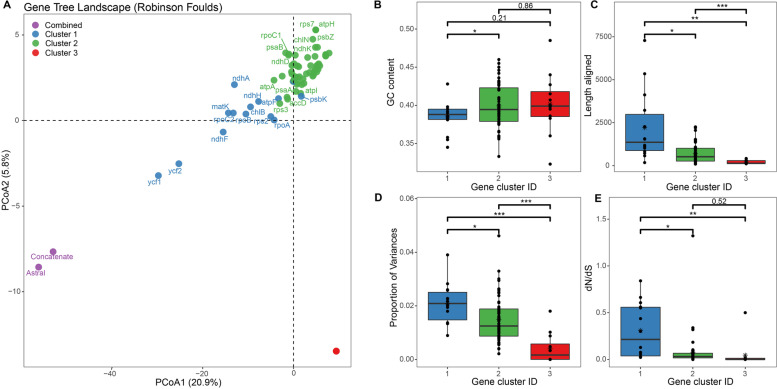
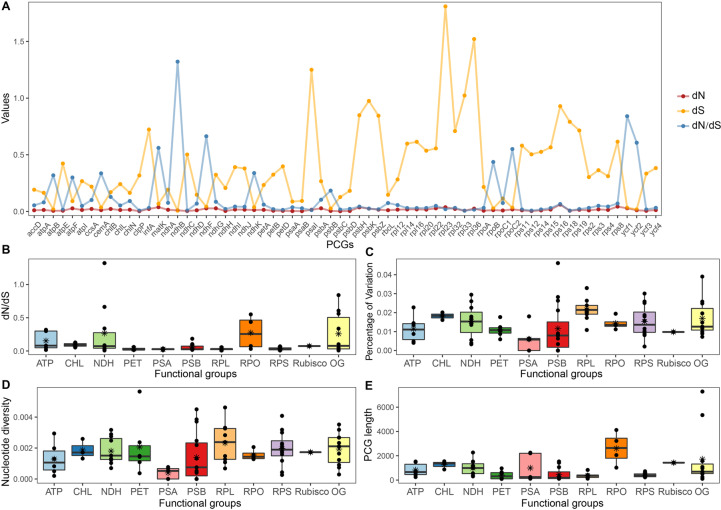
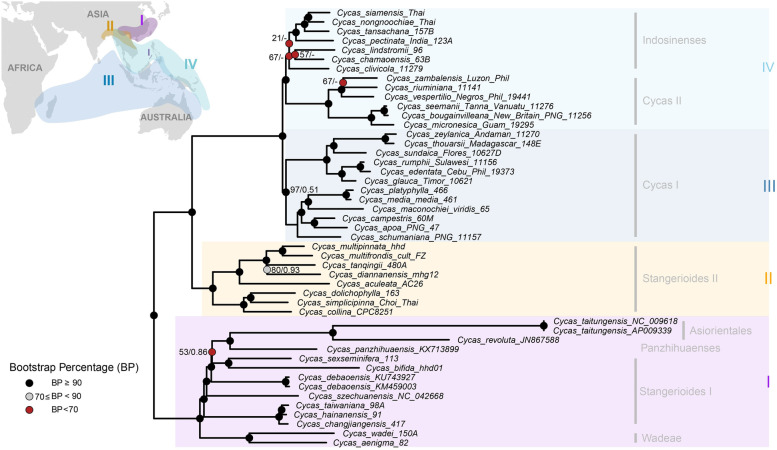
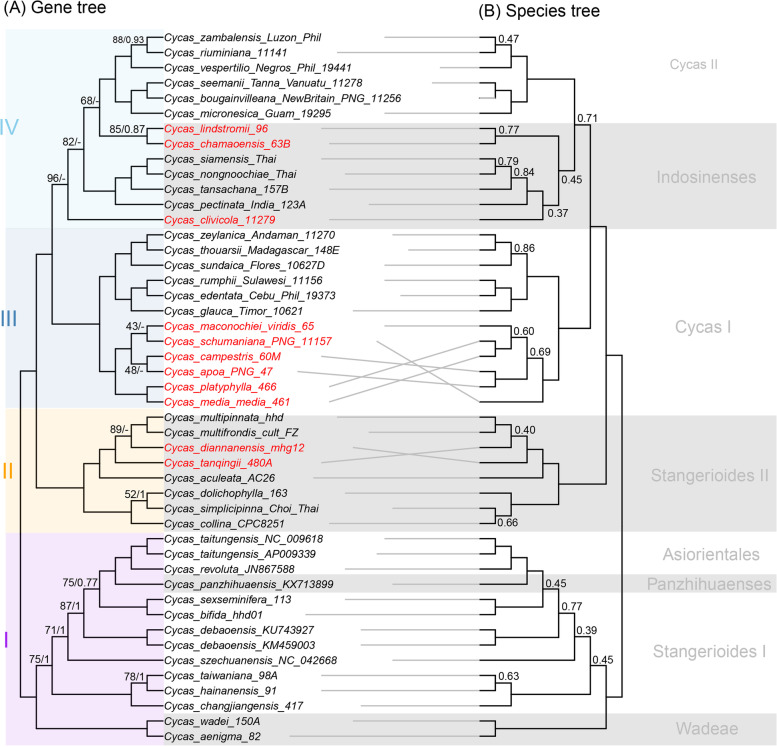
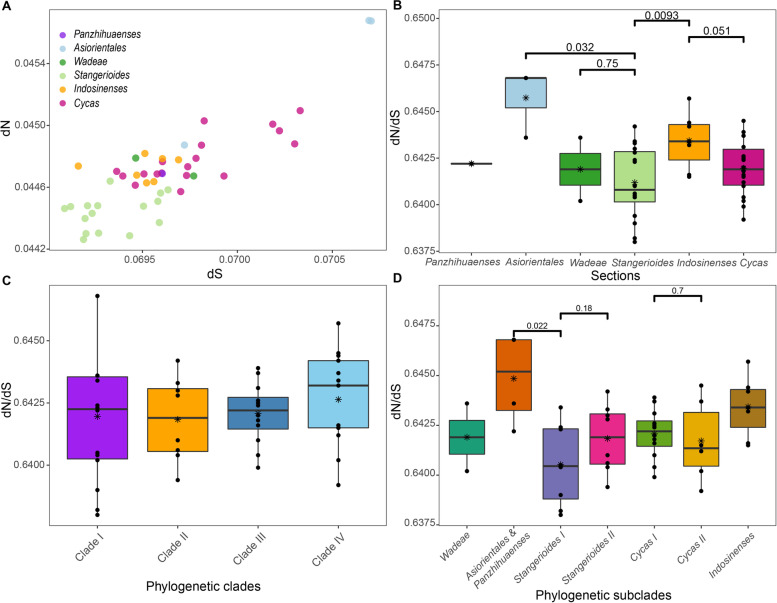
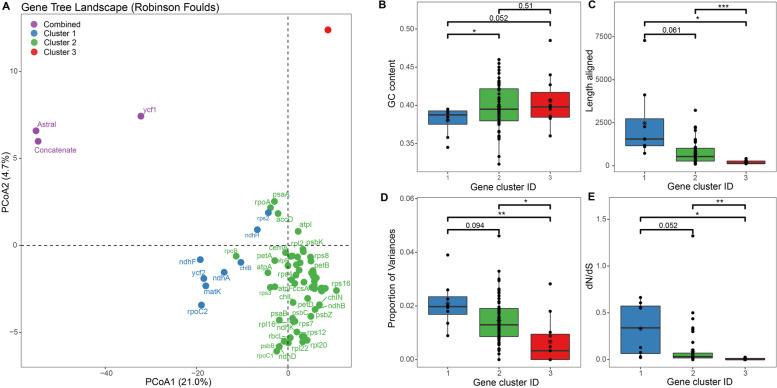
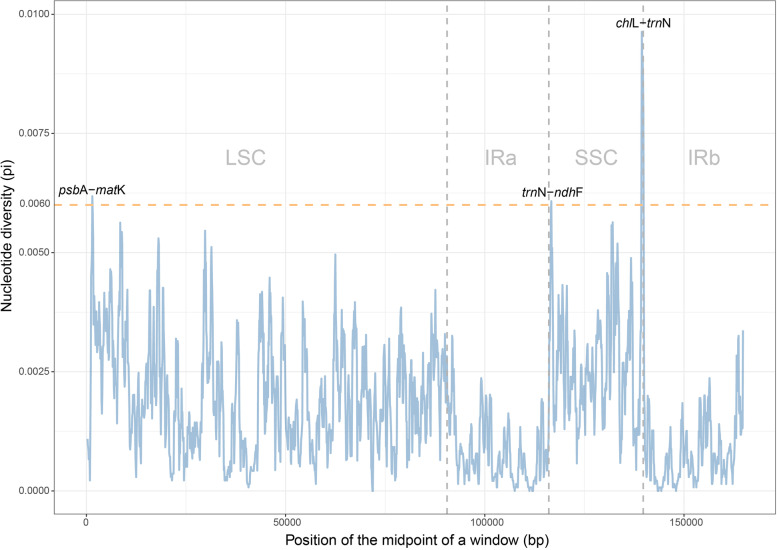
All Cycas plastomes shared consistent gene content and structure with only one gene loss detected in Philippine species C. wadei. Three novel plastome regions (psbA-matK, trnN-ndhF, chlL-trnN) were identified as containing the highest nucleotide variability. Molecular evolutionary analysis showed most of the plastid protein-coding genes have been under purifying selection except ndhB. Phylogenomic analyses that alternatively included concatenated and coalescent methods, both identified four clades but with conflicting topologies at shallow nodes. Specifically, we found three species-rich Cycas sections, namely Stangerioides, Indosinenses and Cycas, were not or only weakly supported as monophyly based on plastomic phylogeny. Tree space analyses based on different tree-inference methods both revealed three gene clusters, of which the cluster with moderate genetic properties showed the best congruence with the favored phylogeny.

CONCLUSIONS

Our exploration in plastomic data for Cycas supports the idea that plastid protein-coding genes may exhibit discordance in phylogenetic signals. The incongruence between molecular phylogeny and morphological classification reported here may largely be attributed to the uniparental attribute of plastid, which cannot offer sufficient information to resolve the phylogeny. Contrasting to a previous consensus that genes with longer sequences and a higher proportion of variances are superior for phylogeny reconstruction, our result implies that the most effective phylogenetic signals could come from loci that own moderate variation, GC content, sequence length, and underwent modest selection.

摘要

背景

质体基因组(质体基因组)在解决多尺度系统发育关系方面具有巨大潜力,但很少有研究关注质体基因的遗传特征,如遗传变异和系统发育分歧,在解决谱系内的系统发育关系。在这里,我们检查了苏铁科中最具多样性的苏铁属的质体特征,并通过采样来自六个节的代表所有主要分支的 47 个质体,调查了苏铁属内的深系统发育关系。

结果

所有苏铁质体基因组都具有一致的基因内容和结构,仅在菲律宾物种 C. wadei 中检测到一个基因丢失。鉴定出三个新的质体区域(psbA-matK、trnN-ndhF、chlL-trnN),这些区域的核苷酸变异率最高。分子进化分析表明,除了 ndhB 外,大多数质体蛋白编码基因都受到了纯化选择的作用。替代地包括串联和合并方法的基因组分析都确定了四个分支,但在浅节点处的拓扑结构存在冲突。具体来说,我们发现三个苏铁科物种丰富的节,即 Stangerioides、Indosinenses 和 Cycas,根据质体系统发育学,它们要么没有被支持为单系群,要么只有微弱的支持。基于不同树推断方法的树空间分析都揭示了三个基因簇,其中具有中等遗传特性的簇与首选系统发育的一致性最好。

结论

我们对苏铁质体数据的探索支持了这样一种观点,即质体蛋白编码基因在系统发育信号中可能表现出不一致性。这里报道的分子系统发育与形态分类之间的不一致性主要归因于质体的单亲属性,它不能提供足够的信息来解决系统发育问题。与先前认为具有较长序列和更高变异比例的基因更适合系统发育重建的共识相反,我们的结果表明,最有效的系统发育信号可能来自拥有适度变异、GC 含量、序列长度和经历适度选择的基因。
https://cdn.ncbi.nlm.nih.gov/pmc/blobs/2c9c/8922756/853cf85d7f64/12870_2022_3491_Fig7_HTML.jpg
https://cdn.ncbi.nlm.nih.gov/pmc/blobs/2c9c/8922756/2c715bd86a21/12870_2022_3491_Fig1_HTML.jpg
https://cdn.ncbi.nlm.nih.gov/pmc/blobs/2c9c/8922756/bad2be811423/12870_2022_3491_Fig2_HTML.jpg
https://cdn.ncbi.nlm.nih.gov/pmc/blobs/2c9c/8922756/81a6bf248abb/12870_2022_3491_Fig3_HTML.jpg
https://cdn.ncbi.nlm.nih.gov/pmc/blobs/2c9c/8922756/97fcc3c3cda1/12870_2022_3491_Fig4_HTML.jpg
https://cdn.ncbi.nlm.nih.gov/pmc/blobs/2c9c/8922756/9100b07cd80a/12870_2022_3491_Fig5_HTML.jpg
https://cdn.ncbi.nlm.nih.gov/pmc/blobs/2c9c/8922756/224dfc324fe3/12870_2022_3491_Fig6_HTML.jpg
https://cdn.ncbi.nlm.nih.gov/pmc/blobs/2c9c/8922756/853cf85d7f64/12870_2022_3491_Fig7_HTML.jpg
https://cdn.ncbi.nlm.nih.gov/pmc/blobs/2c9c/8922756/2c715bd86a21/12870_2022_3491_Fig1_HTML.jpg
https://cdn.ncbi.nlm.nih.gov/pmc/blobs/2c9c/8922756/bad2be811423/12870_2022_3491_Fig2_HTML.jpg
https://cdn.ncbi.nlm.nih.gov/pmc/blobs/2c9c/8922756/81a6bf248abb/12870_2022_3491_Fig3_HTML.jpg
https://cdn.ncbi.nlm.nih.gov/pmc/blobs/2c9c/8922756/97fcc3c3cda1/12870_2022_3491_Fig4_HTML.jpg
https://cdn.ncbi.nlm.nih.gov/pmc/blobs/2c9c/8922756/9100b07cd80a/12870_2022_3491_Fig5_HTML.jpg
https://cdn.ncbi.nlm.nih.gov/pmc/blobs/2c9c/8922756/224dfc324fe3/12870_2022_3491_Fig6_HTML.jpg
https://cdn.ncbi.nlm.nih.gov/pmc/blobs/2c9c/8922756/853cf85d7f64/12870_2022_3491_Fig7_HTML.jpg

相似文献

1
Towards the plastome evolution and phylogeny of Cycas L. (Cycadaceae): molecular-morphology discordance and gene tree space analysis.朝着苏铁属(苏铁科)的质体进化和系统发育前进:分子-形态学分歧和基因树空间分析。
BMC Plant Biol. 2022 Mar 15;22(1):116. doi: 10.1186/s12870-022-03491-2.
2
Plastome phylogenomic study of Gentianeae (Gentianaceae): widespread gene tree discordance and its association with evolutionary rate heterogeneity of plastid genes.系统发育基因组学研究龙胆科(龙胆科):广泛的基因树分歧及其与质体基因进化率异质性的关系。
BMC Plant Biol. 2020 Jul 17;20(1):340. doi: 10.1186/s12870-020-02518-w.
3
Phylogeny of the gymnosperm genus Cycas L. (Cycadaceae) as inferred from plastid and nuclear loci based on a large-scale sampling: Evolutionary relationships and taxonomical implications.基于大规模采样的基于质体和核基因座的苏铁属(苏铁科)植物的系统发育:进化关系和分类学意义。
Mol Phylogenet Evol. 2018 Oct;127:87-97. doi: 10.1016/j.ympev.2018.05.019. Epub 2018 May 18.
4
Phylogeny and diversification of genus Sanicula L. (Apiaceae): novel insights from plastid phylogenomic analyses.山茱萸属(伞形科)的系统发育和多样化:质体基因组学分析的新见解。
BMC Plant Biol. 2024 Jan 24;24(1):70. doi: 10.1186/s12870-024-04750-0.
5
Plastid phylogenomic analyses of the Selaginella sanguinolenta group (Selaginellaceae) reveal conflict signatures resulting from sequence types, outlier genes, and pervasive RNA editing.对卷柏组(卷柏科)的质体系统基因组分析揭示了序列类型、异常基因和广泛的 RNA 编辑导致的冲突特征。
Mol Phylogenet Evol. 2022 Aug;173:107507. doi: 10.1016/j.ympev.2022.107507. Epub 2022 May 16.
6
More than a spiny morphology: plastome variation in the prickly pear cacti (Opuntieae).不止是棘突形态:仙人柱族(Opuntieae)的质体基因组变异。
Ann Bot. 2023 Nov 25;132(4):771-786. doi: 10.1093/aob/mcad098.
7
Incongruence between gene trees and species trees and phylogenetic signal variation in plastid genes.质体基因中基因树与种系树之间的不一致性和系统发育信号变异。
Mol Phylogenet Evol. 2019 Sep;138:219-232. doi: 10.1016/j.ympev.2019.05.022. Epub 2019 May 28.
8
Plastome phylogenomics of Saussurea (Asteraceae: Cardueae).基于质体基因组学的风毛菊属(菊科:菜蓟族)系统发育研究。
BMC Plant Biol. 2019 Jul 2;19(1):290. doi: 10.1186/s12870-019-1896-6.
9
Plastid phylogenomics of Pleurothallidinae (Orchidaceae): Conservative plastomes, new variable markers, and comparative analyses of plastid, nuclear, and mitochondrial data.石豆兰族(兰科)的质体系统发育基因组学:保守的质体基因组、新的可变异标记,以及质体、核和线粒体数据的比较分析。
PLoS One. 2021 Aug 27;16(8):e0256126. doi: 10.1371/journal.pone.0256126. eCollection 2021.
10
Not that young: combining plastid phylogenomic, plate tectonic and fossil evidence indicates a Palaeogene diversification of Cycadaceae.并非那么年轻:结合质体系统发育基因组学、板块构造学和化石证据表明苏铁科在古近纪的多样化。
Ann Bot. 2022 Jan 28;129(2):217-230. doi: 10.1093/aob/mcab118.

引用本文的文献

1
Plastomic evolution and genetic diversity of cultivated sweet cheery (Prunus avium (L.) L.) in China.中国栽培甜樱桃(Prunus avium (L.) L.)的质体基因组进化与遗传多样性
BMC Plant Biol. 2025 Aug 8;25(1):1043. doi: 10.1186/s12870-025-07125-1.
2
Plastome characterization and its phylogenetic implications on Lithocarpus (Fagaceae).柯属(壳斗科)的质体基因组特征及其系统发育意义
BMC Plant Biol. 2024 Dec 30;24(1):1277. doi: 10.1186/s12870-024-05874-z.
3
Transcriptome sequencing data provide a solid base to understand the phylogenetic relationships, biogeography and reticulated evolution of the genus Zamia L. (Cycadales: Zamiaceae).

本文引用的文献

1
Plastid phylogenomic insights into relationships of all flowering plant families.质体系统基因组学对所有开花植物科之间关系的见解。
BMC Biol. 2021 Oct 29;19(1):232. doi: 10.1186/s12915-021-01166-2.
2
Not that young: combining plastid phylogenomic, plate tectonic and fossil evidence indicates a Palaeogene diversification of Cycadaceae.并非那么年轻:结合质体系统发育基因组学、板块构造学和化石证据表明苏铁科在古近纪的多样化。
Ann Bot. 2022 Jan 28;129(2):217-230. doi: 10.1093/aob/mcab118.
3
Congruence between ocean-dispersal modelling and phylogeography explains recent evolutionary history of Cycas species with buoyant seeds.
转录组测序数据为了解棒叶苏铁属(苏铁目:泽米铁科)的系统发育关系、生物地理学和网状进化提供了坚实的基础。
Ann Bot. 2024 Nov 13;134(5):747-768. doi: 10.1093/aob/mcae065.
4
Ghost introgression facilitates genomic divergence of a sympatric cryptic lineage in .幽灵渐渗促进了[具体物种或群体]中一个同域隐秘谱系的基因组分化。 (原文中“in.”后面缺少具体内容)
Ecol Evol. 2023 Aug 18;13(8):e10435. doi: 10.1002/ece3.10435. eCollection 2023 Aug.
5
Characteristics of plastid genomes in the genus Ceratostigma inhabiting arid habitats in China and their phylogenomic implications.中国干旱生境中蜡菊属植物质体基因组的特征及其系统基因组学意义。
BMC Plant Biol. 2023 Jun 7;23(1):303. doi: 10.1186/s12870-023-04323-7.
6
Comparative plastomes of species provide new insights into the plastomes evolution and maternal phylogeny of the genus.物种的比较质体基因组为该属质体基因组的进化和母系系统发育提供了新的见解。
Front Plant Sci. 2022 Oct 13;13:990064. doi: 10.3389/fpls.2022.990064. eCollection 2022.
7
Analysis of the complete plastomes and nuclear ribosomal DNAs from Euonymus hamiltonianus and its relatives sheds light on their diversity and evolution.分析美冬青木及其近缘植物的完整质体基因组和核核糖体 DNA,揭示其多样性和进化。
PLoS One. 2022 Oct 5;17(10):e0275590. doi: 10.1371/journal.pone.0275590. eCollection 2022.
8
CView: A network based tool for enhanced alignment visualization.CView:一种基于网络的工具,用于增强对齐可视化。
PLoS One. 2022 Jun 13;17(6):e0259726. doi: 10.1371/journal.pone.0259726. eCollection 2022.
海洋散布模型与系统地理学的一致性解释了具浮力种子的苏铁物种的近期进化历史。
New Phytol. 2021 Nov;232(4):1863-1875. doi: 10.1111/nph.17663. Epub 2021 Aug 20.
4
Defining Coalescent Genes: Theory Meets Practice in Organelle Phylogenomics.定义融合基因:细胞器系统发生基因组学中的理论与实践。
Syst Biol. 2022 Feb 10;71(2):476-489. doi: 10.1093/sysbio/syab053.
5
Characterization of the complete chloroplast genome of (Zamiaceae), an Endangered monotypic cycad species from Cuba.对来自古巴的濒危单型苏铁物种古巴泽米(泽米科)完整叶绿体基因组的特征分析。
Mitochondrial DNA B Resour. 2019 Oct 23;4(2):3695-3697. doi: 10.1080/23802359.2019.1679683.
6
Comparative Plastid Genomics of Neotropical (Orchidaceae; Epidendroideae).新热带地区(兰科;附生兰亚科)的比较质体基因组学
Front Plant Sci. 2020 Jul 3;11:799. doi: 10.3389/fpls.2020.00799. eCollection 2020.
7
Plastome phylogenomic study of Gentianeae (Gentianaceae): widespread gene tree discordance and its association with evolutionary rate heterogeneity of plastid genes.系统发育基因组学研究龙胆科(龙胆科):广泛的基因树分歧及其与质体基因进化率异质性的关系。
BMC Plant Biol. 2020 Jul 17;20(1):340. doi: 10.1186/s12870-020-02518-w.
8
Phylogenetic tree building in the genomic age.基因组时代的系统发育树构建。
Nat Rev Genet. 2020 Jul;21(7):428-444. doi: 10.1038/s41576-020-0233-0. Epub 2020 May 18.
9
Exploration of Plastid Phylogenomic Conflict Yields New Insights into the Deep Relationships of Leguminosae.探究质体系统发育基因组冲突为豆科植物的深层关系提供新见解。
Syst Biol. 2020 Jul 1;69(4):613-622. doi: 10.1093/sysbio/syaa013.
10
IQ-TREE 2: New Models and Efficient Methods for Phylogenetic Inference in the Genomic Era.IQ-TREE 2:基因组时代系统发育推断的新模型和有效方法。
Mol Biol Evol. 2020 May 1;37(5):1530-1534. doi: 10.1093/molbev/msaa015.