
使用线性和自然三次样条、SITAR 和潜在轨迹模型来描述队列研究中非线性纵向生长轨迹。
Using linear and natural cubic splines, SITAR, and latent trajectory models to characterise nonlinear longitudinal growth trajectories in cohort studies.
机构信息
MRC Integrative Epidemiology Unit at the University of Bristol, Bristol, UK.
Population Health Sciences, Bristol Medical School, University of Bristol, Bristol, UK.
出版信息
BMC Med Res Methodol. 2022 Mar 15;22(1):68. doi: 10.1186/s12874-022-01542-8.
BACKGROUND
Longitudinal data analysis can improve our understanding of the influences on health trajectories across the life-course. There are a variety of statistical models which can be used, and their fitting and interpretation can be complex, particularly where there is a nonlinear trajectory. Our aim was to provide an accessible guide along with applied examples to using four sophisticated modelling procedures for describing nonlinear growth trajectories.
METHODS
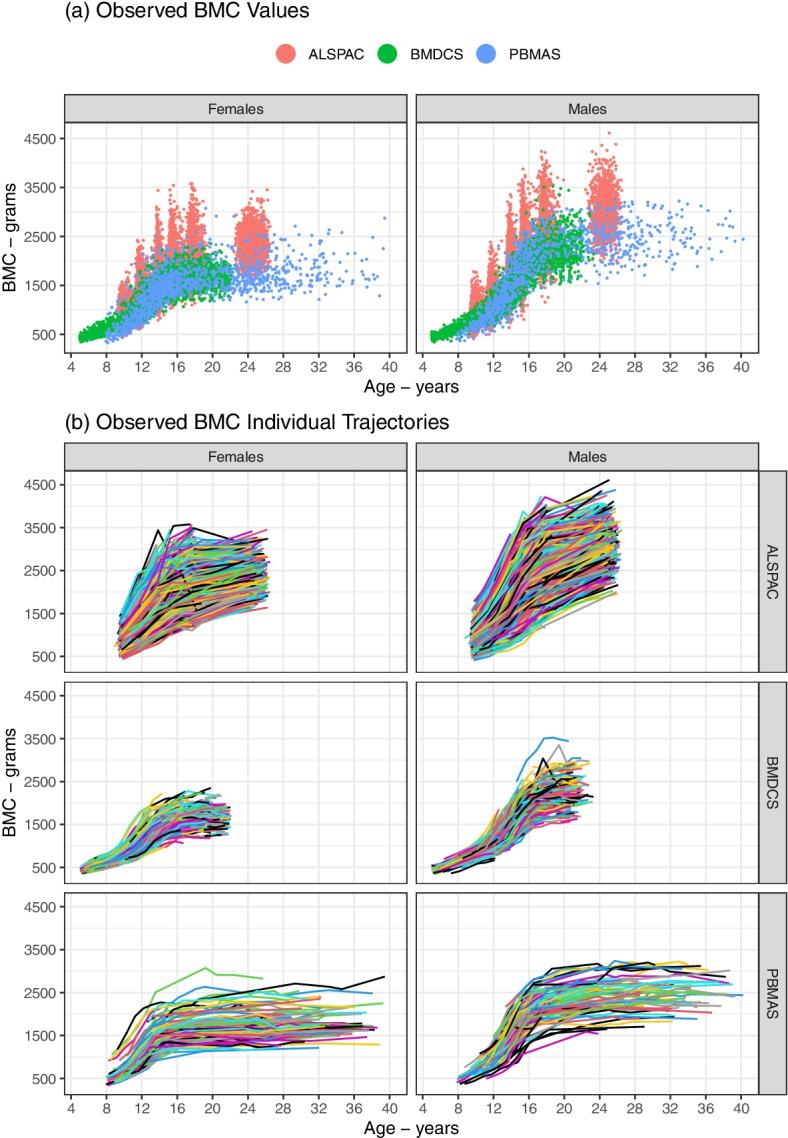
This expository paper provides an illustrative guide to summarising nonlinear growth trajectories for repeatedly measured continuous outcomes using (i) linear spline and (ii) natural cubic spline linear mixed-effects (LME) models, (iii) Super Imposition by Translation and Rotation (SITAR) nonlinear mixed effects models, and (iv) latent trajectory models. The underlying model for each approach, their similarities and differences, and their advantages and disadvantages are described. Their application and correct interpretation of their results is illustrated by analysing repeated bone mass measures to characterise bone growth patterns and their sex differences in three cohort studies from the UK, USA, and Canada comprising 8500 individuals and 37,000 measurements from ages 5-40 years. Recommendations for choosing a modelling approach are provided along with a discussion and signposting on further modelling extensions for analysing trajectory exposures and outcomes, and multiple cohorts.
RESULTS
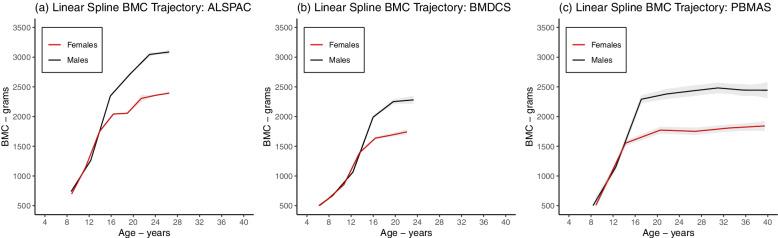
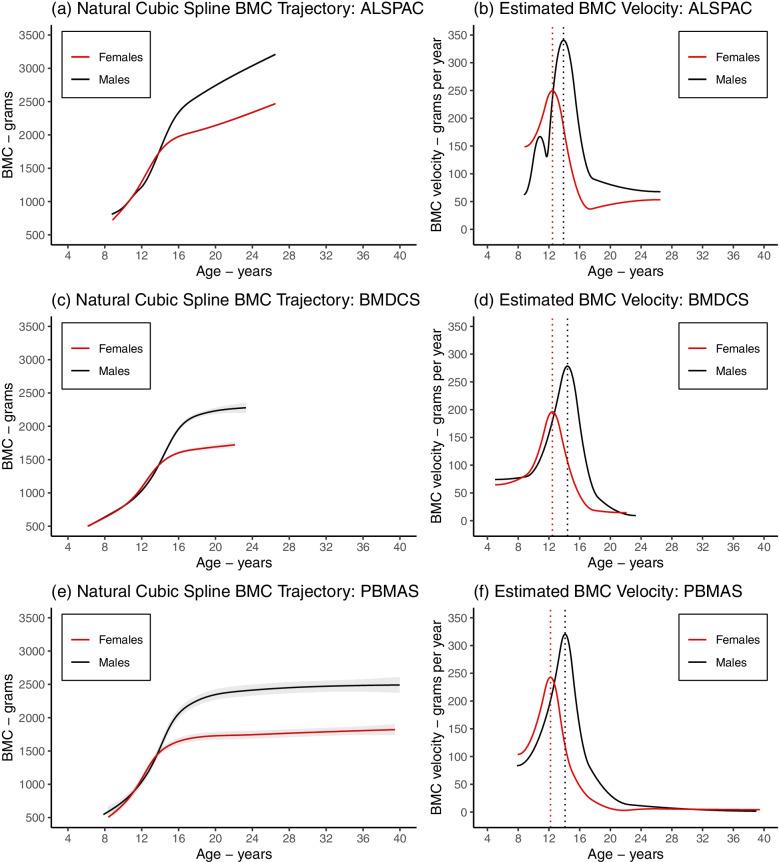
Linear and natural cubic spline LME models and SITAR provided similar summary of the mean bone growth trajectory and growth velocity, and the sex differences in growth patterns. Growth velocity (in grams/year) peaked during adolescence, and peaked earlier in females than males e.g., mean age at peak bone mineral content accrual from multicohort SITAR models was 12.2 years in females and 13.9 years in males. Latent trajectory models (with trajectory shapes estimated using a natural cubic spline) identified up to four subgroups of individuals with distinct trajectories throughout adolescence.
CONCLUSIONS
LME models with linear and natural cubic splines, SITAR, and latent trajectory models are useful for describing nonlinear growth trajectories, and these methods can be adapted for other complex traits. Choice of method depends on the research aims, complexity of the trajectory, and available data. Scripts and synthetic datasets are provided for readers to replicate trajectory modelling and visualisation using the R statistical computing software.
背景
纵向数据分析可以增进我们对整个生命周期中健康轨迹影响因素的理解。有多种可以使用的统计模型,它们的拟合和解释可能很复杂,特别是在存在非线性轨迹的情况下。我们的目的是提供一个易于理解的指南,并结合应用实例,介绍用于描述非线性增长轨迹的四种复杂建模程序。
方法
本文提供了一个说明性指南,用于使用(i)线性样条和(ii)自然三次样条线性混合效应(LME)模型、(iii)平移和旋转叠加(SITAR)非线性混合效应模型以及(iv)潜在轨迹模型来总结重复测量的连续结果的非线性增长轨迹。描述了每种方法的基础模型、它们的相似之处和不同之处,以及它们的优缺点。通过分析来自英国、美国和加拿大的三项队列研究中的重复骨量测量结果,以描述骨骼生长模式及其性别差异,说明了它们的应用和对结果的正确解释。这些研究共包含 8500 个人和 37000 次 5-40 岁的测量值。还提供了选择建模方法的建议,并讨论了进一步的建模扩展,用于分析轨迹暴露和结果以及多个队列。
结果
线性和自然三次样条 LME 模型和 SITAR 提供了相似的平均骨骼生长轨迹和生长速度的总结,以及生长模式的性别差异。生长速度(以克/年为单位)在青春期达到峰值,且女性比男性更早达到峰值,例如,多队列 SITAR 模型中女性骨矿物质含量累积峰值年龄为 12.2 岁,男性为 13.9 岁。潜在轨迹模型(使用自然三次样条估计轨迹形状)确定了青春期内具有不同轨迹的多达四个亚组的个体。
结论
LME 模型中的线性和自然三次样条、SITAR 和潜在轨迹模型可用于描述非线性增长轨迹,并且这些方法可以适用于其他复杂特征。方法的选择取决于研究目的、轨迹的复杂性和可用数据。为读者提供了脚本和合成数据集,以便使用 R 统计计算软件复制轨迹建模和可视化。




 Zotero 插件