Department of Applied Chemistry and Life Science, Toyohashi University of Technology, Japan.
Electronics-Inspired Interdisciplinary Research Institute (EIIRIS), Toyohashi University of Technology, Japan.
FEBS Open Bio. 2022 Apr;12(4):835-851. doi: 10.1002/2211-5463.13377. Epub 2022 Mar 15.
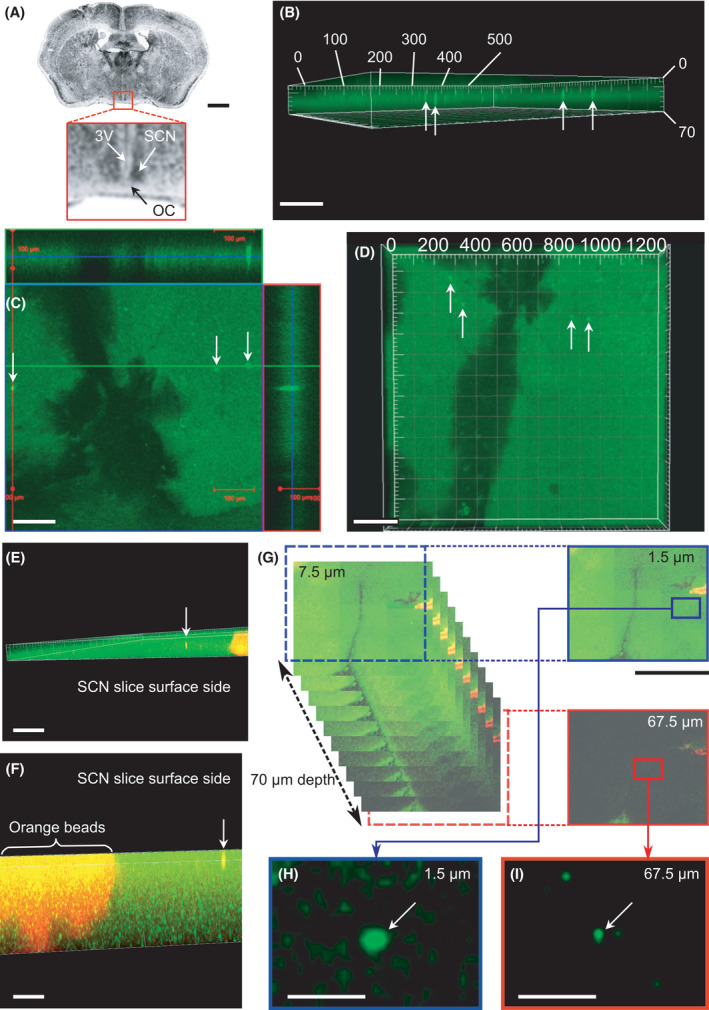
Genetic modification to restore cell functions in the brain can be performed through the delivery of biomolecules in a minimally invasive manner into live neuronal cells within brain tissues. However, conventional nanoscale needles are too short (lengths of ~10 µm) to target neuronal cells in ~1-mm-thick brain tissues because the neuronal cells are located deep within the tissue. Here, we report the use of nanoscale-tipped wire (NTW) arrays with diameters < 100 nm and wire lengths of ~200 µm to address biomolecule delivery issues. The NTW arrays were manufactured by growth of silicon microwire arrays and nanotip formation. This technique uses pinpoint, multiple-cell DNA injections in deep areas of brain tissues, enabling target cells to be marked by fluorescent protein (FP) expression vectors. This technique has potential for use for electrophysiological recordings and biological transfection into neuronal cells. Herein, simply pressing an NTW array delivers and expresses plasmid DNA in multiple-cultured cells and multiple-neuronal cells within a brain slice with reduced cell damage. Additionally, DNA transfection is demonstrated using brain cells ex vivo and in vivo. Moreover, knockdown of a critical clock gene after injecting a short hairpin RNA (shRNA) and a genome-editing vector demonstrates the potential to genetically alter the function of living brain cells, for example, pacemaker cells of the mammalian circadian rhythms. Overall, our NTW array injection technique enables genetic and functional modification of living cells in deep brain tissue areas, both ex vivo and in vivo.
通过以微创方式将生物分子递送至脑组织内活神经元细胞内,可以对大脑中的细胞功能进行基因修饰。然而,传统的纳米尺度针(长度约为 10 μm)太短,无法靶向厚度约为 1mm 的脑组织内的神经元细胞,因为神经元细胞位于组织深处。在这里,我们报告了使用直径 < 100nm 且长度约为 200 μm 的纳米尖端线(NTW)阵列来解决生物分子递送问题。NTW 阵列是通过硅微线阵列的生长和纳米尖端的形成来制造的。该技术使用微针,在脑组织深部进行多点、多细胞 DNA 注射,使靶细胞通过荧光蛋白(FP)表达载体进行标记。该技术有望用于电生理记录和生物转染到神经元细胞中。在此,只需按压 NTW 阵列,即可在脑切片中的多个培养细胞和多个神经元细胞中递送和表达质粒 DNA,同时减少细胞损伤。此外,还在体外和体内使用脑细胞进行了 DNA 转染的演示。此外,在注射短发夹 RNA(shRNA)和基因组编辑载体后敲低关键时钟基因,证明了对活脑细胞(例如,哺乳动物昼夜节律的起搏细胞)的功能进行遗传修饰的潜力。总体而言,我们的 NTW 阵列注射技术能够对体外和体内深部脑组织区域中的活细胞进行基因和功能修饰。