Laboratório de Parasitologia Animal, Departamento de Zootecnia e Desenvolvimento Rural, Centro de Ciências Agrárias, Universidade Federal de Santa Catarina - UFSC, Florianópolis, SC, Brasil.
Laboratório de Etologia Aplicada e Bem-Estar Animal, Departamento de Zootecnia e Desenvolvimento Rural, Centro de Ciências Agrárias, Universidade Federal de Santa Catarina - UFSC, Florianópolis, SC, Brasil.
Rev Bras Parasitol Vet. 2022 Mar 16;31(1):e014021. doi: 10.1590/S1984-29612022012. eCollection 2022.
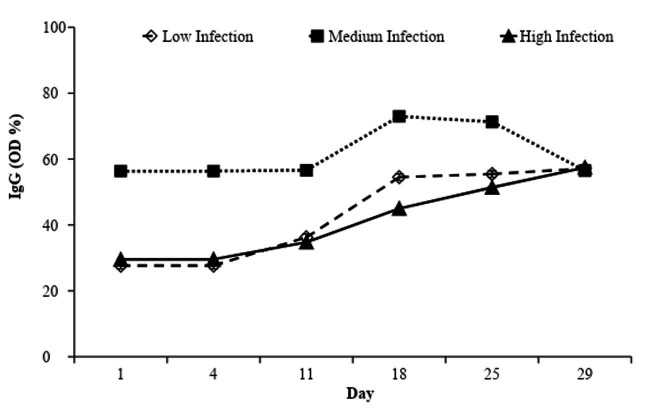
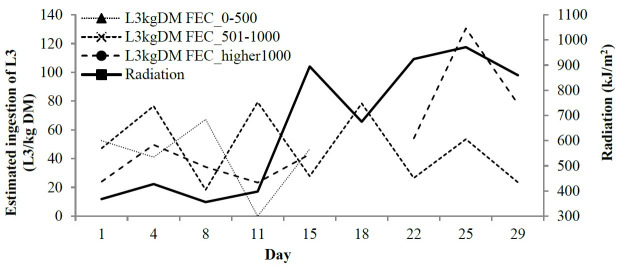
This study aimed to evaluate foraging distance (FD) from the dung, parasitological and physiological factors in 18 Crioula Lanada lambs naturally infected by nematodes with three infection levels (IL) in a Voisin Grazing System. In the pre-experimental phase animal feces collection, deworming, observer training, animal adaptation and dung demarcation were carried out; in the experimental phase, grazing distance, feces, pasture and blood sampling. An initial exploratory analysis was carried out (Kruskal-Wallis test). Fixed predictors were selected with a cumulative logit regression model; an ordinal logistic regression mixed model identified influencing factors of ordinal responses for (i) FD, (ii) infective larvae quantity (L3). Animals approached the dung when the radiation or temperature were more intense (P < 0.05). Paddock entry/exit, IgG and L3 influenced FD over time (P < 0.05). L3, in turn, was influenced by IL, FEC and corpuscular volume (CV). In the High IL group, FD varied between 60-100 cm. Greater L3 and FEC were found in the High and Low IL from the 4th week (P < 0.05). Naturally infected Crioula Lanada lambs increased the distance from the dung, which was not related to IL but to the dynamics of solar radiation and parasitological and immunological factors.
本研究旨在评估 18 只 Crioula Lanada 羔羊在 Voisin 放牧系统中受三种感染水平(IL)感染的线虫的觅食距离(FD)、寄生虫学和生理因素。在预实验阶段进行了动物粪便收集、驱虫、观察员培训、动物适应和粪便标记;在实验阶段进行了放牧距离、粪便、牧场和血液采样。进行了初步的探索性分析(Kruskal-Wallis 检验)。使用累积对数回归模型选择固定预测因子;有序逻辑回归混合模型确定了对(i)FD、(ii)感染性幼虫数量(L3)的有序反应的影响因素。当辐射或温度更强烈时,动物会接近粪便(P < 0.05)。畜栏进出、IgG 和 L3 随时间影响 FD(P < 0.05)。反过来,L3 受 IL、FEC 和红细胞体积(CV)影响。在高 IL 组中,FD 在 60-100cm 之间变化。从第 4 周开始,高 IL 和低 IL 中发现了更大的 L3 和 FEC(P < 0.05)。自然感染 Crioula Lanada 羔羊增加了与粪堆的距离,这与 IL 无关,而是与太阳辐射和寄生虫学及免疫学因素的动态有关。