Department of Obstetrics and Gynecology, Kaohsiung Veterans General Hospital, Kaohsiung, Taiwan.
Department of Obstetrics and Gynecology, University of California, Los Angeles.
JAMA Netw Open. 2022 Mar 1;5(3):e222530. doi: 10.1001/jamanetworkopen.2022.2530.
Nearly 45 000 human papillomavirus (HPV)-associated cancers are diagnosed annually in the US. The HPV vaccine has been approved since 2006, but information on the association between vaccination and the incidence of HPV-attributable cancers is unclear.
To evaluate the potential association of screening and vaccination on the trends of HPV-associated cancers.
DESIGN, SETTING, AND PARTICIPANTS: A retrospective, population-based cross-sectional study was conducted using data on HPV-associated (oropharyngeal squamous cell carcinoma [SCC], anal/rectal SCC, vulvar SCC, vaginal SCC, cervical carcinoma, and penile SCC) cancers from the US Cancer Statistics Public Use Database, representing 99% of the US population, between January 1, 2001, and December 31, 2017; HPV vaccination and screening data from the Behavioral Risk Factor Surveillance between January 1, 2001, and December 31, 2016; and TeenVaxView between January 1, 2008, and December 31, 2018. National Cancer Database and Behavioral Risk Factor Surveillance were used to correct for hysterectomy. Data analysis was performed from April 1, 2020, to June 30, 2021.
Patient demographic characteristics, including age, race and ethnicity, sex, region, and vaccination status.
The main outcomes examined in this study were diagnoses of any HPV-associated cancer and HPV vaccination status.
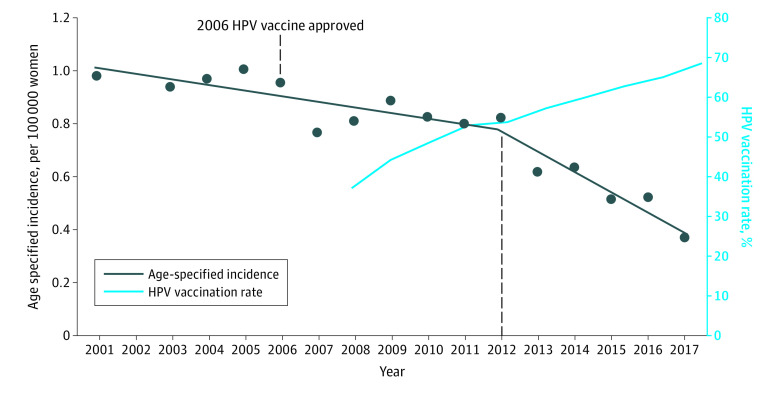
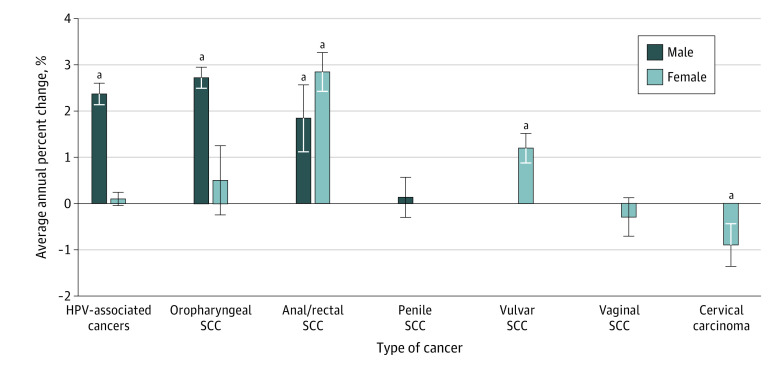
A total of 657 317 HPV-associated cancers (exact ages not collected by the United States Cancer Statistics); of these, 264 019 (40.2%) developed in men and 393 298 (59.8%) in women; 14 520 individuals (2.2%) were non-Hispanic Asian/Pacific Islander, 74 641 (11.4%) were non-Hispanic Black, 59 841 (9.1%) were Hispanic, and 499 899 were non-Hispanic White (76.1%). More than half (206 075 [52.4%]) of cancers in women were cervical, whereas most (211 421 [80.1%]) cancers in men were oropharyngeal. In female adolescents (aged 13-17 years), the vaccination rate increased from 37.2% to 69.9% from 2008 to 2018 (annual percent change: 6.57% [95% CI, 5.83%-7.32%]). Before vaccination approval, cervical cancer rates in the 20- to 24-year age group were decreasing at 2.29% annually (P = .045); after vaccine approval, this rate has been decreasing at 9.50% (P = .003). In men, annual increases were noted in oropharyngeal (2.71%) and anal/rectal (1.83%) cancers (P < .001); in women, the incidence of oropharyngeal remained stable but anal/rectal cancer increased at 2.83% every year (P < .001).
In the US, cervical cancer rates have decreased at a population level, especially in younger women. The findings of this study suggest this decrease may be associated with vaccination. Given the increase in oropharyngeal and anal/rectal cancers, particularly in men, it may be important to highlight vaccination uptake in both sexes.
在美国,每年诊断出近 45000 例人乳头瘤病毒(HPV)相关癌症。HPV 疫苗自 2006 年以来已获得批准,但疫苗接种与 HPV 相关癌症发病率之间的关联信息尚不清楚。
评估筛查和疫苗接种对 HPV 相关癌症趋势的潜在影响。
设计、地点和参与者:这是一项回顾性、基于人群的横断面研究,使用了美国癌症统计公共数据库中 HPV 相关癌症(口咽鳞状细胞癌[SCC]、肛门/直肠 SCC、外阴 SCC、阴道 SCC、宫颈癌和阴茎 SCC)的数据,代表了 2001 年 1 月 1 日至 2017 年 12 月 31 日期间美国 99%的人口;HPV 疫苗接种和筛查数据来自 2001 年 1 月 1 日至 2016 年 12 月 31 日的行为风险因素监测;以及 2008 年 1 月 1 日至 2018 年 12 月 31 日的 TeenVaxView。国家癌症数据库和行为风险因素监测用于纠正子宫切除术。数据分析于 2020 年 4 月 1 日至 2021 年 6 月 30 日进行。
患者的人口统计学特征,包括年龄、种族和民族、性别、地区和疫苗接种状况。
本研究主要观察结果是任何 HPV 相关癌症的诊断和 HPV 疫苗接种状况。
共发现 657317 例 HPV 相关癌症(确切年龄未由美国癌症统计数据收集);其中 264019 例(40.2%)发生在男性,393298 例(59.8%)发生在女性;14520 人(2.2%)是非西班牙裔亚裔/太平洋岛民,74641 人(11.4%)是非西班牙裔黑人,59841 人(9.1%)是西班牙裔,499899 人是非西班牙裔白人(76.1%)。女性中超过一半(206075 [52.4%])的癌症是宫颈癌,而男性中大多数(211421 [80.1%])癌症是口咽癌。在女性青少年(13-17 岁)中,疫苗接种率从 2008 年的 37.2%增加到 2018 年的 69.9%(年增长率:6.57%[95%CI,5.83%-7.32%])。疫苗批准前,20-24 岁年龄组的宫颈癌发病率每年下降 2.29%(P=0.045);疫苗批准后,这一比率以每年 9.50%的速度下降(P=0.003)。在男性中,口咽癌(2.71%)和肛门/直肠癌(1.83%)的发病率呈逐年上升趋势(P<0.001);在女性中,口咽癌的发病率保持稳定,但肛门/直肠癌的发病率每年增加 2.83%(P<0.001)。
在美国,宫颈癌的发病率在人群水平上呈下降趋势,尤其是在年轻女性中。本研究结果表明,这种下降可能与疫苗接种有关。鉴于口咽癌和肛门/直肠癌的增加,特别是在男性中,强调男女两性的疫苗接种率可能很重要。