Pollard Elinita, Holt Hunter K, Vu Milkie, Tsai Meng-Han
Georgia Prevention Institute, Augusta University, Augusta, GA, USA.
Center for Health Equity Transformation, University of Kentucky, Lexington, KY, USA.
Prev Med Rep. 2025 Jul 5;56:103160. doi: 10.1016/j.pmedr.2025.103160. eCollection 2025 Aug.
Male children are less likely to initiate the human papillomavirus (HPV) vaccine series than their female counterparts. Furthermore, evidence suggests children with parents who initiated the vaccine series may be more likely to do the same. However, no studies have examined if parents' vaccination status modifies sex differences in HPV vaccine series initiation among children.
Using the 2022 National Health Interview Survey data, we examined the association between parents' HPV vaccination status (unvaccinated, initiated the vaccine series, unknown) and sex disparities in HPV vaccine series initiation among children using weighted multivariable logistic regression models.
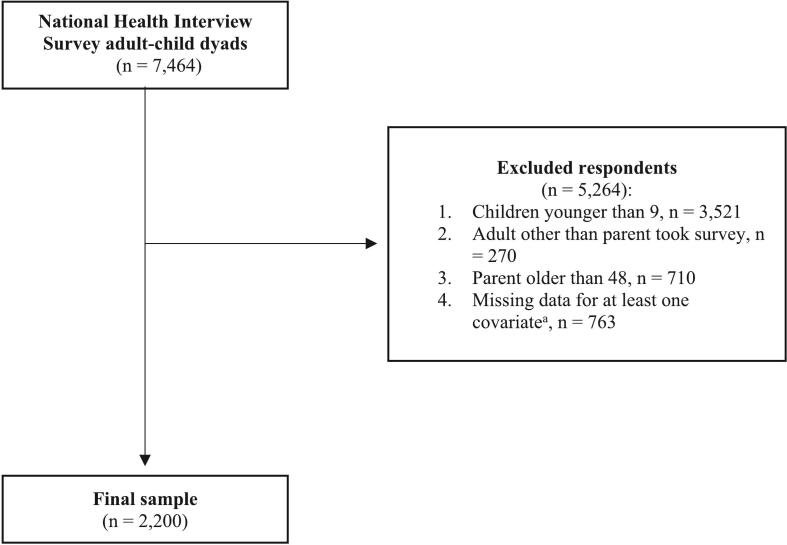
Among 2200 parent-child dyads, less than half of parents (15.6 %) and children (32.6 %) initiated the HPV vaccine series. In adjusted analysis, male children had decreased odds of vaccine series initiation (OR: 0.73, 95 % CI: 0.58, 0.92). Children with parents who initiated the vaccine series had an increased odds of initiating the vaccine series compared to those whose parents were unvaccinated (OR: 2.88, 95 % CI: 2.00, 4.15). When stratified by parent's HPV vaccine series initiation, male children only had a decreased odds of HPV vaccine series initiation among children with unvaccinated parents (OR: 0.69, 95 % CI: 0.54, 0.89).
Male children were only less likely to initiate the HPV vaccine series among children whose parents were unvaccinated against HPV. Thus, healthcare providers should engage both the parent and child in the vaccine recommendation process. Doing so may improve HPV vaccine series initiation for parents who are within the recommended age range and male children.
与女童相比,男童开始接种人乳头瘤病毒(HPV)疫苗系列的可能性更低。此外,有证据表明,父母已开始接种该疫苗系列的儿童更有可能同样接种。然而,尚无研究探讨父母的疫苗接种状况是否会改变儿童HPV疫苗系列接种中的性别差异。
利用2022年全国健康访谈调查数据,我们使用加权多变量逻辑回归模型,研究了父母的HPV疫苗接种状况(未接种、已开始接种疫苗系列、情况不明)与儿童HPV疫苗系列接种中的性别差异之间的关联。
在2200对亲子中,不到一半的父母(15.6%)和儿童(32.6%)开始接种HPV疫苗系列。在调整分析中,男童开始接种疫苗系列的几率降低(比值比:0.73,95%置信区间:0.58,0.92)。与父母未接种疫苗的儿童相比,父母已开始接种疫苗系列的儿童开始接种疫苗系列的几率增加(比值比:2.88,95%置信区间:2.00,4.15)。按父母的HPV疫苗系列接种情况分层时,只有在父母未接种疫苗的儿童中,男童开始接种HPV疫苗系列的几率降低(比值比:0.69,95%置信区间:0.54,0.89)。
只有在父母未接种HPV疫苗的儿童中,男童开始接种HPV疫苗系列的可能性才较低。因此,医疗保健提供者应让父母和儿童都参与疫苗推荐过程。这样做可能会提高处于推荐年龄范围内的父母和男童的HPV疫苗系列接种率。