• 文献检索
  • 文档翻译
  • 深度研究
  • 学术资讯
  • Suppr Zotero 插件Zotero 插件
  • 邀请有礼
  • 套餐&价格
  • 历史记录
应用&插件
Suppr Zotero 插件Zotero 插件浏览器插件Mac 客户端Windows 客户端微信小程序
定价
高级版会员购买积分包购买API积分包
服务
文献检索文档翻译深度研究API 文档MCP 服务
关于我们
关于 Suppr公司介绍联系我们用户协议隐私条款
关注我们

Suppr 超能文献

核心技术专利:CN118964589B侵权必究
粤ICP备2023148730 号-1Suppr @ 2026

文献检索

告别复杂PubMed语法,用中文像聊天一样搜索,搜遍4000万医学文献。AI智能推荐,让科研检索更轻松。

立即免费搜索

文件翻译

保留排版,准确专业,支持PDF/Word/PPT等文件格式,支持 12+语言互译。

免费翻译文档

深度研究

AI帮你快速写综述,25分钟生成高质量综述,智能提取关键信息,辅助科研写作。

立即免费体验

[关于阿片类药物处理的认知:聚焦2019冠状病毒病:通过德国麻醉与重症医学学会/德国麻醉医师协会专业协会对麻醉医师进行的一项调查]

[Perceptions on handling of opioids: focus COVID-19 : A survey among anesthesiologists via the specialist societies DGAI/BDA].

作者信息

Peuckmann-Post Vera, Wiese Christoph, Keszei András, Rolke Roman, Elsner Frank

机构信息

Klinik für Palliativmedizin, Medizinische Fakultät, Uniklinik RWTH Aachen, RWTH Aachen University, Aachen, Deutschland.

Klinik für Anästhesiologie, Medizinische Fakultät, Uniklinik RWTH Aachen, RWTH Aachen University, Aachen, Deutschland.

出版信息

Anaesthesiologie. 2022 Aug;71(8):586-598. doi: 10.1007/s00101-022-01101-2. Epub 2022 Mar 16.

DOI:10.1007/s00101-022-01101-2
PMID:35294560
原文链接:https://pmc.ncbi.nlm.nih.gov/articles/PMC8924352/
Abstract

BACKGROUND

Opioids are part of the daily routine in anesthesiology and palliative care; however, treatment of dyspnea with opioids is presented heterogeneously in guidelines. This may result in an uncertainty concerning opioid indications and ethical concerns, especially when caring for COVID-19 patients.

OBJECTIVE

We aimed to examine the perception of anesthesiologists concerning the handling of morphine as the reference opioid (subsequently termed M/O) for symptom control within and outside of a palliative care setting, including care for COVID-19 patients.

MATERIAL AND METHODS

Members of the German Society of Anesthesiology and Intensive Care Medicine (DGAI) and the Professional Association of German Anesthesiologists (BDA) received an anonymized online questionnaire (Survey Monkey®; Momentive Inc., San Mateo, CA, USA) in October 2020, containing questions regarding their perception of symptom management with M/O in general, and in particular concerning COVID-19 patients. Participants were asked to rate their perception within and outside a palliative care setting.

RESULTS AND DISCUSSION

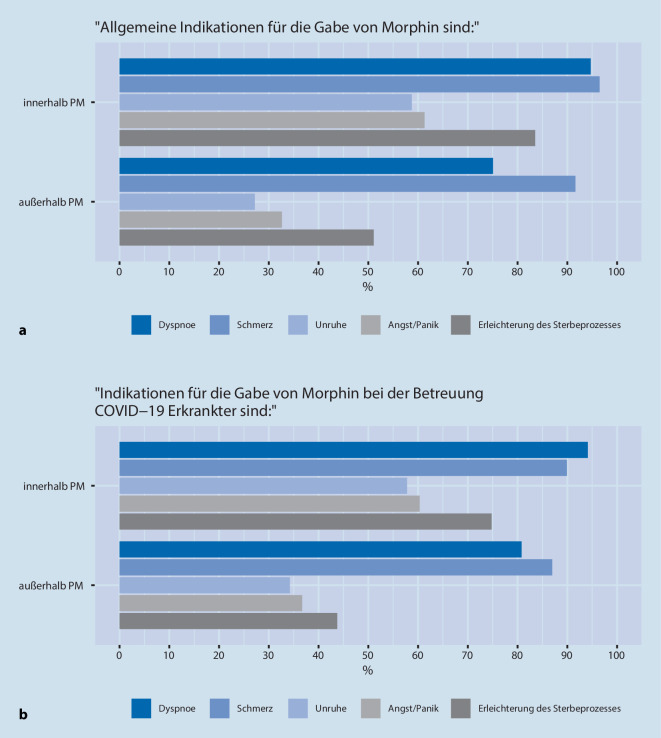
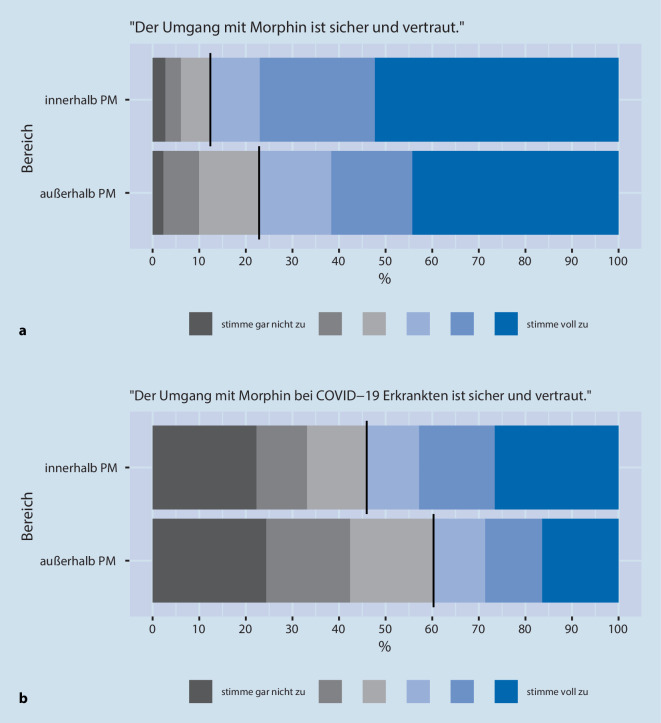
A total of 1365 anesthesiologists participated; 46% women. Most anesthesiologists were 41-60 years old (58%), worked in a hospital setting (78%), in the operating theatre (63%) and in intensive care units (49%). The majority (57%) reported > 20 years of professional experience (52%) and partial involvement in palliative care (57%). Perception of M/O handling was mostly "certain and confident" (88%) and "clearly regulated" (85%) within a palliative care setting but rated substantially lower for outside palliative care (77%/63%). When caring for COVID-19 patients, handling of M/O was even less often rated "certain and confident" (40%) or "clearly regulated" (29%) outside palliative care. Dyspnea (95%/75%), relief of the dying process (84%/51%), agitation (59%/27%) and anxiety/panic (61%/33%) were more frequently rated as general indications for morphine within versus outside palliative care. The majority of anesthesiologists disputed that M/O is given with the intention to hasten death within (87%) and outside (93%) palliative care. Highest difference in route of administration was reported for the subcutaneous administration of M/O within (76%) versus outside (33%) palliative care, followed by the intravenous route (57%/79%), while oral (66/62%) and transdermal (48%/39%) administration were reported to be used comparatively frequently. Most participants (85%) wanted more frequent involvement of palliative care consultation teams but also more team conferences (75%), supervision (72%), and training on opioid management (69%).

CONCLUSION

Anesthesiologists perceived considerable uncertainty in using M/O for nonpalliative care medical settings. Highest uncertainty was seen for the care of patients with COVID-19. The prevalent use of the subcutaneous route for M/O application in palliative care can serve as inspiration for areas outside palliative care as well. Uniform interdisciplinary guidelines for symptom control including dyspnea, education and involvement of a palliative care consultation team should be more considered in the future.
https://cdn.ncbi.nlm.nih.gov/pmc/blobs/716a/9352749/440f5adb77b8/101_2022_1101_Fig5_HTML.jpg
https://cdn.ncbi.nlm.nih.gov/pmc/blobs/716a/9352749/e19d77bee52a/101_2022_1101_Fig1_HTML.jpg
https://cdn.ncbi.nlm.nih.gov/pmc/blobs/716a/9352749/5db423bf4d54/101_2022_1101_Fig2_HTML.jpg
https://cdn.ncbi.nlm.nih.gov/pmc/blobs/716a/9352749/af14205dd738/101_2022_1101_Fig3_HTML.jpg
https://cdn.ncbi.nlm.nih.gov/pmc/blobs/716a/9352749/6f4e0d9e82b3/101_2022_1101_Fig4_HTML.jpg
https://cdn.ncbi.nlm.nih.gov/pmc/blobs/716a/9352749/440f5adb77b8/101_2022_1101_Fig5_HTML.jpg
https://cdn.ncbi.nlm.nih.gov/pmc/blobs/716a/9352749/e19d77bee52a/101_2022_1101_Fig1_HTML.jpg
https://cdn.ncbi.nlm.nih.gov/pmc/blobs/716a/9352749/5db423bf4d54/101_2022_1101_Fig2_HTML.jpg
https://cdn.ncbi.nlm.nih.gov/pmc/blobs/716a/9352749/af14205dd738/101_2022_1101_Fig3_HTML.jpg
https://cdn.ncbi.nlm.nih.gov/pmc/blobs/716a/9352749/6f4e0d9e82b3/101_2022_1101_Fig4_HTML.jpg
https://cdn.ncbi.nlm.nih.gov/pmc/blobs/716a/9352749/440f5adb77b8/101_2022_1101_Fig5_HTML.jpg
摘要

背景

阿片类药物是麻醉学和姑息治疗日常工作的一部分;然而,阿片类药物治疗呼吸困难在指南中的呈现并不统一。这可能导致阿片类药物适应证的不确定性以及伦理问题,尤其是在护理新冠肺炎患者时。

目的

我们旨在研究麻醉医生对于在姑息治疗环境内外,包括护理新冠肺炎患者时,使用吗啡作为参考阿片类药物(以下简称M/O)控制症状的看法。

材料与方法

德国麻醉与重症医学学会(DGAI)和德国麻醉医生专业协会(BDA)的成员于2020年10月收到一份匿名在线问卷(Survey Monkey®;美国加利福尼亚州圣马特奥市Momentive公司),其中包含关于他们对一般情况下以及特别是新冠肺炎患者使用M/O进行症状管理的看法的问题。参与者被要求对他们在姑息治疗环境内外的看法进行评分。

结果与讨论

共有1365名麻醉医生参与;46%为女性。大多数麻醉医生年龄在41 - 60岁(58%),在医院工作(78%),在手术室工作(63%),在重症监护病房工作(49%)。大多数人(57%)报告有超过20年的专业经验(52%)且部分参与姑息治疗(57%)。在姑息治疗环境中,对M/O使用的看法大多是“确定且自信”(88%)和“明确规范”(85%),但在姑息治疗环境外的评分则低得多(77%/63%)。在护理新冠肺炎患者时,在姑息治疗环境外,对M/O使用的看法被评为“确定且自信”(40%)或“明确规范”(29%)的情况更少。与姑息治疗环境外相比,呼吸困难(95%/75%)、缓解临终过程(84%/51%)、躁动(59%/27%)和焦虑/恐慌(61%/33%)在姑息治疗环境内更常被评为使用吗啡的一般适应证。大多数麻醉医生反对在姑息治疗环境内(87%)和外(93%)使用M/O的目的是加速死亡。报告的给药途径差异最大的是M/O在姑息治疗环境内(76%)与外(33%)的皮下给药,其次是静脉途径(57%/79%),而口服(66/62%)和透皮(48%/39%)给药据报道使用相对频繁。大多数参与者(85%)希望姑息治疗咨询团队更频繁地参与,也希望有更多的团队会议(75%)、监督(72%)以及阿片类药物管理培训(69%)。

结论

麻醉医生认为在非姑息治疗医疗环境中使用M/O存在很大的不确定性。在护理新冠肺炎患者时不确定性最高。在姑息治疗中普遍使用的M/O皮下给药途径也可为姑息治疗环境外的领域提供借鉴。未来应更多考虑制定包括呼吸困难症状控制、姑息治疗咨询团队的教育和参与在内的统一跨学科指南。

相似文献

1
[Perceptions on handling of opioids: focus COVID-19 : A survey among anesthesiologists via the specialist societies DGAI/BDA].[关于阿片类药物处理的认知:聚焦2019冠状病毒病:通过德国麻醉与重症医学学会/德国麻醉医师协会专业协会对麻醉医师进行的一项调查]
Anaesthesiologie. 2022 Aug;71(8):586-598. doi: 10.1007/s00101-022-01101-2. Epub 2022 Mar 16.
2
[Perceptions on the use of opioids in COVID-19 : A survey of members of the German Association for Palliative Medicine].[关于新冠疫情期间阿片类药物使用的认知:对德国姑息医学协会成员的一项调查]
Schmerz. 2022 Feb;36(1):19-29. doi: 10.1007/s00482-021-00596-9. Epub 2021 Oct 18.
3
[Perceptions on the use of opioids: focus on COVID-19 : Free-text analysis of a survey in anesthesiology/intensive care, internal medicine, and palliative care].[关于阿片类药物使用的认知:聚焦于2019冠状病毒病:麻醉学/重症监护、内科和姑息治疗领域一项调查的自由文本分析]
Schmerz. 2022 Apr;36(2):99-108. doi: 10.1007/s00482-021-00620-y. Epub 2022 Jan 24.
4
5
End-of-life care in COVID-19: An audit of pharmacological management in hospital inpatients.COVID-19 患者的临终关怀:医院住院患者药物治疗管理的审计。
Palliat Med. 2020 Oct;34(9):1235-1240. doi: 10.1177/0269216320935361. Epub 2020 Jun 26.
6
Interventions for palliative symptom control in COVID-19 patients.干预措施以控制 COVID-19 患者的姑息症状。
Cochrane Database Syst Rev. 2021 Aug 23;8(8):CD015061. doi: 10.1002/14651858.CD015061.
7
End-of-life perceptions among physicians in intensive care units managed by anesthesiologists in Germany: a survey about structure, current implementation and deficits.德国麻醉科医生管理的重症监护病房中医生对临终的看法:一项关于结构、当前实施情况及不足的调查
BMC Anesthesiol. 2017 Jul 11;17(1):93. doi: 10.1186/s12871-017-0384-5.
8
The Current Practice of Opioid for Cancer Dyspnea: The Result From the Nationwide Survey of Japanese Palliative Care Physicians.癌症呼吸困难的阿片类药物使用现状:日本姑息治疗医师全国调查结果。
J Pain Symptom Manage. 2019 Oct;58(4):672-677.e2. doi: 10.1016/j.jpainsymman.2019.06.006. Epub 2019 Jun 13.
9
[On the safe side? Safety culture and patient safety in German anesthesiology clinics-A nationwide survey on the status quo].[为安全起见?德国麻醉科诊所的安全文化与患者安全——一项关于现状的全国性调查]
Anaesthesiologie. 2022 Jul;71(7):526-534. doi: 10.1007/s00101-021-01073-9. Epub 2022 Feb 18.
10
Out-of-hospital opioid therapy of palliative care patients with "acute dyspnoea": a retrospective multicenter investigation.姑息治疗患者“急性呼吸困难”的院外阿片类药物治疗:一项回顾性多中心调查
J Opioid Manag. 2009 Mar-Apr;5(2):115-22. doi: 10.5055/jom.2009.0013.

引用本文的文献

1
[Perceptions on the use of opioids: focus on COVID-19 : Free-text analysis of a survey in anesthesiology/intensive care, internal medicine, and palliative care].[关于阿片类药物使用的认知:聚焦于2019冠状病毒病:麻醉学/重症监护、内科和姑息治疗领域一项调查的自由文本分析]
Schmerz. 2022 Apr;36(2):99-108. doi: 10.1007/s00482-021-00620-y. Epub 2022 Jan 24.

本文引用的文献

1
A critical review of the respiratory benefits and harms of orally administered opioids for dyspnea management in COPD.口服阿片类药物治疗 COPD 呼吸困难的呼吸获益和危害的系统评价。
Expert Rev Respir Med. 2021 Dec;15(12):1579-1587. doi: 10.1080/17476348.2021.2005584. Epub 2021 Nov 22.
2
Pharmacological strategies used to manage symptoms of patients dying of COVID-19: A rapid systematic review.用于管理 COVID-19 死亡患者症状的药物治疗策略:快速系统评价。
Palliat Med. 2021 Jun;35(6):1099-1107. doi: 10.1177/02692163211013255. Epub 2021 May 13.
3
'Necessity is the mother of invention': Specialist palliative care service innovation and practice change in response to COVID-19. Results from a multinational survey (CovPall).
“需要是发明之母”:应对 COVID-19 而进行的专科姑息治疗服务创新和实践变革。一项多国调查(CovPall)的结果。
Palliat Med. 2021 May;35(5):814-829. doi: 10.1177/02692163211000660. Epub 2021 Mar 23.
4
Pharmacologic Interventions for Breathlessness in Patients With Advanced Cancer: A Systematic Review and Meta-analysis.药物干预对晚期癌症患者呼吸困难的影响:系统评价和荟萃分析。
JAMA Netw Open. 2021 Feb 1;4(2):e2037632. doi: 10.1001/jamanetworkopen.2020.37632.
5
Challenges of Combining Opioids and P2Y Inhibitors in Acute Coronary Syndrome: Should the Future Be Opioid Free?急性冠状动脉综合征中联合使用阿片类药物和P2Y抑制剂的挑战:未来是否应无阿片类药物?
Curr Probl Cardiol. 2021 Apr;46(4):100781. doi: 10.1016/j.cpcardiol.2020.100781. Epub 2020 Dec 26.
6
[S2k Guideline - Recommendations for Inpatient Therapy of Patients with COVID-19].[S2k指南 - 2019冠状病毒病住院患者治疗建议]
Pneumologie. 2021 Feb;75(2):88-112. doi: 10.1055/a-1334-1925. Epub 2021 Jan 15.
7
Association between opioid dose escalation and time to death in a comfort measures only population.仅采取姑息治疗措施人群中阿片类药物剂量增加与死亡时间之间的关联。
Am J Health Syst Pharm. 2021 Jan 22;78(3):203-209. doi: 10.1093/ajhp/zxaa367.
8
Independent Research on Cancer Pain Management in the Setting of Early Palliative Care: A Flywheel to Counteract General Opioid Misuse and Abuse.在早期姑息治疗背景下进行癌症疼痛管理的独立研究:反通用阿片类药物滥用的飞轮。
Int J Environ Res Public Health. 2020 Sep 28;17(19):7097. doi: 10.3390/ijerph17197097.
9
Administration of label and off-label drugs by the subcutaneous route in palliative care: an observational cohort study.在姑息治疗中通过皮下途径给予标签和非标签药物的管理:一项观察性队列研究。
BMJ Support Palliat Care. 2022 Dec;12(e6):e723-e729. doi: 10.1136/bmjspcare-2020-002185. Epub 2020 Sep 4.
10
2020 ESC Guidelines for the management of acute coronary syndromes in patients presenting without persistent ST-segment elevation.2020年欧洲心脏病学会非持续性ST段抬高型急性冠状动脉综合征患者管理指南
Eur Heart J. 2021 Apr 7;42(14):1289-1367. doi: 10.1093/eurheartj/ehaa575.