Desmarteaux Carolane, Streff Anouk, Chen Jen-I, Houzé Bérengère, Piché Mathieu, Rainville Pierre
University of Montréal, Montréal, QC, Canada.
University Institute of Geriatrics of Montréal, Montréal, QC, Canada.
Front Pain Res (Lausanne). 2021 Dec 23;2:757384. doi: 10.3389/fpain.2021.757384. eCollection 2021.
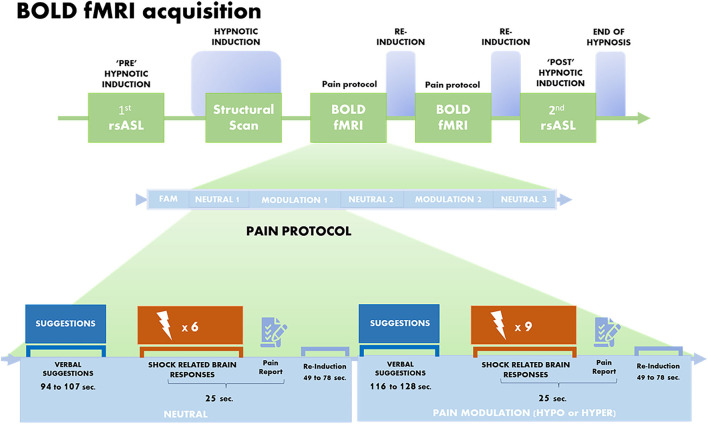
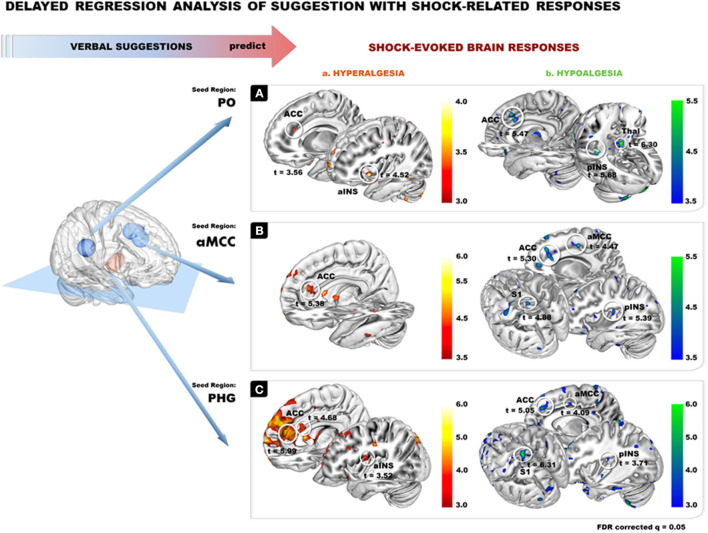
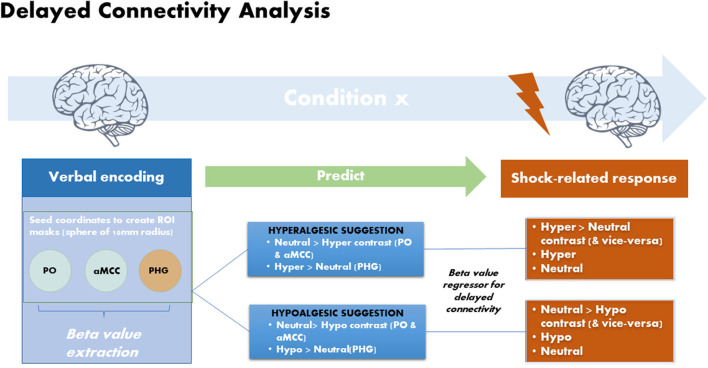
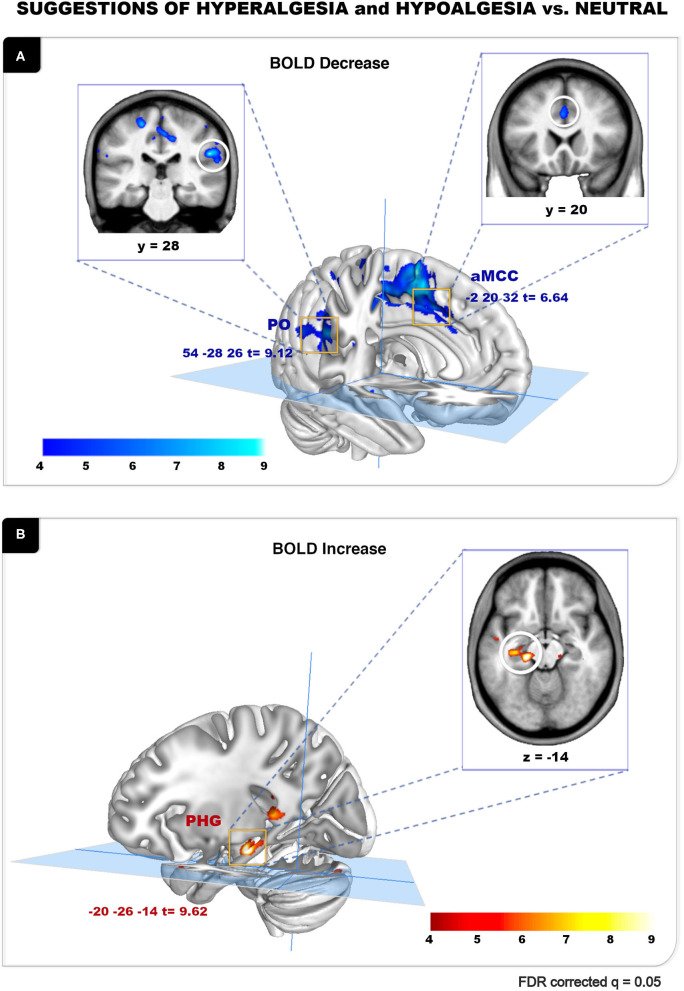
The effectiveness of hypnosis in reducing pain is well supported by the scientific literature. Hypnosis typically involves verbal suggestions but the mechanisms by which verbal contents are transformed into predictive signals to modulate perceptual processes remain unclear. We hypothesized that brain activity during verbal suggestions would predict the modulation of responses to acute nociceptive stimuli. Brain activity was measured using BOLD-fMRI in healthy participants while they listened to verbal suggestions of HYPERALGESIA, HYPOALGESIA, or NORMAL sensation (control) following a standardized hypnosis induction. Immediately after the suggestions, series of noxious electrical stimuli were administered to assess pain-related responses. Brain responses measured during the suggestions were then used to predict changes in pain-related responses using delayed regression analyses. Listening to suggestions of HYPERALGESIA and HYPOALGESIA produced BOLD decreases (vs. control) in the parietal operculum (PO) and in the anterior midcingulate cortex (aMCC), and increases in the left parahippocampal gyrus (lPHG). Changes in activity in PO, aMCC and PHG during the suggestions predicted larger pain-evoked responses following the HYPERALGESIA suggestions in the anterior cingulate cortex (ACC) and the anterior insula (aINS), and smaller pain-evoked responses following the HYPOALGESIA suggestions in the ACC, aMCC, posterior insula (pINS) and thalamus. These changes in pain-evoked brain responses are consistent with the changes in pain perception reported by the participants in HYPERALGESIA and HYPOALGESIA, respectively. The fronto-parietal network (supracallosal ACC and PO) has been associated with self-regulation and perceived self-agency. Deactivation of these regions during suggestions is predictive of the modulation of brain responses to noxious stimuli in areas previously associated with pain perception and pain modulation. The response of the hippocampal complex may reflect its role in contextual learning, memory and pain anticipation/expectations induced by verbal suggestions of pain modulation. This study provides a basis to further explore the transformation of verbal suggestions into perceptual modulatory processes fundamental to hypnosis neurophenomenology. These findings are discussed in relation to predictive coding models.
科学文献充分支持了催眠在减轻疼痛方面的有效性。催眠通常涉及言语暗示,但言语内容转化为预测信号以调节感知过程的机制仍不清楚。我们假设言语暗示期间的大脑活动将预测对急性伤害性刺激反应的调节。在健康参与者接受标准化催眠诱导后,当他们听到痛觉过敏、痛觉减退或正常感觉(对照)的言语暗示时,使用血氧水平依赖性功能磁共振成像(BOLD-fMRI)测量大脑活动。在暗示之后,立即施加一系列有害电刺激以评估疼痛相关反应。然后,使用延迟回归分析,将暗示期间测量的大脑反应用于预测疼痛相关反应的变化。听到痛觉过敏和痛觉减退的暗示后,顶叶岛盖部(PO)和前扣带回中部皮质(aMCC)的血氧水平依赖信号降低(与对照相比),左侧海马旁回(lPHG)的血氧水平依赖信号增加。暗示期间PO、aMCC和海马旁回的活动变化预测,在痛觉过敏暗示后,前扣带回皮质(ACC)和前脑岛(aINS)的疼痛诱发反应更大,而在痛觉减退暗示后,ACC、aMCC、后脑岛(pINS)和丘脑的疼痛诱发反应更小。这些疼痛诱发的大脑反应变化分别与痛觉过敏和痛觉减退参与者报告的疼痛感知变化一致。额顶网络(胼胝体上ACC和PO)与自我调节和自我能动性感知有关。暗示期间这些区域的失活可预测先前与疼痛感知和疼痛调节相关区域对有害刺激的大脑反应调节。海马复合体的反应可能反映了其在由疼痛调节言语暗示引起的情境学习、记忆和疼痛预期/期望中的作用。本研究为进一步探索言语暗示转化为催眠神经现象学基础的感知调节过程提供了依据。结合预测编码模型对这些发现进行了讨论。