Woodman Sara E, Antonopoulos Sophia R, Durham Paul L
Department of Biology, Missouri State University, Jordan Valley Innovation Center-Center for Biomedical and Life Sciences, Springfield, MO, United States.
Front Pain Res (Lausanne). 2022 Jan 27;3:809352. doi: 10.3389/fpain.2022.809352. eCollection 2022.
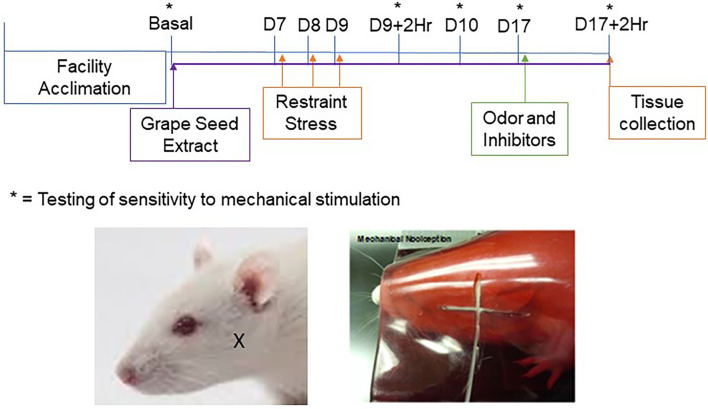
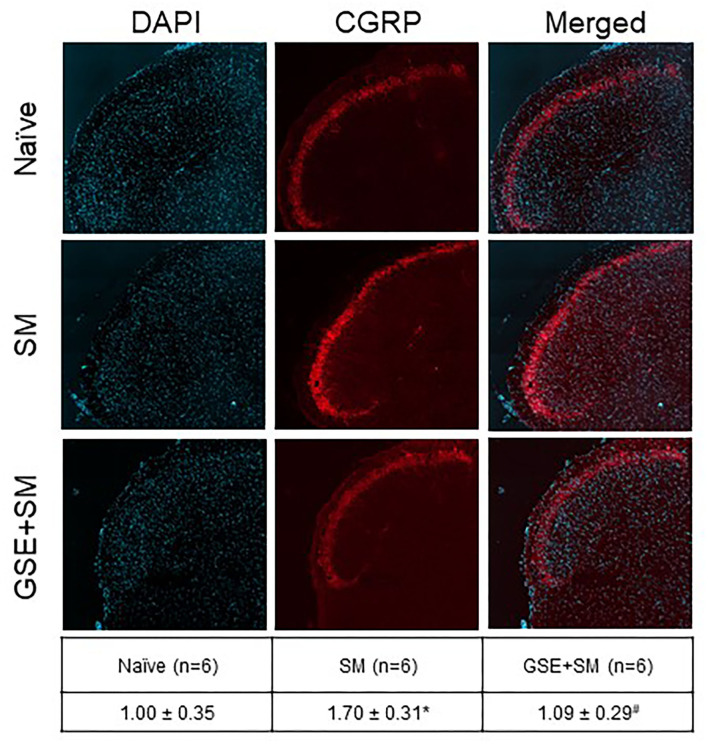
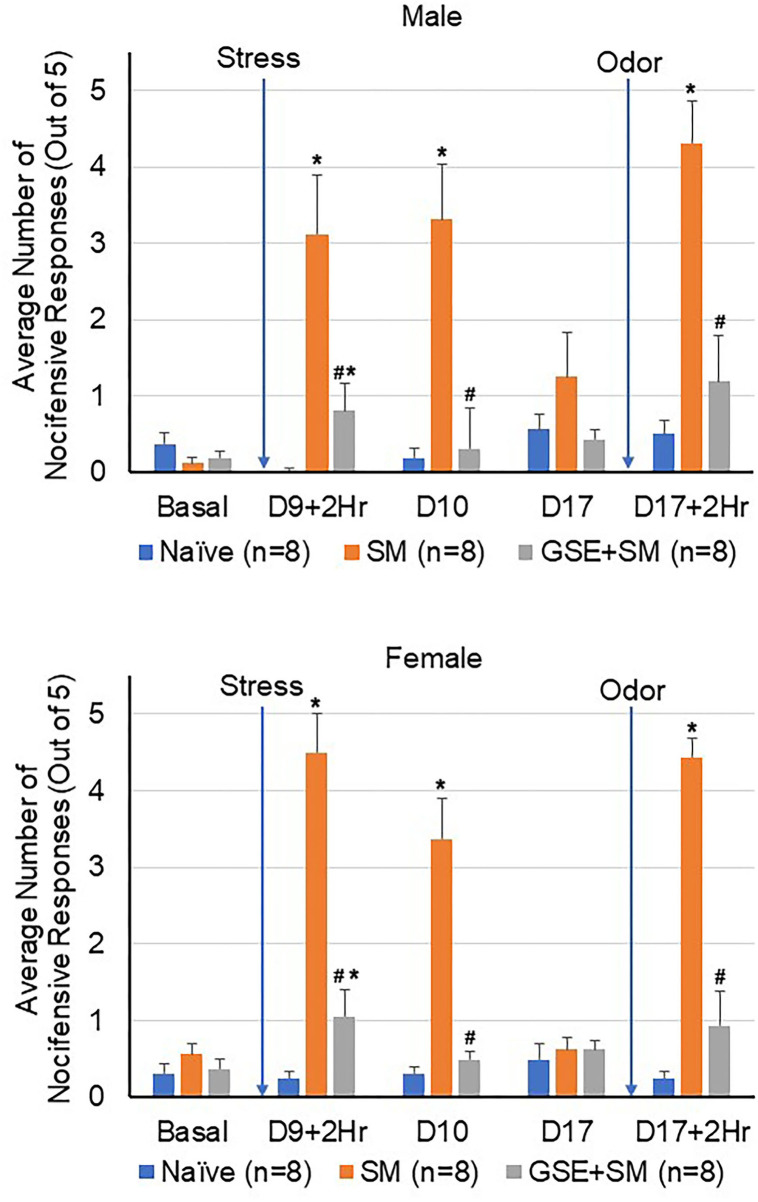
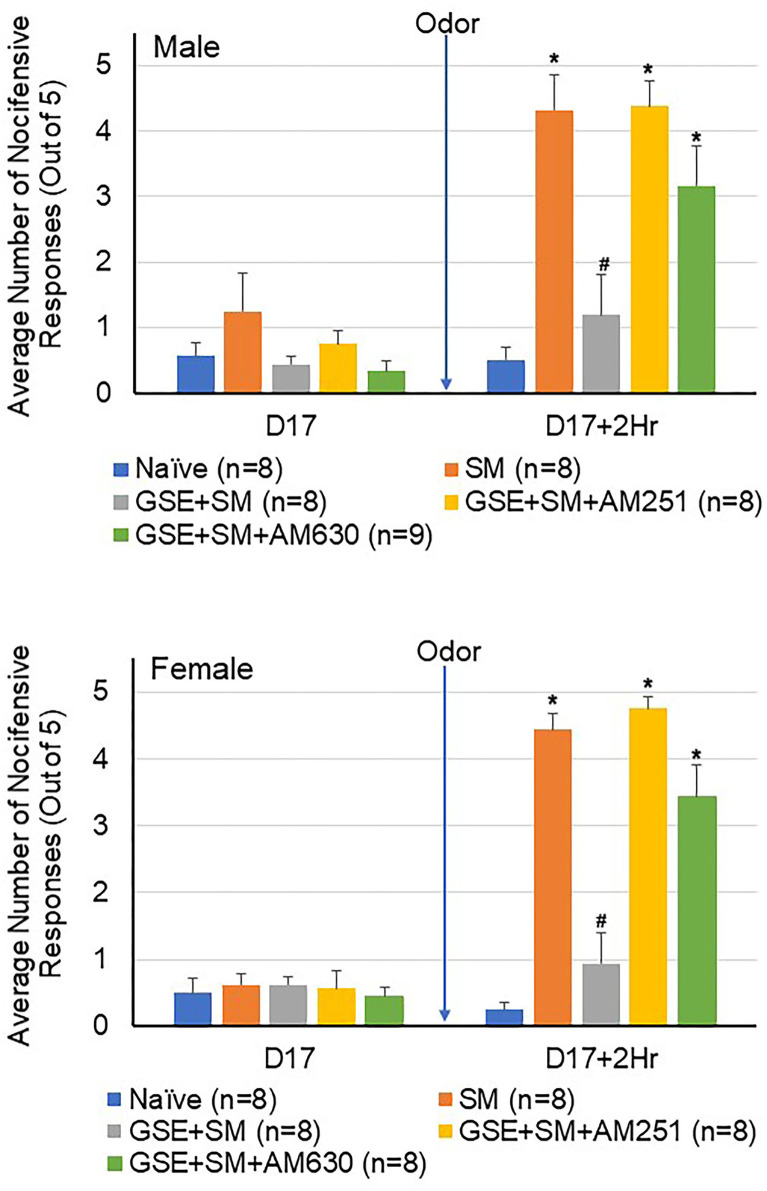
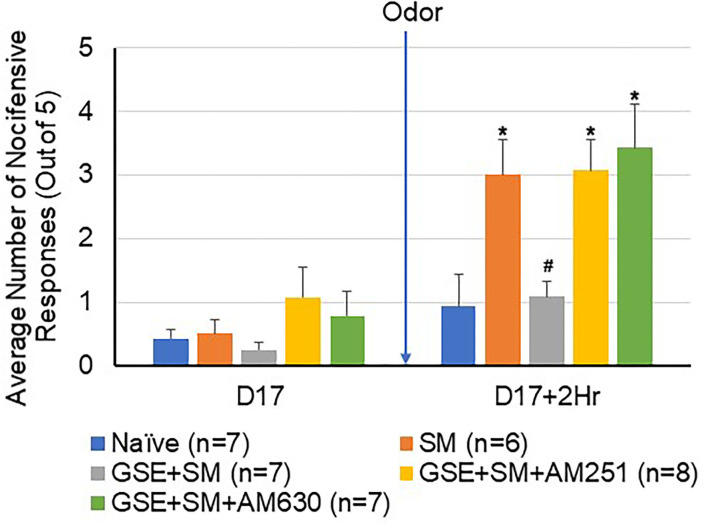
Migraine is associated with peripheral and central sensitization of the trigeminal system and dysfunction of descending pain modulation pathways. Recently, dietary inclusion of grape seed extract (GSE) was shown to inhibit mechanical nociception in a preclinical model of chronic temporomandibular joint disorder, a condition often comorbid with migraine, with the antinociceptive effect mediated, in part, by activation of 5-HT3/7 and GABAB receptors. This study further investigated the mechanisms by which GSE inhibits mechanical nociception in a preclinical model of episodic migraine. Hyperalgesic priming of female and male Sprague Dawley rats was induced by three consecutive daily two-hour episodes of restraint stress. Seven days after the final restraint stress, rats were exposed to pungent odors from an oil extract that contains the compound umbellulone, which stimulates CGRP release and induces migraine-like pain. Some animals received dietary supplementation of GSE in their drinking water beginning one week prior to restraint stress. Changes in mechanical sensitivity in the orofacial region and hindpaw were determined using von Frey filaments. To investigate the role of the endocannabinoid receptors in the effect of GSE, some animals were injected intracisternally with the CB1 antagonist AM 251 or the CB2 antagonist AM 630 prior to odor inhalation. Changes in CGRP expression in the spinal trigeminal nucleus (STN) in response to stress, odor and GSE supplementation were studied using immunohistochemistry. Exposure of stress-primed animals to the odor caused a significant increase in the average number of withdrawal responses to mechanical stimulation in both the orofacial region and hindpaw, and the effect was significantly suppressed by daily supplementation with GSE. The anti-nociceptive effect of GSE was inhibited by intracisternal administration of antagonists of CB1 and CB2 receptors. GSE supplementation inhibited odor-mediated stimulation of CGRP expression in the STN in sensitized animals. These results demonstrate that GSE supplementation inhibits trigeminal pain signaling in an injury-free model of migraine-like pain via activation of endocannabinoid receptors and repression of CGRP expression centrally. Hence, we propose that GSE may be beneficial as a complementary migraine therapeutic.
偏头痛与三叉神经系统的外周和中枢敏化以及下行性疼痛调制通路功能障碍有关。最近的研究表明,在慢性颞下颌关节紊乱(一种常与偏头痛共病的疾病)的临床前模型中,饮食中添加葡萄籽提取物(GSE)可抑制机械性伤害感受,其抗伤害感受作用部分是由5-HT3/7和GABAB受体的激活介导的。本研究进一步探讨了GSE在发作性偏头痛临床前模型中抑制机械性伤害感受的机制。通过连续三天每天两小时的束缚应激诱导雌性和雄性Sprague Dawley大鼠产生痛觉过敏致敏。在最后一次束缚应激后七天,大鼠暴露于含有化合物伞形酮的油提取物中的刺鼻气味中,该提取物会刺激降钙素基因相关肽(CGRP)释放并诱发偏头痛样疼痛。一些动物在束缚应激前一周开始在饮用水中补充GSE。使用von Frey细丝测定口面部区域和后爪的机械敏感性变化。为了研究内源性大麻素受体在GSE作用中的作用,一些动物在吸入气味前脑池内注射CB1拮抗剂AM 251或CB2拮抗剂AM 630。使用免疫组织化学研究应激、气味和GSE补充对应激致敏动物三叉神经脊束核(STN)中CGRP表达的影响。将应激致敏动物暴露于气味中会导致口面部区域和后爪对机械刺激的平均撤回反应次数显著增加,而每天补充GSE可显著抑制这种作用。脑池内给予CB1和CB2受体拮抗剂可抑制GSE的抗伤害感受作用。补充GSE可抑制致敏动物中气味介导的STN中CGRP表达的刺激。这些结果表明,在无损伤的偏头痛样疼痛模型中,补充GSE通过激活内源性大麻素受体和中枢抑制CGRP表达来抑制三叉神经疼痛信号传导。因此,我们认为GSE作为偏头痛的辅助治疗可能有益。