Liu Xiaoming, Zou Yao, Zhang Li, Guo Ye, Chen Yumei, Yang Wenyu, Chen Xiaojuan, Wang Shuchun, Zhang Yingchi, Ruan Min, Chang Lixian, Zhang Xiaoyan, Zhao Beibei, Zhang Ranran, Zhang Aoli, Liu Lipeng, Zhang Luyang, Yi Meihui, Zhu Xiaofan
State Key Laboratory of Experimental Hematology, National Clinical Research Center for Blood Diseases, Haihe Laboratory of Cell Ecosystem, Institute of Hematology & Blood Diseases Hospital, Chinese Academy of Medical Sciences & Peking Union Medical College, Tianjin, China.
Front Oncol. 2022 Feb 28;12:841179. doi: 10.3389/fonc.2022.841179. eCollection 2022.
T-cell acute lymphoblastic leukemia (T-ALL) is a rare hematological malignancy with a poor prognosis. The present study aims to identify the precise risk grouping of children with T-ALL.
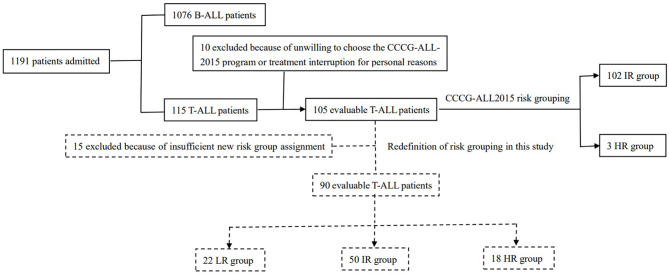
We analyzed the outcomes for 105 consecutive patients treated using the Chinese Children's Cancer Group ALL-2015 (CCCG-ALL-2015) protocol registered with the Chinese Clinical Trial Registry (ChiCTR-IPR-14005706) between 2015 and 2020 in our center. Nine out of 21 clinical and biological indicators were selected for the new scoring system based on the analysis in this study.
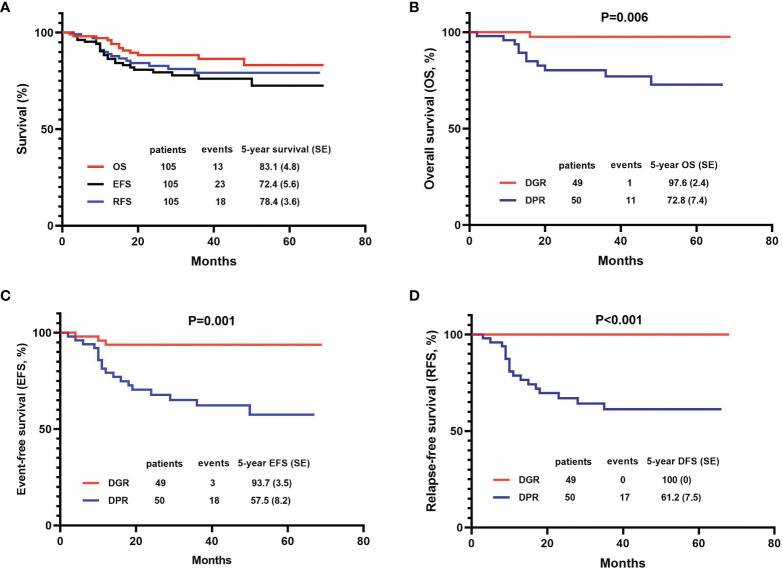
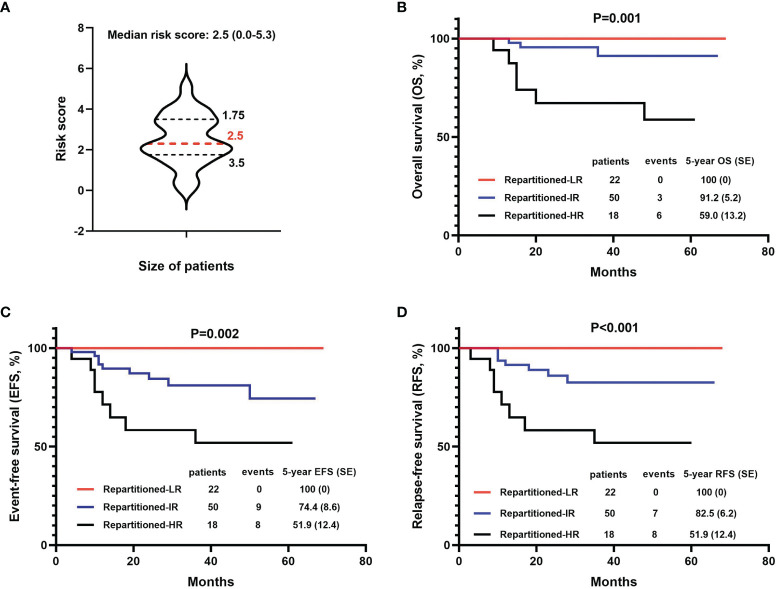
The 5-year overall survival (OS), event-free survival (EFS), and disease-free survival (DFS) rates for the 105 patients were 83.1 ± 4.8%, 72.4 ± 5.6%, and 78.4 ± 3.6%, respectively. Based on the new scoring system, 90 evaluable children were regrouped into low-risk (n=22), intermediate-risk (n=50), and high-risk (n=18) groups. The 5-year survival (OS, EFS, and RFS) rates for all patients in the low-risk group were 100%, significantly higher than the rates for those in the intermediate-risk group (91.2 ± 5.2%, 74.4 ± 8.6%, and 82.5 ± 6.2%, respectively) and high-risk group (59.0 ± 13.2%, 51.9 ± 12.4%, and 51.9 ± 12.4%, respectively) (all P values < 0.01).
The CCCG-ALL-2015 program significantly improved the treatment outcomes for childhood T-ALL as compared with the CCCG-ALL-2008 protocol. Our new refined risk grouping system showed better stratification among pediatric T-ALL patients and better potential in evaluating therapeutic efficacy.
T 细胞急性淋巴细胞白血病(T-ALL)是一种预后较差的罕见血液系统恶性肿瘤。本研究旨在确定儿童 T-ALL 的精确风险分组。
我们分析了 2015 年至 2020 年期间在本中心按照中国儿童癌症协作组 ALL-2015(CCCG-ALL-2015)方案治疗的 105 例连续患者的结局,该方案已在中国临床试验注册中心(ChiCTR-IPR-14005706)注册。基于本研究中的分析,从 21 项临床和生物学指标中选择了 9 项用于新的评分系统。
105 例患者的 5 年总生存率(OS)、无事件生存率(EFS)和无病生存率(DFS)分别为 83.1±4.8%、72.4±5.6%和 78.4±3.6%。根据新的评分系统,90 例可评估的儿童被重新分组为低风险组(n = 22)、中风险组(n = 50)和高风险组(n = 18)。低风险组所有患者的 5 年生存率(OS、EFS 和 RFS)均为 100%,显著高于中风险组(分别为 91.2±5.2%、74.4±8.6%和 82.5±6.2%)和高风险组(分别为 59.0±13.2%、51.9±12.4%和 51.9±12.4%)(所有 P 值<0.01)。
与 CCCG-ALL-2008 方案相比,CCCG-ALL-2015 方案显著改善了儿童 T-ALL 的治疗结局。我们新的精细风险分组系统在小儿 T-ALL 患者中显示出更好的分层,在评估治疗效果方面具有更好的潜力。