Li Zhiheng, Chu Xinran, Gao Li, Ling Jing, Xiao Peifang, Lu Jun, Wang Yi, He Hailong, Li Jianqin, Hu Yixin, Li Jie, Pan Jian, Xiao Sheng, Hu Shaoyan
Institute of Pediatric Research, Children's Hospital of Soochow University, Suzhou, China.
Department of Pathology, Brigham and Women's Hospital, Harvard Medical School, Boston, MA, United States.
Front Oncol. 2021 Mar 16;11:614420. doi: 10.3389/fonc.2021.614420. eCollection 2021.
Aberrant expression of CD123 (IL-3Rα) was observed in various hematological malignancies including acute lymphoblastic leukemia (ALL), which is the most common malignancy in childhood. Although widely used for minimal residual disease (MRD) monitoring, the prognostic value of CD123 has not been fully characterized in pediatric B-ALL. This retrospective study aims to evaluate the association between the CD123 expression of leukemic blasts and the outcomes of the pediatric B-ALL patients.
A total of 976 pediatric B-ALL, including 328 treated with CCLG-ALL-2008 protocol and 648 treated with CCCG-ALL-2015 protocol, were recruited in this retrospective study. CD123 expression was evaluated by flow cytometry. Patients with >50, 20-50, or <20% of CD123 expressing blasts were grouped into CD123, CD123, and CD123, respectively. The correlation between CD123 expression and the patients' clinical characteristics, overall survival (OS), event-free survival (EFS), and relapse-free survival (RFS) were studied statistically.
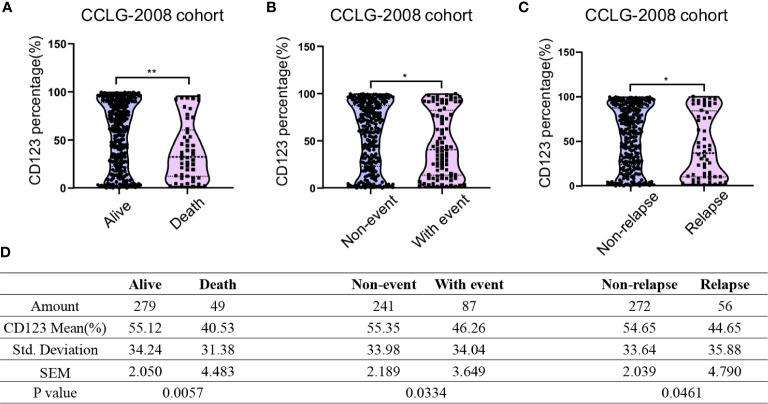
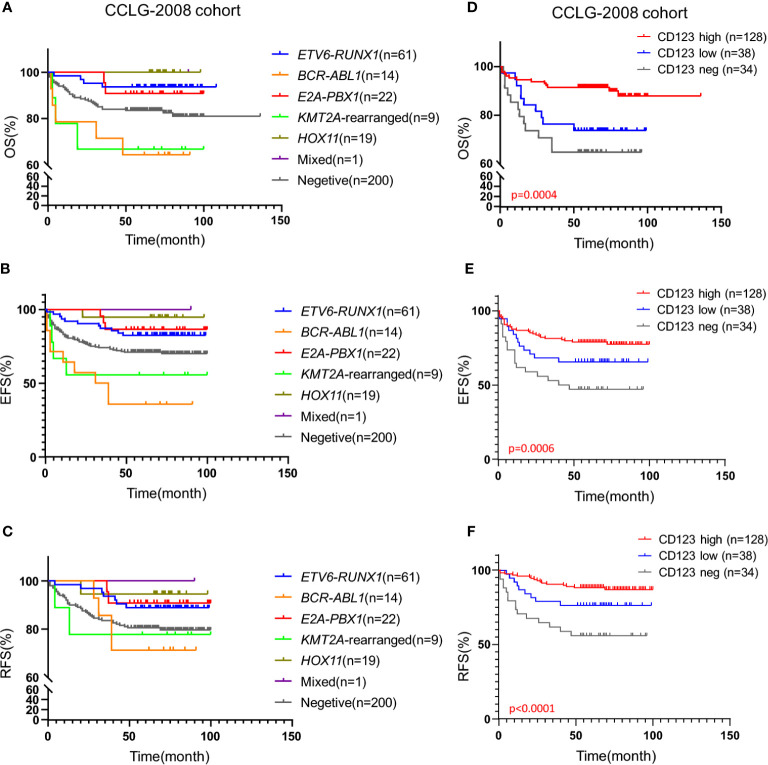
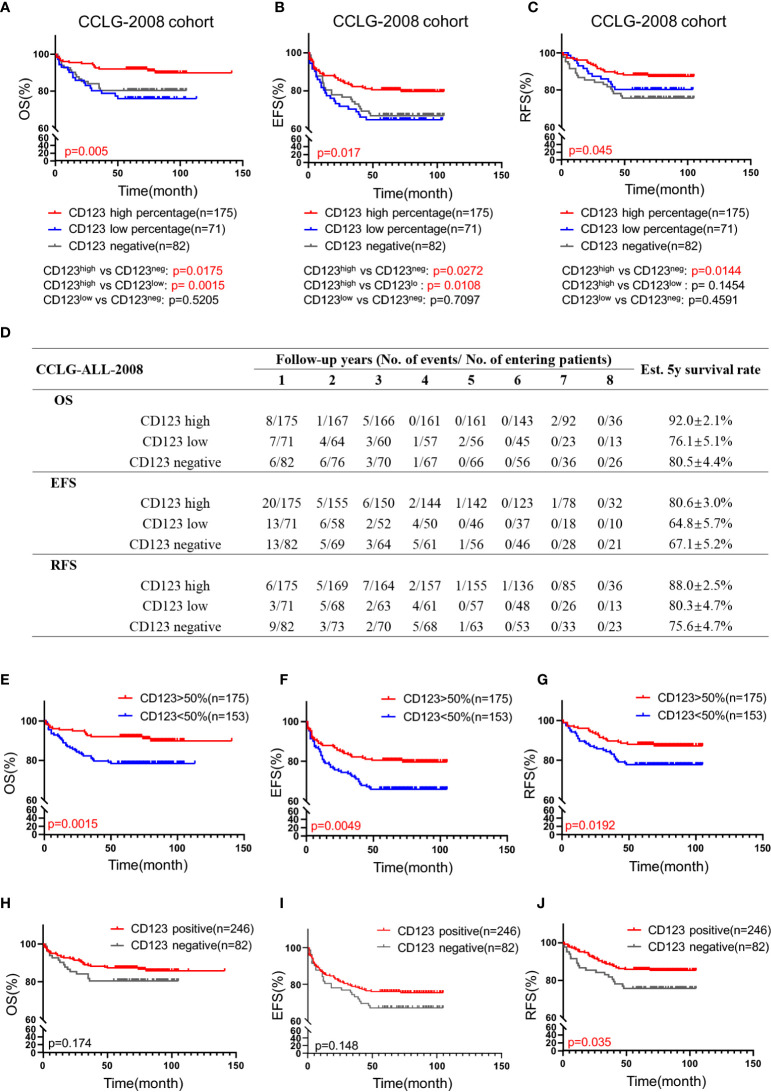
Of 976 pediatric B-ALL, 53.4% from the CCLG-ALL-2008 cohort and 49.2% from the CCCG-ALL-2015 cohort were CD123. In the CCLG-ALL-2008 cohort, CD123 was significantly associated with chromosome hyperdiploidy (p < 0.0001), risk stratification (p = 0.004), and high survival rate (p = 0.005). By comparing clinical outcomes, patients with CD123 displayed favorable prognosis, with a significantly better OS (p = 0.005), EFS (p = 0.017), and RFS (p = 0.045), as compared to patients with CD123 and CD123. The prognostic value of CD123 expression was subsequently confirmed in the CCCG-ALL-2015 cohort. Univariate and multivariate cox regression model analysis showed that high CD123 expression was independently associated with favorable EFS (OR: 0.528; 95% CI: 0.327 to 0.853; p = 0.009) in this cohort. In patients without prognosis-defining genomic abnormalities, high CD123 expression strongly indicated superior survival rates and was identified as an independent prognosis factor for EFS and RFS in both cohorts.
A group of B-ALL lacks prognosis-defining genomic aberrations, which proposes a challenge in risk stratification. Our findings revealed that high CD123 expression of leukemic blasts was associated with favorable clinical outcomes in pediatric B-ALL and CD123 could serve as a promising prognosis predictor, especially in patients without prognosis-defining genetic aberrations.
在包括急性淋巴细胞白血病(ALL)在内的多种血液系统恶性肿瘤中均观察到CD123(白细胞介素-3受体α)的异常表达,ALL是儿童期最常见的恶性肿瘤。尽管CD123广泛用于微小残留病(MRD)监测,但其在儿童B-ALL中的预后价值尚未完全明确。本回顾性研究旨在评估白血病原始细胞的CD123表达与儿童B-ALL患者预后之间的关联。
本回顾性研究共纳入976例儿童B-ALL患者,其中328例接受CCLG-ALL-2008方案治疗,648例接受CCCG-ALL-2015方案治疗。通过流式细胞术评估CD123表达。CD123表达原始细胞>50%、20%-50%或<20%的患者分别分为CD123高表达组、CD123中表达组和CD123低表达组。对CD123表达与患者临床特征、总生存期(OS)、无事件生存期(EFS)和无复发生存期(RFS)之间的相关性进行统计学研究。
在976例儿童B-ALL中,CCLG-ALL-2008队列中有53.4%的患者为CD123高表达,CCCG-ALL-2015队列中有49.2%的患者为CD123高表达。在CCLG-ALL-2008队列中,CD123高表达与染色体超二倍体(p<0.0001)、危险分层(p=0.004)及高生存率(p=0.005)显著相关。通过比较临床结局,与CD123中表达组和CD123低表达组患者相比,CD123高表达组患者预后良好,OS(p=0.005)、EFS(p=0.017)和RFS(p=0.045)均显著更好。随后在CCCG-ALL-2015队列中证实了CD123表达的预后价值。单因素和多因素cox回归模型分析显示,在该队列中,CD123高表达与良好的EFS独立相关(OR:0.528;95%CI:0.327至0.853;p=0.009)。在无预后定义基因组异常的患者中,CD123高表达强烈提示生存率更高,并且在两个队列中均被确定为EFS和RFS的独立预后因素。
一组B-ALL缺乏预后定义的基因组畸变,这给风险分层带来了挑战。我们的研究结果表明,白血病原始细胞CD123高表达与儿童B-ALL的良好临床结局相关,CD123可作为一个有前景的预后预测指标,尤其是在无预后定义遗传畸变的患者中。