Aziz Mohammad Hosein, van Dongen Jelle C, Saida Lawlaw, Suker Mustafa, van Vugt Jeroen L A, van Putten Yordi, Sideras Kostandinos, Groen Jesse V, Mieog J Sven D, Lucassen Claudia J, Droop Anneke, Mauff Katya, Shahbazi Feshtali Shirin, Groot Koerkamp Bas, Mustafa Dana A M, van Eijck Casper J
Department of Surgery, Erasmus University Medical Center, Rotterdam, Netherlands.
Department of Pathology, The Tumor Immuno-Pathology Laboratory, Erasmus, University Medical Center, Rotterdam, Netherlands.
Front Oncol. 2022 Feb 28;12:827755. doi: 10.3389/fonc.2022.827755. eCollection 2022.
Failing immune surveillance in pancreatic ductal adenocarcinoma (PDAC) is related to poor prognosis. PDAC is also characterized by its substantial alterations to patients' body composition. Therefore, we investigated associations between the host systemic immune inflammation response and body composition in patients with resected PDAC.
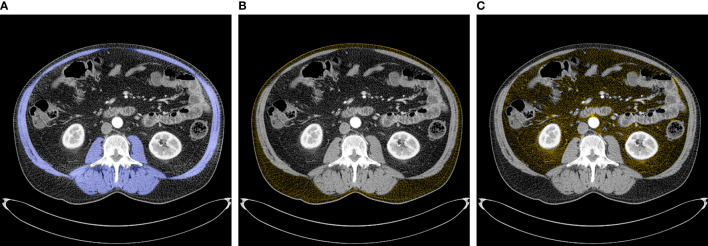
Patients who underwent a pancreatectomy for PDAC between 2004 and 2016 in two tertiary referral centers were included. Skeletal muscle mass quantity and muscle attenuation, as well as subcutaneous and visceral adipose tissue at the time of diagnosis, were determined by CT imaging measured transversely at the third lumbar vertebra level. Baseline clinicopathological characteristics, laboratory values including the systemic immune inflammation index (SIII), postoperative, and survival outcomes were collected.
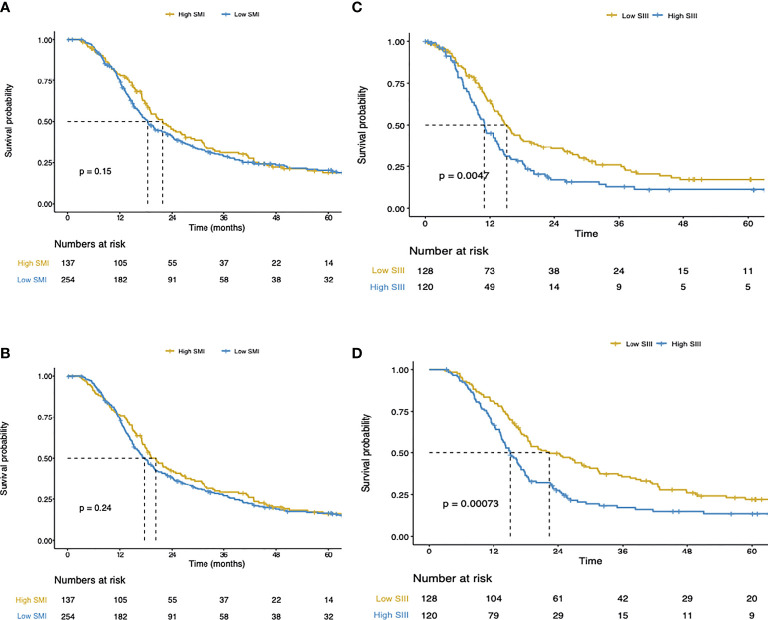
A total of 415 patients were included, and low skeletal muscle mass quantity was found in 273 (65.7%) patients. Of the body composition indices, only low skeletal muscle mass quantity was independently associated with a high (≥900) SIII (OR 7.37, 95% CI 2.31-23.5, p=0.001). The SIII was independently associated with disease-free survival (HR 1.86, 95% CI 1.12-3.04), and cancer-specific survival (HR 2.21, 95% CI 1.33-3.67). None of the body composition indices were associated with survival outcomes.
This study showed a strong association between preoperative low skeletal muscle mass quantity and elevated host systemic immune inflammation in patients with resected PDAC. Understanding how systemic inflammation may contribute to changes in body composition or whether reversing these changes may affect the host systemic immune inflammation response could expose new therapeutic possibilities for improving patients' survival outcomes.
胰腺导管腺癌(PDAC)中免疫监视功能失效与预后不良相关。PDAC的另一个特征是患者身体成分发生显著改变。因此,我们研究了接受手术切除的PDAC患者的宿主全身免疫炎症反应与身体成分之间的关联。
纳入2004年至2016年在两家三级转诊中心因PDAC接受胰腺切除术的患者。通过在第三腰椎水平横向测量的CT成像确定诊断时的骨骼肌质量和肌肉衰减,以及皮下和内脏脂肪组织。收集基线临床病理特征、包括全身免疫炎症指数(SIII)在内的实验室值、术后情况和生存结果。
共纳入415例患者,其中273例(65.7%)患者骨骼肌质量较低。在身体成分指标中,只有骨骼肌质量低与高(≥900)SIII独立相关(OR 7.37,95%CI 2.31 - 23.5,p = 0.001)。SIII与无病生存期(HR 1.86,95%CI 1.12 - 3.04)和癌症特异性生存期(HR 2.21,95%CI 1.33 - 3.67)独立相关。没有任何身体成分指标与生存结果相关。
本研究表明,接受手术切除的PDAC患者术前骨骼肌质量低与宿主全身免疫炎症升高之间存在密切关联。了解全身炎症如何导致身体成分变化,或者逆转这些变化是否会影响宿主全身免疫炎症反应,可能会为改善患者生存结果带来新的治疗可能性。