Gu Qianbiao, He Mengqing, He Yaqiong, Dai Anqi, Liu Jianbin, Chen Xiang, Liu Peng
Department of Radiology, Hunan Provincial People's Hospital, First Affiliated Hospital of Hunan Normal University, Changsha, 410005, China.
Discov Oncol. 2023 Feb 3;14(1):16. doi: 10.1007/s12672-023-00624-3.
To explored the value of CT-measured body composition radiomics in preoperative evaluation of lymph node metastasis (LNM) in localized pancreatic ductal adenocarcinoma (LPDAC).
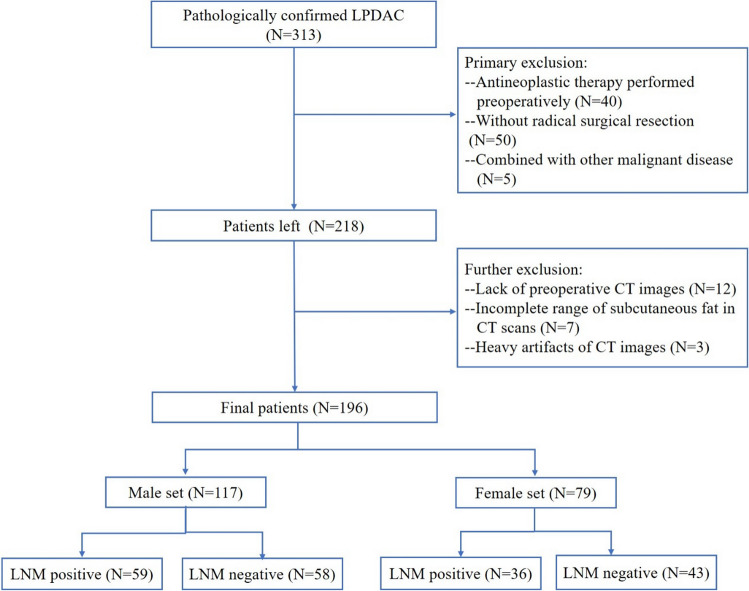
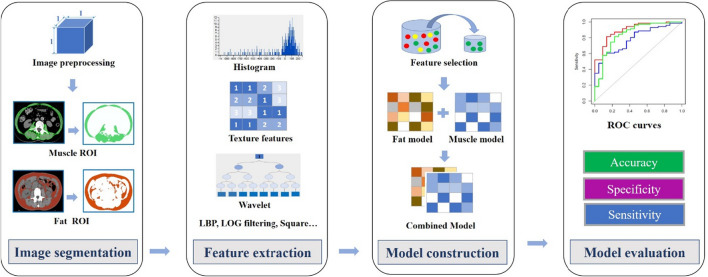
We retrospectively collected patients with LPDAC who underwent surgical resection from January 2016 to June 2022. According to whether there was LNM after operation, the patients were divided into LNM group and non-LNM group in both male and female patients. The patient's body composition was measured by CT images at the level of the L3 vertebral body before surgery, and the radiomics features of adipose tissue and muscle were extracted. Multivariate logistic regression (forward LR) analyses were used to determine the predictors of LNM from male and female patient, respectively. Sexual dimorphism prediction signature using adipose tissue radiomics features, muscle tissue radiomics features and combined signature of both were developed and compared. The model performance is evaluated on discrimination and validated through a leave-one-out cross-validation method.
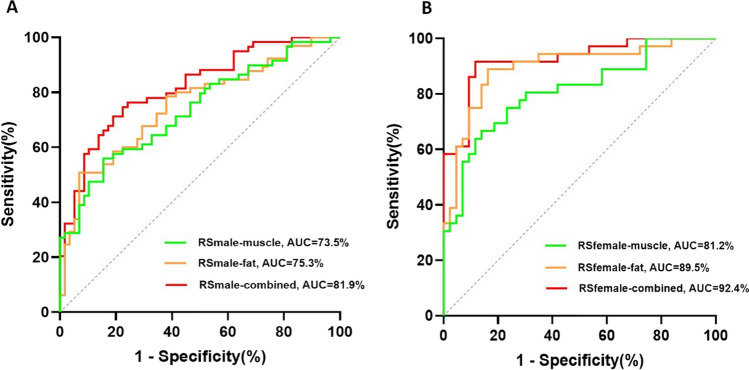
A total of 196 patients (mean age, 60 years ± 9 [SD]; 117 men) were enrolled, including 59 LNM in male and 36 LNM in female. Both male and female CT-measured body composition radiomics signatures have a certain predictive power on LNM of LPDAC. Among them, the female adipose tissue signature showed the highest performance (area under the ROC curve (AUC), 0.895), and leave one out cross validation (LOOCV) indicated that the signature could accurately classify 83.5% of cases; The prediction efficiency of the signature can be further improved after adding the muscle radiomics features (AUC, 0.924, and the accuracy of the LOOCV was 87.3%); The abilities of male adipose tissue and muscle tissue radiomics signatures in predicting LNM of LPDAC was similar, AUC was 0.735 and 0.773, respectively, and the accuracy of LOOCV was 62.4% and 68.4%, respectively.
CT-measured body composition Radiomics strategy showed good performance for predicting LNM in LPDAC, and has sexual dimorphism. It may provide a reference for individual treatment of LPDAC and related research about body composition in the future.
探讨CT测量的身体成分放射组学在局部胰腺导管腺癌(LPDAC)术前评估淋巴结转移(LNM)中的价值。
回顾性收集2016年1月至2022年6月接受手术切除的LPDAC患者。根据术后是否存在LNM,将男性和女性患者均分为LNM组和非LNM组。术前通过L3椎体水平的CT图像测量患者的身体成分,并提取脂肪组织和肌肉的放射组学特征。分别采用多因素逻辑回归(向前LR)分析确定男性和女性患者LNM的预测因素。利用脂肪组织放射组学特征、肌肉组织放射组学特征以及两者的联合特征建立并比较了性别差异预测模型。通过判别分析评估模型性能,并采用留一法交叉验证进行验证。
共纳入196例患者(平均年龄60岁±9[标准差];男性117例),其中男性LNM 59例,女性LNM 36例。男性和女性CT测量的身体成分放射组学特征对LPDAC的LNM均具有一定的预测能力。其中,女性脂肪组织特征表现最佳(ROC曲线下面积[AUC]为0.895),留一法交叉验证(LOOCV)表明该特征可准确分类83.5%的病例;添加肌肉放射组学特征后,该特征的预测效率可进一步提高(AUC为0.924,LOOCV准确率为87.3%);男性脂肪组织和肌肉组织放射组学特征预测LPDAC的LNM能力相似,AUC分别为0.735和0.773,LOOCV准确率分别为62.4%和68.4%。
CT测量的身体成分放射组学策略在预测LPDAC的LNM方面表现良好,且具有性别差异。它可能为LPDAC的个体化治疗及未来身体成分相关研究提供参考。