Department of Ecology, Environment and Plant Sciences, Stockholm University, 106 91, Stockholm, Sweden.
Bergius Foundation, The Royal Academy of Sciences, Box 50005, 104 05, Stockholm, Sweden.
BMC Ecol Evol. 2022 Mar 16;22(1):32. doi: 10.1186/s12862-022-01988-w.
Merlin's grass (Isoetes, Isoetaceae, Lycopsida), is the extant remnant of the isoetalean wood-producing lycopsids that originated during the Paleozoic, possibly in aquatic or boggy habitats. Modern day species are aquatic, semi-aquatic or terrestrial and occur almost worldwide. They display little morphological variation; the lobed corm has helically arranged leaves with internal air channels and basal sporangia. Genetic variation has also proven limited, which has hampered phylogenetic inference. We investigate evolutionary relationships in Isoetes, using molecular data and an extended sample of species compared to previous work, adding species that have never before been included in a phylogenetic study.
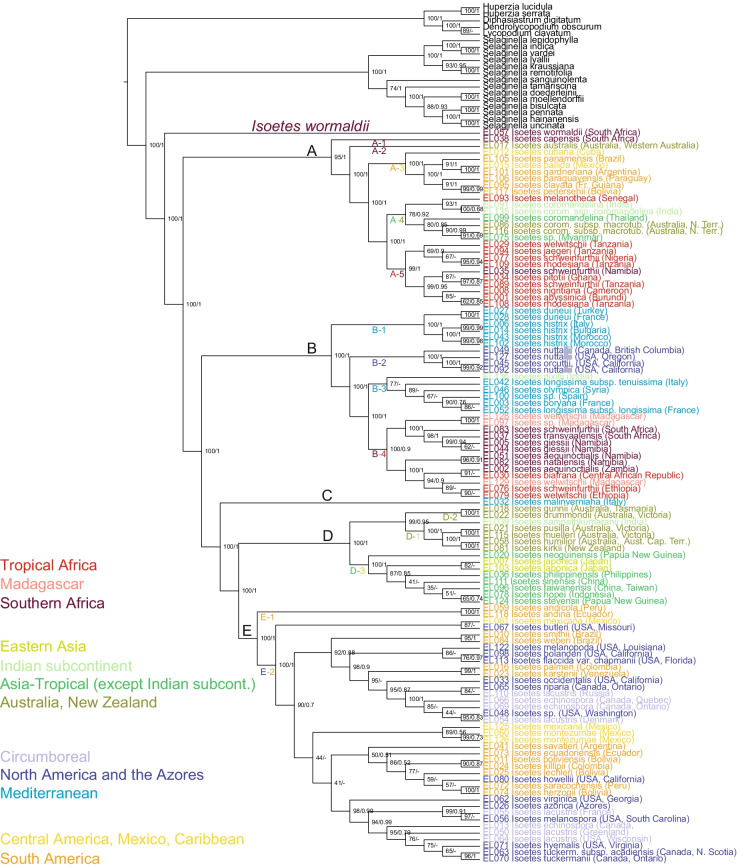
Our results reveal an unexpected discovery of an "Amborella syndrome" in Isoetaceae: a single poorly known species is sister to the remaining family. The species, Isoetes wormaldii, is a rare endemic to the Eastern Cape of South Africa. Its leaves are flattened with a rounded point, which sharply contrasts with the awl-shaped leaves of most other species of Isoetes. The remaining species of Isoetes are resolved in five major clades, also indicated in previous work. While the phylogeny shows geographic structure, the patterns are complex. For example, tropical-southern African species occur in at least five clades, and Indian, Australian and Mediterranean species in at least three clades each.
The evolutionary and biogeographical history of Isoetes is not easily explained, and may conceivably include ample extinction and a mixture of ancient and more recent processes. Previously shown difficulties with node age estimation increase the problem. The here demonstrated sister-relationship between the phylogenetically, morphologically and genetically distinct Isoetes wormaldii and the remaining family appears to bridge the morphological gap between Isoetes and its extinct relatives, although further studies are needed. Moreover, it shortens the branch length to its living sister genus Selaginella, and may enhance node age estimation in future studies. Isoetes wormaldii is critically endangered, known only from one (to a few) minor populations. Immediate actions need to be taken if we want to prevent this unique species from going extinct.
Merlin's grass(水韭,水韭科,木贼纲)是起源于古生代的产木石松类的现存遗迹,可能生活在水生或沼泽环境中。现代物种为水生、半水生或陆生,几乎遍布全球。它们形态变化很小;具叶的鳞茎有螺旋状排列的叶子,内有空气通道和基生孢子囊。遗传变异也证明是有限的,这阻碍了系统发育推断。我们使用分子数据和比以前工作扩展的物种样本研究了水韭属的进化关系,增加了以前从未包含在系统发育研究中的物种。
我们的研究结果揭示了水韭科一个出人意料的“Amborella 综合征”的发现:一个鲜为人知的单一物种是其余家族的姐妹群。该物种,Isoetes wormaldii,是南非东开普省的特有种。它的叶子是扁平的,有一个圆形的尖端,与大多数其他水韭属物种的锥形叶子形成鲜明对比。其余的水韭属物种分为五个主要分支,这一点在前人的工作中也得到了表明。尽管系统发育显示出地理结构,但模式是复杂的。例如,热带-南部非洲物种出现在至少五个分支中,而印度、澳大利亚和地中海物种分别出现在至少三个分支中。
水韭属的进化和生物地理历史不容易解释,可能包括大量的灭绝和古老的和更近的过程的混合。以前显示的节点年龄估计困难增加了这个问题。这里显示的形态、遗传上有明显差异的 Isoetes wormaldii 与其余家族的姐妹关系似乎弥合了水韭属与其已灭绝的近亲之间的形态差距,尽管还需要进一步的研究。此外,它缩短了与活的姊妹属 Selaginella 的分支长度,并可能增强未来研究中的节点年龄估计。Isoetes wormaldii 是极度濒危物种,仅在一个(少数)小种群中发现。如果我们想防止这个独特的物种灭绝,就需要立即采取行动。