Department of General and Biological Psychology, University of Wuppertal, Max-Horkheimer-Str. 20, 42119, Wuppertal, Germany.
Institute of Movement and Training Science, University of Leipzig, Leipzig, Germany.
Sci Rep. 2022 Mar 16;12(1):4496. doi: 10.1038/s41598-022-08480-x.
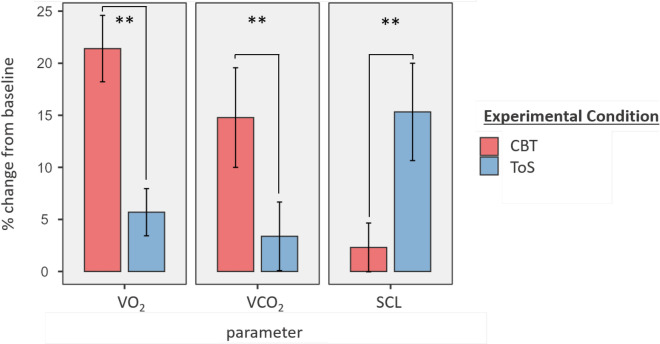
The objective distinction of different types of mental demands as well as their intensity is relevant for research and practical application but poses a challenge for established physiological methods. We investigated whether respiratory gases (oxygen uptake and carbon dioxide output) are suitable to distinguish between emotional stress and cognitive load. To this end, we compared the application of spirometry with an established procedure, namely electrodermal activity (EDA). Our results indicate that electrodermal activity shows a strong responsivity to emotional stress induction, which was highly correlated with its responsivity to cognitive load. Respiratory gases were both sensitive and specific to cognitive load and had the advantage of being predictive for cognitive performance as well as self-reported emotional state. These results support the notion that respiratory gases are a valuable complement to common physiological procedures in the detection and discrimination of different mental demands.
不同类型的心理需求及其强度的客观区分对于研究和实际应用具有重要意义,但这对已有的生理方法提出了挑战。我们研究了呼吸气体(氧气摄取和二氧化碳排出)是否适合区分情绪应激和认知负荷。为此,我们将肺活量测定法与一种已建立的程序,即皮肤电活动(EDA)进行了比较。结果表明,皮肤电活动对情绪应激诱导具有很强的反应性,与认知负荷的反应性高度相关。呼吸气体对认知负荷既敏感又特异,并且具有预测认知表现和自我报告情绪状态的优势。这些结果支持了这样一种观点,即呼吸气体是检测和区分不同心理需求的常用生理程序的有价值的补充。