Staudacher Heidi M, Yao Chu Kion, Chey William D, Whelan Kevin
Deakin University, IMPACT (Institute for Mental and Physical Health and Clinical Translation), Food & Mood Centre, Geelong, VIC, Australia.
Monash University and Alfred Health, Melbourne, Victoria, Australia.
Am J Gastroenterol. 2022 Jun 1;117(6):973-984. doi: 10.14309/ajg.0000000000001732. Epub 2022 Mar 16.
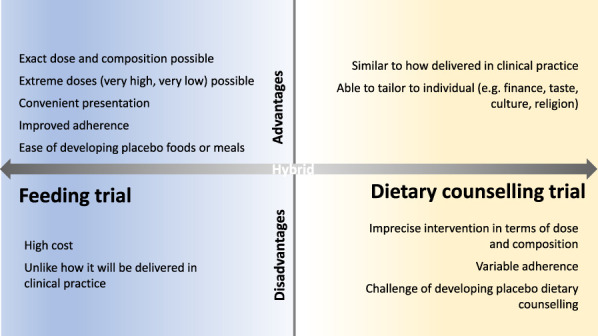
There is accumulating evidence for the fundamental role of diet in the integrated care of disorders of gut-brain interaction. Food is a complex mixture of components with individual, synergistic, and antagonistic effects, compared with the relative purity of a pharmaceutical. Food is also an inherent part of individuals' daily lives, and food choice is strongly tied to food preferences, personal beliefs, cultural and religious practices, and economic status, which can influence its ability to function as a therapeutic intervention. Hence, randomized controlled trials of dietary interventions carry unique methodological complexities that are not applicable to pharmaceutical trials that if disregarded can pose significant risk to trial quality. The challenges of designing and delivering the dietary intervention depend on the type of intervention (i.e., nutrient vs food supplementation or whole-diet intervention). Furthermore, there are multiple modes of delivery of dietary interventions, each with their own advantages (e.g., the high precision of feeding trials and the strong clinical applicability of dietary counseling trials). Randomized placebo-controlled trials of dietary interventions are possible with sufficient attention to their design and methodological nuances. Collaboration with experts in nutrition and dietetics is essential for the planning phase; however, even with expert input, not all challenges can be overcome. Researchers undertaking future dietary trials must be transparent in reporting these challenges and approaches for overcoming them. This review aims to provide guiding principles and recommendations for addressing these challenges to facilitate the conduct and reporting of high-quality trials that inform and improve clinical practice.
越来越多的证据表明,饮食在肠道-大脑相互作用紊乱的综合护理中起着根本性作用。与药物相对单一的成分相比,食物是一种由具有个体、协同和拮抗作用的成分组成的复杂混合物。食物也是个人日常生活中不可或缺的一部分,食物选择与食物偏好、个人信仰、文化和宗教习俗以及经济状况紧密相关,这些因素会影响食物作为一种治疗手段的作用效果。因此,饮食干预的随机对照试验具有独特的方法学复杂性,这些复杂性并不适用于药物试验,如果忽视这些复杂性,可能会对试验质量构成重大风险。设计和实施饮食干预的挑战取决于干预类型(即营养补充、食物补充或全饮食干预)。此外,饮食干预有多种实施方式,每种方式都有其自身的优势(例如,喂养试验的高精度和饮食咨询试验的强临床适用性)。只要充分关注设计和方法细节,饮食干预的随机安慰剂对照试验是可行的。在规划阶段,与营养和饮食学专家合作至关重要;然而,即使有专家的意见,也并非所有挑战都能克服。未来进行饮食试验的研究人员在报告这些挑战及克服方法时必须保持透明。本综述旨在提供应对这些挑战的指导原则和建议,以促进高质量试验的开展和报告,为临床实践提供参考并加以改进。