Xie Ting, Guo Dan, Luo Jinmei, Guo Zijian, Zhang Sumei, Wang Anqi, Wang Xiaoxi, Wang Xiaona, Cao Wenhao, Su Linfan, Guo Junwei, Huang Rong, Xiao Yi
Department of Medical Research Center, Peking Union Medical College Hospital, Chinese Academy of Medical Sciences and Peking Union Medical College, Beijing, People's Republic of China.
Department of Pulmonary and Critical Care Medicine, Peking Union Medical College Hospital, Chinese Academy of Medical Sciences and Peking Union Medical College, Beijing, People's Republic of China.
Nat Sci Sleep. 2022 Mar 8;14:381-392. doi: 10.2147/NSS.S348580. eCollection 2022.
In this study, we aimed to investigate the precise relationship between hypoxia-inducible factor 1α (HIF1α), circadian clock genes, and OSA.
We recruited 21 patients with OSA and 22 age-matched controls who underwent polysomnography and had their peripheral blood collected on the evening before and the morning after sleep. OSA was defined as an apnea hypopnea index (AHI) ≥15 events/h. Patients in which T90 > 0 were defined as having nocturnal hypoxemia (NH) and were referred to as the NH group. The mRNA levels of and several clock genes (s, , and were determined by RT-qPCR. The percentage difference in gene expression levels when compared between the morning and evening was then determined as referred to as morning-evening variation (MEV).
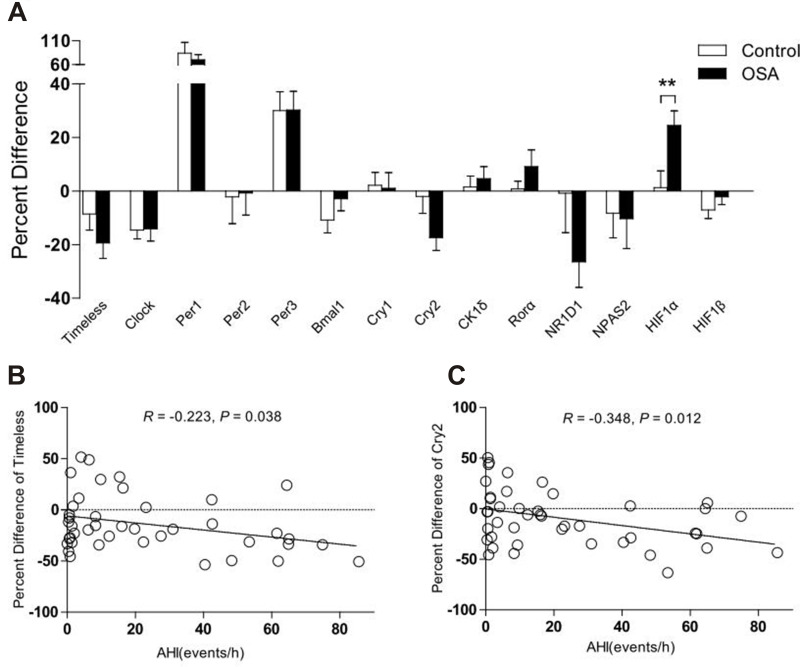
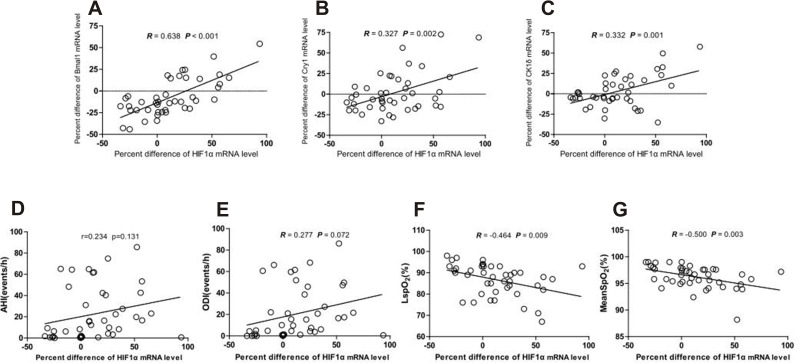
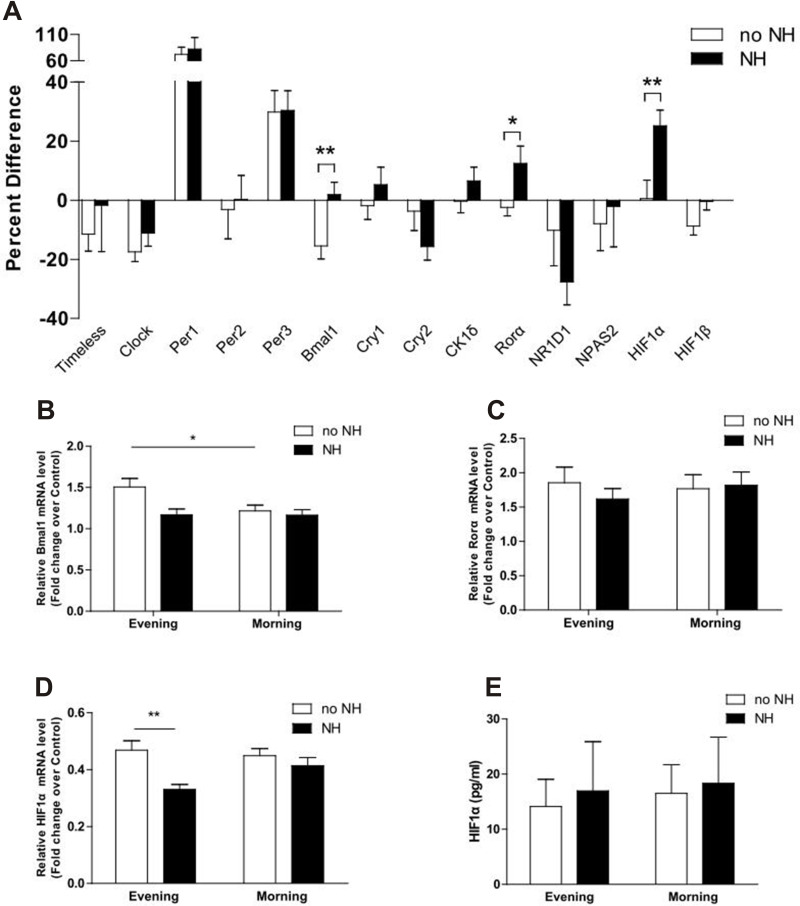
The MEV for mRNA expression in OSA patients increased significantly by 23% ( = 0.008) when compared to patients without OSA. The gene expression levels of ( = 0.038) and ( = 0.012) decreased with AHI. The MEV of , and mRNA levels were upregulated by 16% ( = 0.006), 14% ( = 0.027), and 25% ( = 0.005), respectively, in participants with NH when compared to those without NH. Furthermore, the MEV for mRNA levels was positively correlated with the MEV of , and mRNA levels ( = 0.638, < 0.001; = 0.327, = 0.002; = 0.332, = 0.001, respectively) and negatively correlated with LSpO ( = -0.464, =0.009) and Mean SpO ( = -0.500, = 0.003).
Our data suggest that patients with OSA or NH tend to develop circadian rhythm disorders that may be induced by the hypoxia-mediated augmentation of gene expression in OSA.
在本研究中,我们旨在探究缺氧诱导因子1α(HIF1α)、生物钟基因与阻塞性睡眠呼吸暂停(OSA)之间的确切关系。
我们招募了21例OSA患者和22例年龄匹配的对照者,这些人接受了多导睡眠图检查,并在睡眠前一晚和睡眠后早晨采集了外周血。OSA定义为呼吸暂停低通气指数(AHI)≥15次/小时。T90>0的患者被定义为患有夜间低氧血症(NH),并被归为NH组。通过逆转录定量聚合酶链反应(RT-qPCR)测定HIF1α以及几个生物钟基因(时钟蛋白s、时钟蛋白、周期蛋白)的mRNA水平。然后将早晨和晚上相比时基因表达水平的百分比差异确定为早晚变化(MEV)。
与无OSA的患者相比,OSA患者中HIF1α mRNA表达的MEV显著增加了23%(P = 0.008)。时钟蛋白和周期蛋白的基因表达水平随AHI降低(P = 0.038和P = 0.012)。与无NH的参与者相比,有NH的参与者中时钟蛋白s、时钟蛋白和周期蛋白mRNA水平的MEV分别上调了16%(P = 0.006)、14%(P = 0.027)和25%(P = 0.005)。此外,HIF1α mRNA水平的MEV与时钟蛋白s、时钟蛋白和周期蛋白mRNA水平的MEV呈正相关(分别为r = 0.638,P < 0.001;r = 0.327,P = 0.002;r = 0.332,P = 0.001),与最低血氧饱和度(LSpO)(r = -0.464,P = 0.009)和平均血氧饱和度(Mean SpO)(r = -0.500,P = 0.003)呈负相关。
我们的数据表明,OSA或NH患者倾向于出现昼夜节律紊乱,这可能是由OSA中缺氧介导的HIF1α基因表达增强所诱导的。