Smith Kirsten E, Rogers Jeffrey M, Dunn Kelly E, Grundmann Oliver, McCurdy Christopher R, Schriefer Destiny, Epstein David H
Real-World Assessment, Prediction, and Treatment Unit, National Institute on Drug Abuse Intramural Research Program, Baltimore, MD, United States.
Department of Psychiatry and Behavioral Sciences, Johns Hopkins University School of Medicine, Baltimore, MD, United States.
Front Pharmacol. 2022 Mar 1;13:765917. doi: 10.3389/fphar.2022.765917. eCollection 2022.
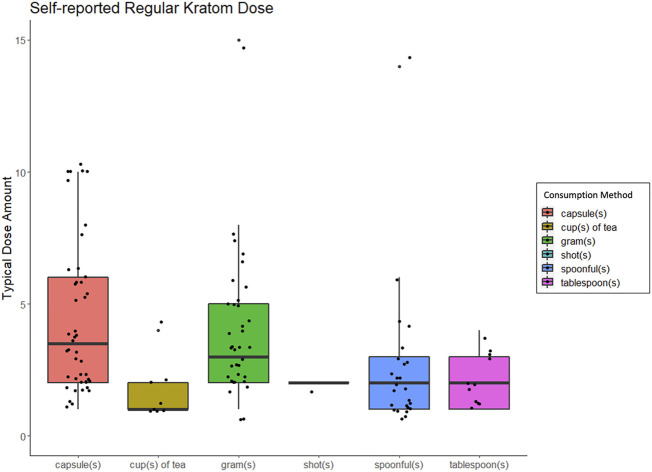
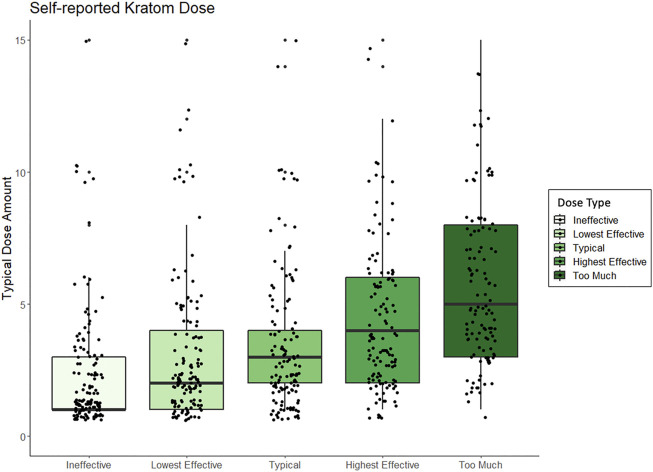
There is limited understanding regarding kratom use among US adults. Although motivations for use are increasingly understood, typical kratom doses, threshold of (low and high) doses for perceived effectiveness, and effects produced during cessation are not well documented. We aimed to extend prior survey work by recruiting adults with current and past kratom exposure. Our goal was to better understand kratom dosing, changes in routines, and perception of effects, including time to onset, duration, and variability of beneficial and adverse outcomes from use and cessation. Among respondents who reported experiencing acute kratom effects, we also sought to determine if effects were perceived as helpful or unhelpful in meeting daily obligations. Finally, we attempted to detect any signal of a relationship between the amount of kratom consumed weekly and weeks of regular use with ratings of beneficial effects from use and ratings of adverse effects from cessation. We conducted an online survey between April-May 2021 by re-recruiting participants from a separate study who reported lifetime kratom use. A total of 129 evaluable surveys were collected. Most (59.7%) had used kratom >100 times and reported currently or having previously used kratom >4 times per week (62 weeks on average). Under half (41.9%) reported that they considered themselves to be a current "regular kratom user." A majority (79.8%) reported experiencing acute effects from their typical kratom dose and that onset of effects began in minutes but dissipated within hours. Over a quarter reported that they had increased their kratom dose since use initiation, whereas 18.6% had decreased. Greater severity of unwanted effects from ≥1 day of kratom cessation was predicted by more weeks of regular kratom use ( 6.74, = 0.02). Acute kratom effects were largely reported as compatible with, and sometimes helpful in, meeting daily obligations. In the absence of human laboratory studies, survey methods must be refined to more precisely assess dose-effect relationships. These can help inform the development of controlled observational and experimental studies needed to advance the public health understanding of kratom product use.
美国成年人对 kratom 使用的了解有限。尽管使用动机越来越为人所知,但典型的 kratom 剂量、(低剂量和高剂量)产生有效感的阈值以及戒断期间产生的影响尚无充分记录。我们旨在通过招募目前和过去接触过 kratom 的成年人来扩展先前的调查工作。我们的目标是更好地了解 kratom 的剂量、日常习惯的变化以及对效果的感知,包括起效时间、持续时间以及使用和戒断产生的有益和不良结果的变异性。在报告经历过 kratom 急性效应的受访者中,我们还试图确定这些效应在履行日常义务方面是被视为有帮助还是无帮助。最后,我们试图检测每周摄入的 kratom 量和定期使用的周数与使用产生的有益效果评分以及戒断产生的不良效果评分之间是否存在任何关联信号。我们在 2021 年 4 月至 5 月期间通过重新招募来自另一项研究且报告有终身 kratom 使用史的参与者进行了一项在线调查。共收集到 129 份可评估的调查问卷。大多数(59.7%)使用 kratom 的次数超过 100 次,且报告目前或以前每周使用 kratom 超过 4 次(平均 62 周)。不到一半(41.9%)的人报告称他们认为自己是当前的“常规 kratom 用户”。大多数(79.8%)报告称他们从典型的 kratom 剂量中体验到急性效应,且效应在数分钟内开始,但在数小时内消散。超过四分之一的人报告称自开始使用以来他们增加了 kratom 剂量,而 18.6% 的人减少了剂量。定期使用 kratom 的周数越多,预测 kratom 戒断≥1 天产生的不良效应的严重程度越高(β = 6.74,P = 0.02)。大多数人报告称 kratom 的急性效应在很大程度上与履行日常义务相符,有时还有帮助。在缺乏人体实验室研究的情况下,必须改进调查方法以更精确地评估剂量 - 效应关系。这些有助于为开展必要的对照观察性和实验性研究提供信息,以增进公众对 kratom 产品使用的健康理解。