Department of Pediatric Surgery, Children's Hospital of Soochow University, Pediatric Research Institute of Soochow University, Suzhou, Jiangsu 215123, P.R. China.
Department of Pediatric Surgery, Affiliated Hospital of Zunyi Medical University, Zunyi, Guizhou 563000, P.R. China.
Mol Med Rep. 2022 May;25(5). doi: 10.3892/mmr.2022.12684. Epub 2022 Mar 18.
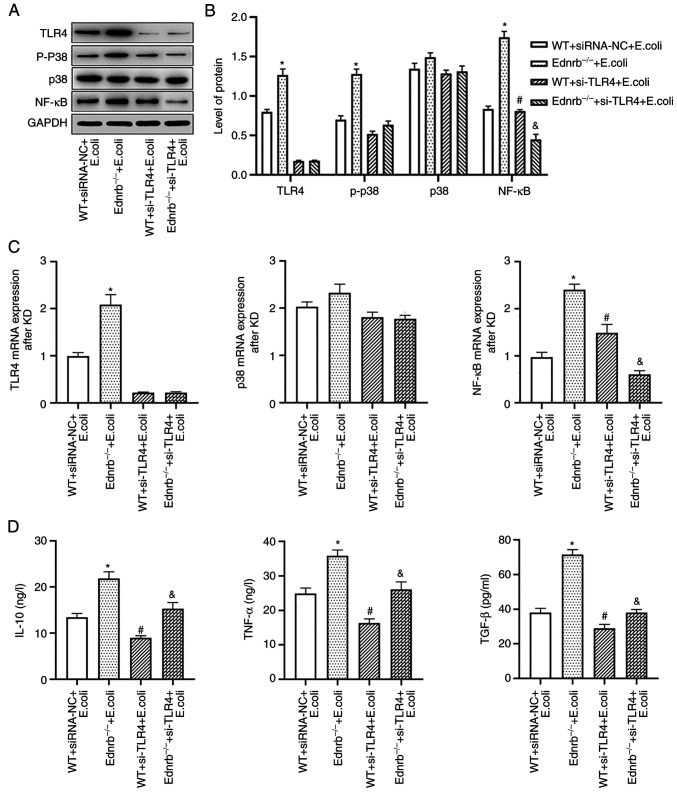
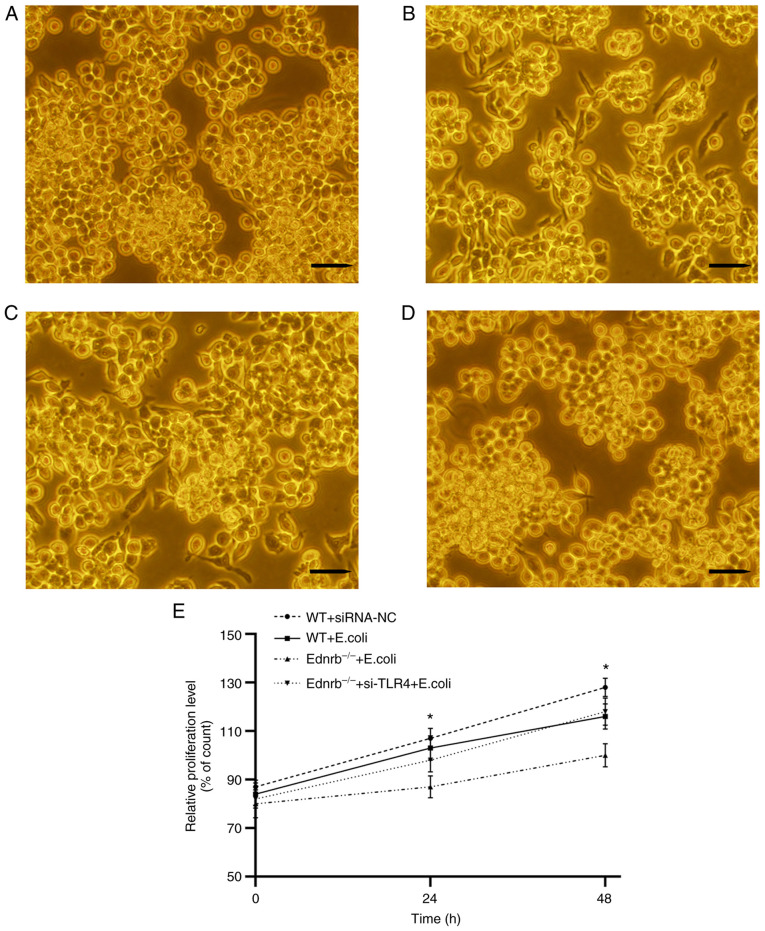
Hirschsprung‑associated enterocolitis (HAEC) is characterized by intestinal mucosal damage and an imbalance in the intestinal microbiota. Recent studies have indicated that the TLR4/p‑p38/NF‑κB signaling pathway in the intestine is of great importance to intestinal mucosal integrity. The present study aimed to investigate the role of TLR4/phosphorylated (p‑)38/NF‑κB signaling in the pathogenesis of HAEC in JM83‑infected endothelin receptor B (Ednrb) mice. Ednrb mice were infected with JM83 by oral gavage to establish the HAEC model. Wild‑type and Ednrb mice were randomly divided into uninfected and E. coli groups. The role of TLR4/p‑p38/NF‑κB signaling was further evaluated by and analyses. The activation of the TLR4/p‑p38/NF‑κB signaling pathway induced by JM83 resulted in HAEC in Ednrb mice, which was evidenced by a significant increase in the expression of TNF‑α, TGF‑β and IL‑10, and a decreased density of F‑actin protein expression. TLR4 knockdown reduced the severity of enterocolitis and attenuated the expression of IL‑10, TNF‑α and TGF‑β, whilst increasing the density of F‑actin protein in Ednrb mice after infection. These results indicated that E. coli JM83 activates TLR4/p‑p38/NF‑κB signaling in Ednrb to promote the development of HAEC. Thus, inhibition of this signaling pathway may benefit the treatment and prevention of HAEC.
先天性巨结肠相关性肠炎(HAEC)的特征为肠道黏膜损伤和肠道微生物群落失衡。最近的研究表明,肠道中的 TLR4/磷酸化(p)38/NF-κB 信号通路对于肠道黏膜完整性非常重要。本研究旨在探讨 TLR4/磷酸化 p38/NF-κB 信号通路在 JM83 感染内皮素受体 B(Ednrb)小鼠中 HAEC 发病机制中的作用。通过口服灌胃 JM83 感染 Ednrb 小鼠以建立 HAEC 模型。野生型和 Ednrb 小鼠被随机分为未感染和大肠杆菌组。通过 Western blot 分析进一步评估 TLR4/p-p38/NF-κB 信号的作用。JM83 诱导的 TLR4/p-p38/NF-κB 信号通路的激活导致 Ednrb 小鼠发生 HAEC,这表现在 TNF-α、TGF-β 和 IL-10 的表达显著增加,以及 F-actin 蛋白表达密度降低。TLR4 敲低减少了结肠炎的严重程度,并减弱了 Ednrb 小鼠感染后 IL-10、TNF-α 和 TGF-β 的表达,同时增加了 F-actin 蛋白的密度。这些结果表明,大肠杆菌 JM83 激活 Ednrb 中的 TLR4/p-p38/NF-κB 信号以促进 HAEC 的发展。因此,抑制该信号通路可能有益于 HAEC 的治疗和预防。