Department of Healthcare Epidemiology, Graduate School of Medicine and Public Health, Kyoto University, Kyoto, Japan.
Department of Human Health Sciences, Graduate School of Medicine, Kyoto University, Kyoto, Japan.
JAMA Netw Open. 2022 Mar 1;5(3):e222973. doi: 10.1001/jamanetworkopen.2022.2973.
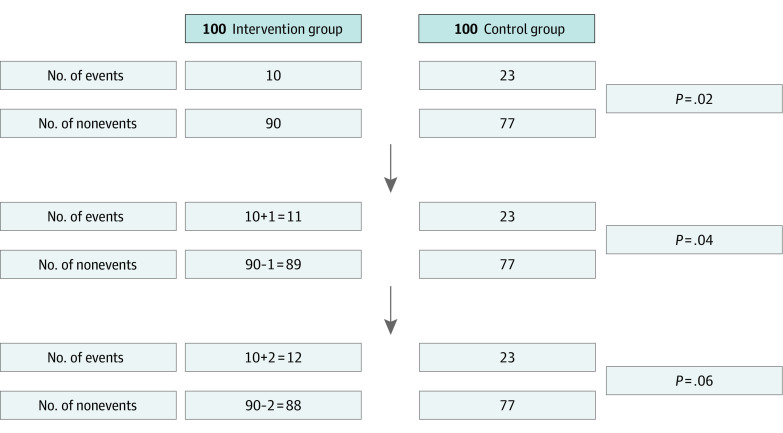
Interpreting results from randomized clinical trials (RCTs) for COVID-19, which have been published rapidly and in vast numbers, is challenging during a pandemic.
To evaluate the robustness of statistically significant findings from RCTs for COVID-19 using the fragility index.
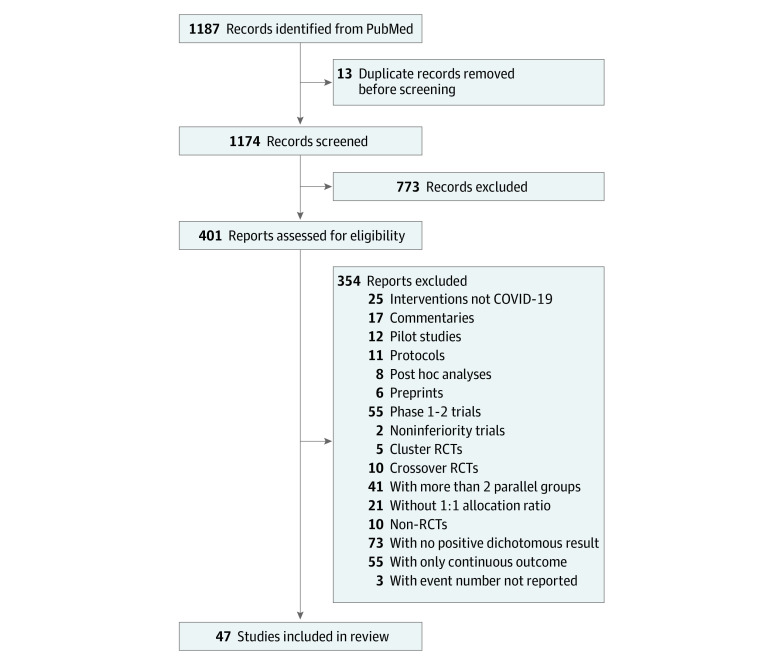
DESIGN, SETTING, AND PARTICIPANTS: This cross-sectional study included COVID-19 trial articles that randomly assigned patients 1:1 into 2 parallel groups and reported at least 1 binary outcome as significant in the abstract. A systematic search was conducted using PubMed to identify RCTs on COVID-19 published until August 7, 2021.
Trial characteristics, such as type of intervention (treatment drug, vaccine, or others), number of outcome events, and sample size.
Fragility index.
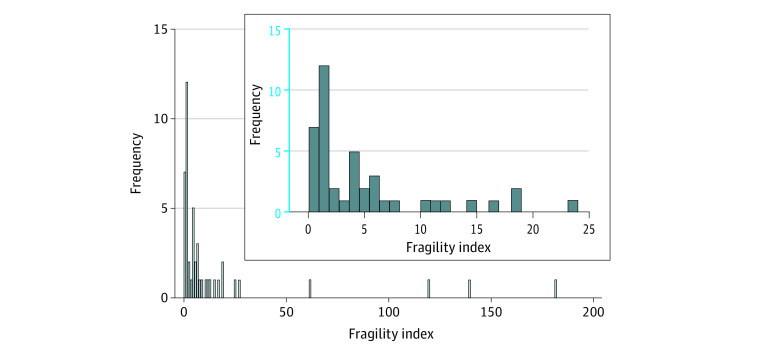
Of the 47 RCTs for COVID-19 included, 36 (77%) were studies of the effects of treatment drugs, 5 (11%) were studies of vaccines, and 6 (13%) were of other interventions. A total of 138 235 participants were included in these trials. The median (IQR) fragility index of the included trials was 4 (1-11). The medians (IQRs) of the fragility indexes of RCTs of treatment drugs, vaccines, and other interventions were 2.5 (1-6), 119 (61-139), and 4.5 (1-18), respectively. The fragility index among more than half of the studies was less than 1% of each sample size, although the fragility index as a proportion of events needing to change would be much higher.
This cross-sectional study found a relatively small number of events (a median of 4) would be required to change the results of COVID-19 RCTs from statistically significant to not significant. These findings suggest that health care professionals and policy makers should not rely heavily on individual results of RCTs for COVID-19.
在大流行期间,解释大量快速发表的 COVID-19 随机临床试验 (RCT) 的结果具有挑战性。
使用脆弱指数评估 COVID-19 RCT 中具有统计学意义的发现的稳健性。
设计、设置和参与者:这项横断面研究包括将患者以 1:1 的比例随机分配到 2 个平行组的 COVID-19 试验文章,并在摘要中报告至少有 1 个二分类结局有统计学意义。使用 PubMed 进行系统搜索,以确定截至 2021 年 8 月 7 日发表的 COVID-19 RCT。
试验特征,如干预类型(治疗药物、疫苗或其他)、结局事件数量和样本量。
脆弱指数。
在纳入的 47 项 COVID-19 RCT 中,36 项(77%)为治疗药物效果研究,5 项(11%)为疫苗研究,6 项(13%)为其他干预研究。这些试验共纳入 138235 名参与者。纳入试验的中位数(IQR)脆弱指数为 4(1-11)。治疗药物、疫苗和其他干预 RCT 的脆弱指数中位数(IQR)分别为 2.5(1-6)、119(61-139)和 4.5(1-18)。虽然脆弱指数作为需要改变的事件比例会高得多,但超过一半的研究的脆弱指数小于每个样本量的 1%。
这项横断面研究发现,需要较少的事件(中位数为 4)就可以将 COVID-19 RCT 的结果从统计学上显著变为不显著。这些发现表明,医疗保健专业人员和政策制定者不应过分依赖 COVID-19 RCT 的个别结果。