Department of Environmental Sciences, Zoological Institute, University of Basel, Basel, Switzerland.
Department of Zoology, Faculty of Science, Charles University, Prague, Czech Republic.
Mol Ecol. 2022 May;31(10):2882-2897. doi: 10.1111/mec.16429. Epub 2022 Mar 30.
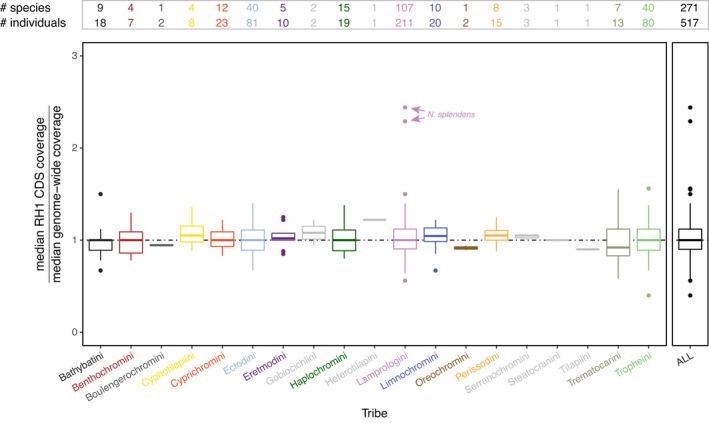
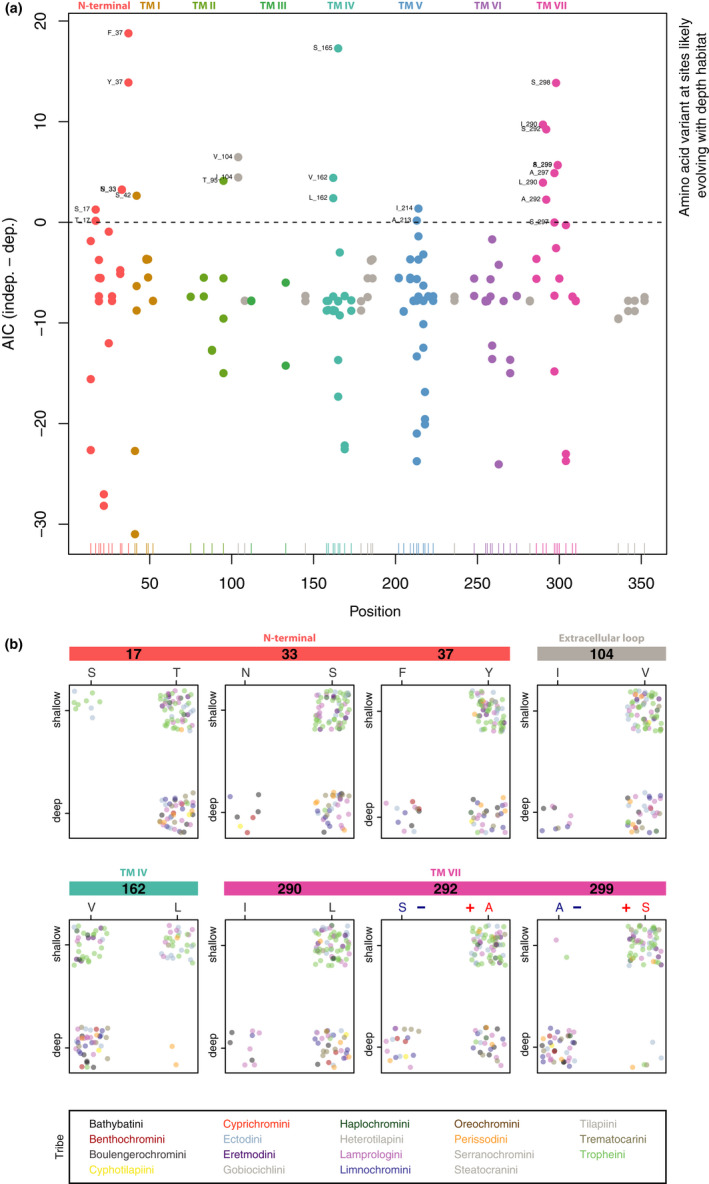
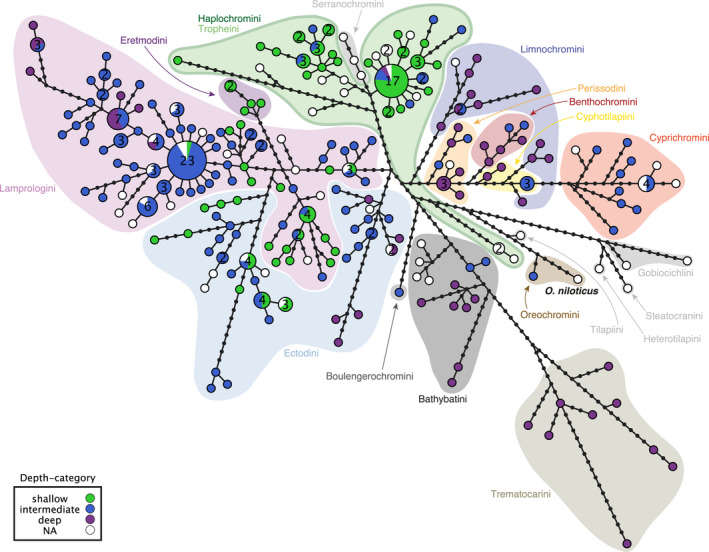
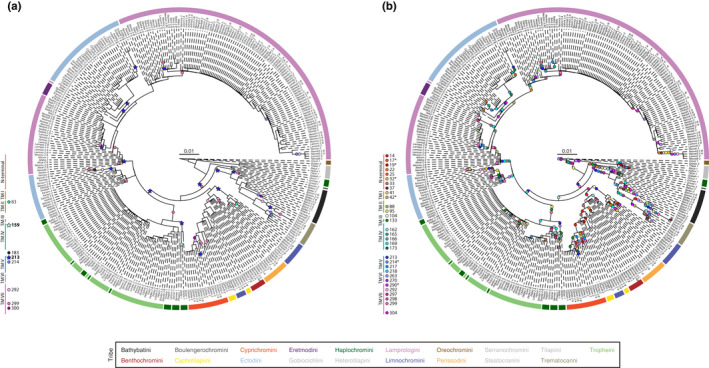
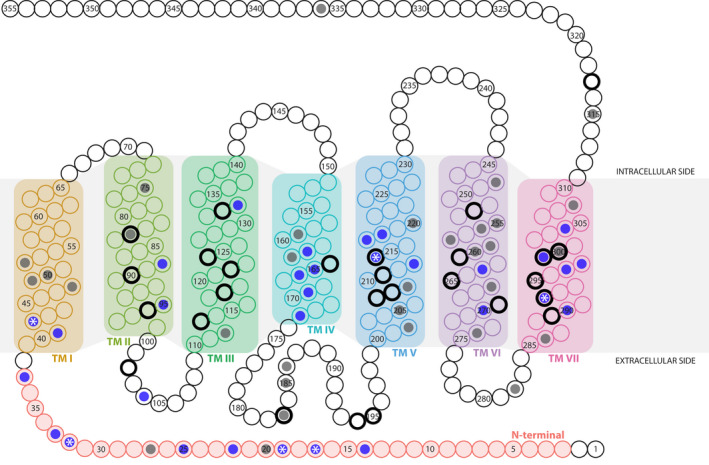
The visual sensory system is essential for animals to perceive their environment and is thus under strong selection. In aquatic environments, light intensity and spectrum differ primarily along a depth gradient. Rhodopsin (RH1) is the only opsin responsible for dim-light vision in vertebrates and has been shown to evolve in response to the respective light conditions, including along a water depth gradient in fishes. In this study, we examined the diversity and sequence evolution of RH1 in virtually the entire adaptive radiation of cichlid fishes in Lake Tanganyika, focusing on adaptations to the environmental light with respect to depth. We show that Tanganyikan cichlid genomes contain a single copy of RH1. The 76 variable amino acid sites detected in RH1 across the radiation were not uniformly distributed along the protein sequence, and 31 of these variable sites show signals of positive selection. Moreover, the amino acid substitutions at 15 positively selected sites appeared to be depth-related, including three key tuning sites that directly mediate shifts in the peak spectral sensitivity, one site involved in protein stability and 11 sites that may be functionally important on the basis of their physicochemical properties. Among the strongest candidate sites for deep-water adaptations are two known key tuning sites (positions 292 and 299) and three newly identified variable sites (37, 104 and 290). Our study, which is the first comprehensive analysis of RH1 evolution in a massive adaptive radiation of cichlid fishes, provides novel insights into the evolution of RH1 in a freshwater environment.
视觉感应系统对动物感知环境至关重要,因此受到强烈选择。在水生环境中,光强和光谱主要沿着深度梯度变化。视蛋白(RH1)是脊椎动物暗视觉唯一的视蛋白,已经证明它会响应不同的光照条件而进化,包括在鱼类的水深梯度上进化。在这项研究中,我们研究了坦噶尼喀湖慈鲷鱼类几乎整个适应性辐射中的 RH1 的多样性和序列进化,重点关注了对环境光的适应与水深的关系。我们发现,坦噶尼喀慈鲷的基因组只包含一个 RH1 拷贝。在整个辐射范围内,我们在 RH1 中检测到 76 个可变氨基酸位点,但这些可变位点并不是沿着蛋白质序列均匀分布的,其中 31 个可变位点显示出正选择的信号。此外,在 15 个正选择位点的氨基酸取代似乎与水深有关,包括三个直接介导峰值光谱敏感性变化的关键调谐位点,一个与蛋白质稳定性有关的位点,以及 11 个可能基于其物理化学性质具有功能重要性的位点。在适应深水的最强候选位点中,有两个已知的关键调谐位点(位置 292 和 299)和三个新鉴定的可变位点(37、104 和 290)。我们的研究首次对慈鲷鱼类大规模适应性辐射中的 RH1 进化进行了全面分析,为淡水环境中 RH1 的进化提供了新的见解。