Mahmood Atif, Dimitrova Maria, Wirz Lukas N, Sundholm Dage
Department of Chemistry, University of Helsinki, P.O. Box 55, A. I. Virtasen aukio 1, FIN-00014 Helsinki, Finland.
J Phys Chem A. 2022 Mar 31;126(12):1936-1945. doi: 10.1021/acs.jpca.1c10815. Epub 2022 Mar 18.
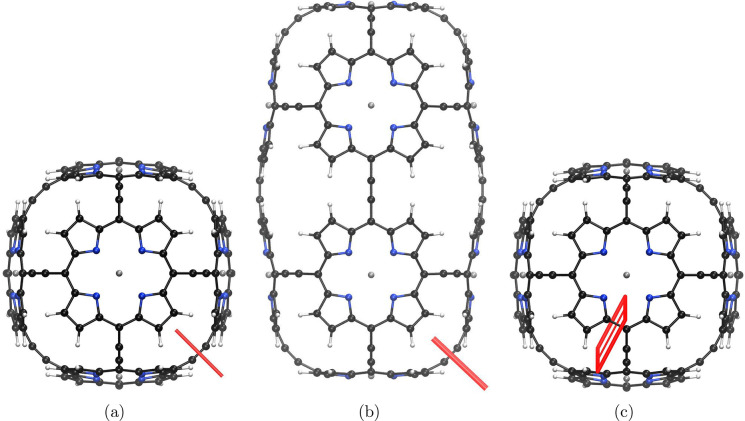
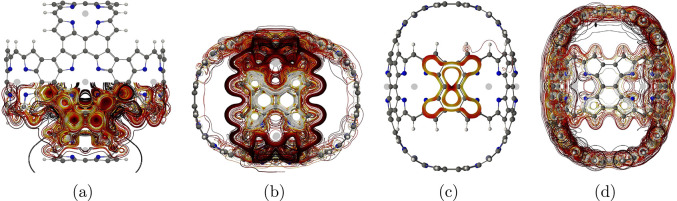
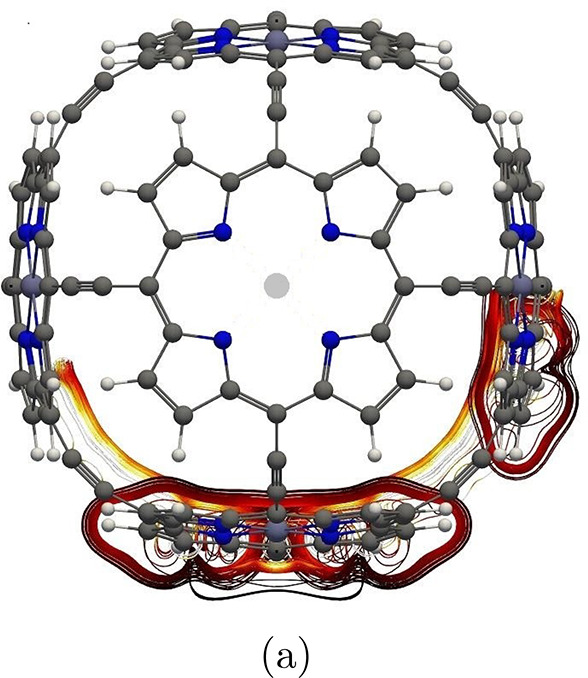
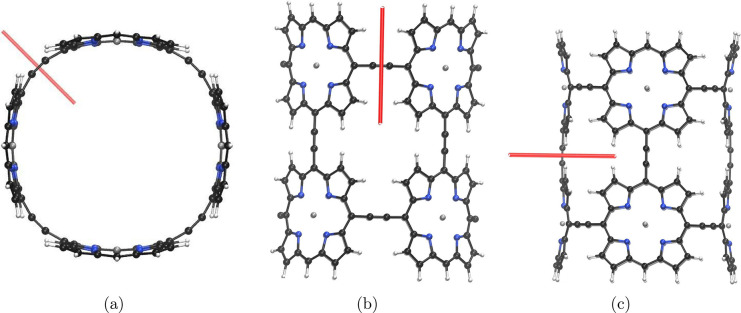
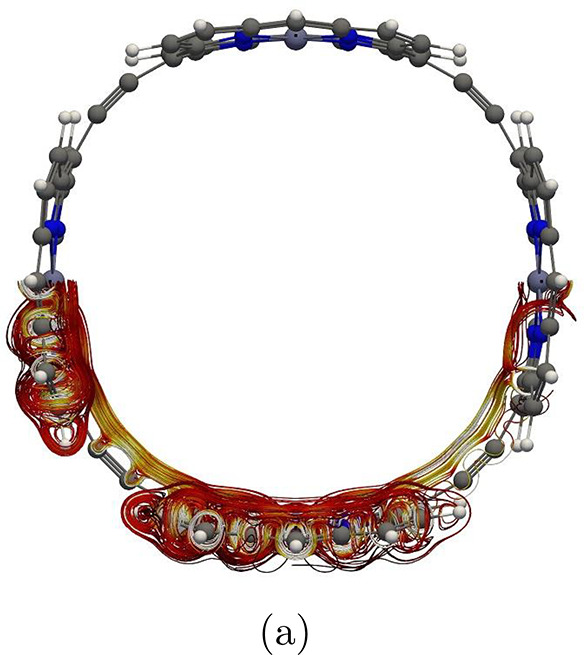
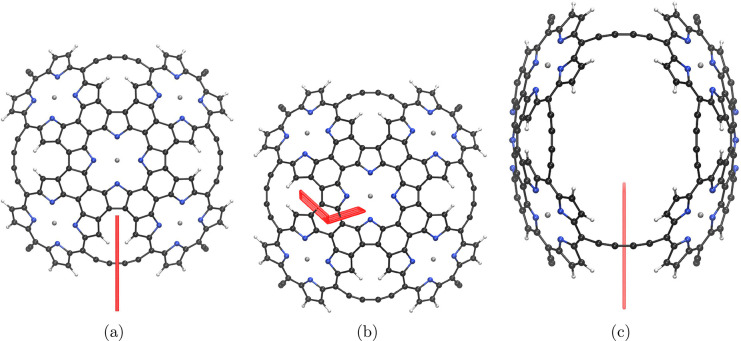
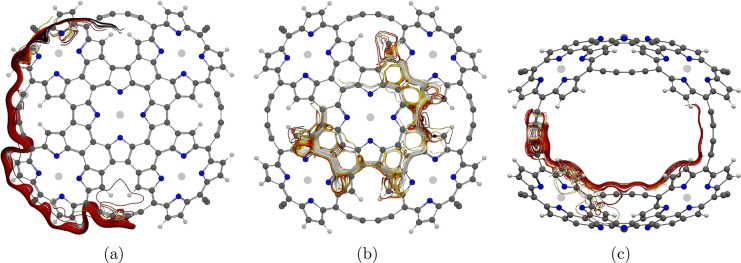
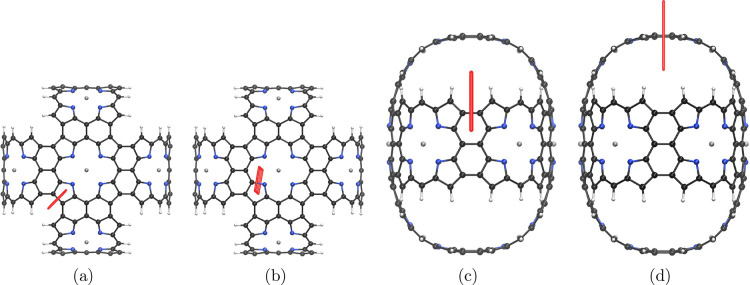
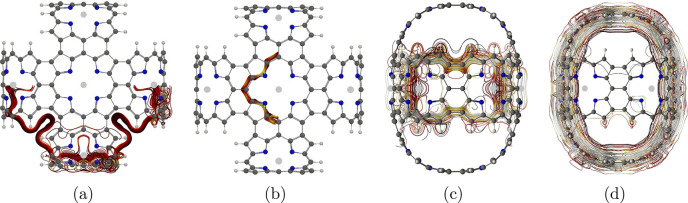
The molecular structures of porphyrinoid cages were obtained by constructing small polyhedral graphs whose vertices have degree-4. The initial structures were then fully optimized at the density functional theory (DFT) level using the generalized gradient approximation. Some of polyhedral vertices were replaced with Zn-porphyrin units and their edges were replaced with ethyne or butadiyne bridges or connected by fusing two neighboring Zn-porphyrin units. Molecule is an ethyne-bridge porphyrinoid nanotube, whose ends are sealed with a Zn-porphyrin. Molecule is the corresponding open porphyrinoid nanotube. Molecule is a clam-like porphyrinoid cage, whose shells consist of fused Zn-porphyrins, and the two halves are connected via butadiyne bridges. Molecule is a cross-belt of fused Zn-porphyrins, and molecule is a cross-belt of Zn-porphyrins connected with butadiyne bridges. The magnetically induced current density of the optimized porphyrinoid cages was calculated for determining the aromatic character, the degree of aromaticity and the current-density pathways. The current-density calculations were performed at the DFT level with the gauge─including magnetically induced currents (GIMIC) method using the B3LYP hybrid functional and def2-SVP basis sets. Calculations of the current densities show that molecule sustains a paratropic ring current around the nanotube, whereas sealing the ends as in molecule leads to an almost nonaromatic nanotube. Fusing porphyrinoids as in molecules and results in complicated current-density pathways that differ from the ones usually appearing in porphyrinoids. The aromatic character of molecules and changes upon oxidation. The neutral molecule is antiaromatic, whereas the dication is nonaromatic. Molecule is nonaromatic, and its dication is aromatic.
卟啉类笼状结构的分子结构是通过构建顶点度为4的小型多面体图获得的。然后使用广义梯度近似在密度泛函理论(DFT)水平上对初始结构进行完全优化。一些多面体顶点被锌卟啉单元取代,其边被乙炔或丁二炔桥取代,或者通过融合两个相邻的锌卟啉单元相连。分子 是一种乙炔桥卟啉类纳米管,其两端用锌卟啉封闭。分子 是相应的开放卟啉类纳米管。分子 是一种蛤状卟啉类笼,其壳由融合的锌卟啉组成,两半通过丁二炔桥相连。分子 是融合锌卟啉的交叉带,分子 是通过丁二炔桥连接的锌卟啉交叉带。为了确定芳香性、芳香度和电流密度路径,计算了优化后的卟啉类笼的磁诱导电流密度。电流密度计算是在DFT水平上使用包含磁诱导电流的规范(GIMIC)方法,采用B3LYP杂化泛函和def2-SVP基组进行的。电流密度计算表明,分子 在纳米管周围维持抗磁环电流,而像分子 那样封闭两端会导致几乎无芳香性的纳米管。像分子 和 那样融合卟啉类会导致复杂的电流密度路径,这与卟啉类中通常出现的路径不同。分子 和 的芳香性在氧化时会发生变化。中性分子 是反芳香性的,而其二价阳离子是无芳香性的。分子 是无芳香性的,其二价阳离子是芳香性的。