University of Cologne, Faculty of Medicine and University Hospital Cologne, Department of Otorhinolaryngology, Head and Neck Surgery, Audiology and Pediatric Audiology, Cochlear Implant Center, Germany.
University of Cologne, Faculty of Medicine and University Hospital Cologne, Department of Otorhinolaryngology, Head and Neck Surgery, Audiology and Pediatric Audiology, Cochlear Implant Center, Germany.
Neuroimage Clin. 2022;34:102982. doi: 10.1016/j.nicl.2022.102982. Epub 2022 Mar 4.
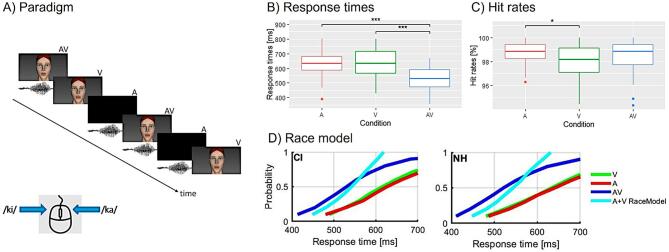
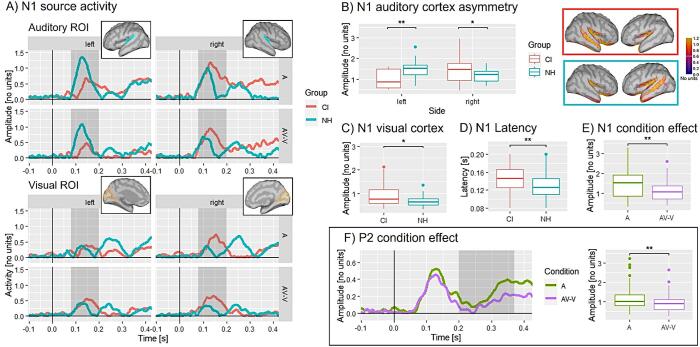
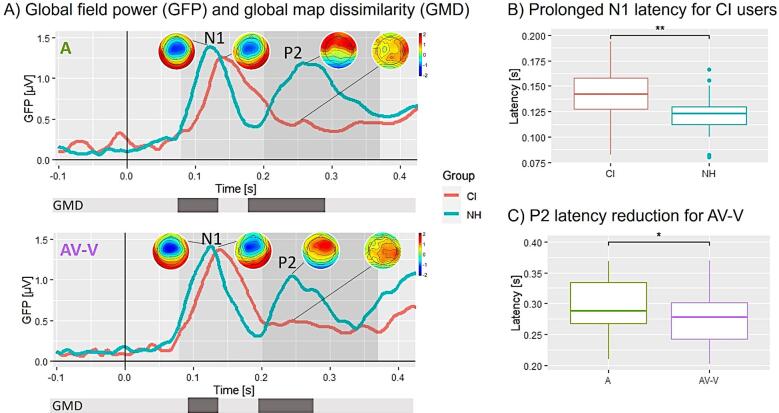
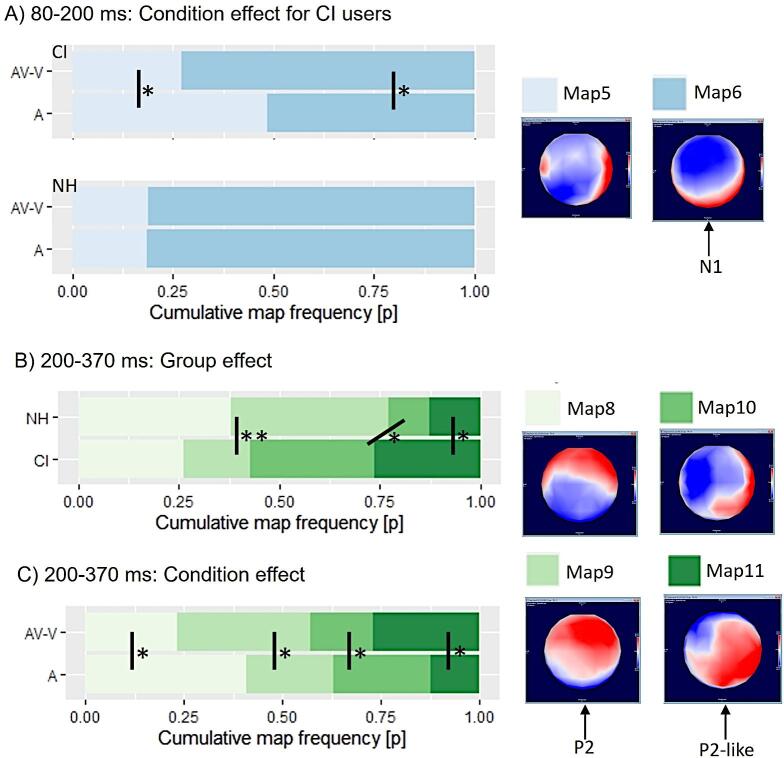
A cochlear implant (CI) is an auditory prosthesis which can partially restore the auditory function in patients with severe to profound hearing loss. However, this bionic device provides only limited auditory information, and CI patients may compensate for this limitation by means of a stronger interaction between the auditory and visual system. To better understand the electrophysiological correlates of audiovisual speech perception, the present study used electroencephalography (EEG) and a redundant target paradigm. Postlingually deafened CI users and normal-hearing (NH) listeners were compared in auditory, visual and audiovisual speech conditions. The behavioural results revealed multisensory integration for both groups, as indicated by shortened response times for the audiovisual as compared to the two unisensory conditions. The analysis of the N1 and P2 event-related potentials (ERPs), including topographic and source analyses, confirmed a multisensory effect for both groups and showed a cortical auditory response which was modulated by the simultaneous processing of the visual stimulus. Nevertheless, the CI users in particular revealed a distinct pattern of N1 topography, pointing to a strong visual impact on auditory speech processing. Apart from these condition effects, the results revealed ERP differences between CI users and NH listeners, not only in N1/P2 ERP topographies, but also in the cortical source configuration. When compared to the NH listeners, the CI users showed an additional activation in the visual cortex at N1 latency, which was positively correlated with CI experience, and a delayed auditory-cortex activation with a reversed, rightward functional lateralisation. In sum, our behavioural and ERP findings demonstrate a clear audiovisual benefit for both groups, and a CI-specific alteration in cortical activation at N1 latency when auditory and visual input is combined. These cortical alterations may reflect a compensatory strategy to overcome the limited CI input, which allows the CI users to improve the lip-reading skills and to approximate the behavioural performance of NH listeners in audiovisual speech conditions. Our results are clinically relevant, as they highlight the importance of assessing the CI outcome not only in auditory-only, but also in audiovisual speech conditions.
人工耳蜗是一种听觉假体,可以部分恢复重度至极重度听力损失患者的听觉功能。然而,这种仿生装置只能提供有限的听觉信息,而人工耳蜗患者可以通过听觉和视觉系统之间更强的相互作用来弥补这一限制。为了更好地理解视听言语感知的电生理相关性,本研究使用了脑电图(EEG)和冗余目标范式。比较了后天失聪的人工耳蜗使用者和正常听力(NH)听众在听觉、视觉和视听言语条件下的情况。行为结果表明,两组都存在多感觉整合,即与两个单感觉条件相比,视听条件下的反应时间更短。对 N1 和 P2 事件相关电位(ERP)的分析,包括地形图和源分析,证实了两组的多感觉效应,并显示了皮质听觉反应,该反应受到同时处理视觉刺激的调制。然而,人工耳蜗使用者特别是在 N1 地形图上表现出明显的模式,表明视觉对听觉言语处理有强烈的影响。除了这些条件效应外,研究结果还揭示了人工耳蜗使用者和 NH 听众之间的 ERP 差异,不仅在 N1/P2 ERP 地形图上,而且在皮质源配置上。与 NH 听众相比,人工耳蜗使用者在 N1 潜伏期时在视觉皮层显示出额外的激活,这与人工耳蜗的使用经验呈正相关,并且听觉皮层的激活延迟,功能侧化向右反转。总之,我们的行为和 ERP 发现表明,两组都有明显的视听获益,当听觉和视觉输入结合时,N1 潜伏期的皮质激活存在人工耳蜗特异性改变。这些皮质改变可能反映了一种补偿策略,以克服人工耳蜗输入的限制,使人工耳蜗使用者能够提高唇读技能,并在视听言语条件下接近 NH 听众的行为表现。我们的研究结果具有临床意义,因为它们强调了不仅在听觉单一条件下,而且在视听言语条件下评估人工耳蜗结果的重要性。