CHU de Bordeaux, Pôle de Médecine et Chirurgie Bucco-Dentaire, 33000, Bordeaux, France.
Université de Bordeaux, UFR des Sciences Odontologiques, 33076, Bordeaux, France.
Trials. 2022 Mar 18;23(1):221. doi: 10.1186/s13063-022-06163-6.
Soft palate defects created during oral cancer surgery may prevent complete palatal closure and trigger palatopharyngeal insufficiency. One current treatment employs a rigid obturator prosthesis; an extension of acrylic resin at the level of the hard palate ensures surface contact with the remaining musculature. Unfortunately, airflow escape often causes hypernasality, compromises speech intelligibility, and creates swallowing problems (including leakage of food and fluid into the nasal airway). We plan to test a new removable denture featuring a thick dental dam that serves as a membrane obturator. The principal objective of the clinical trial is a comparison of speech handicap levels after 1 month in patients with acquired velar insufficiencies who wear either the new device or a conventional, rigid obturator. The secondary objectives are between-device comparisons of the swallowing handicaps and the health-related qualities of life.
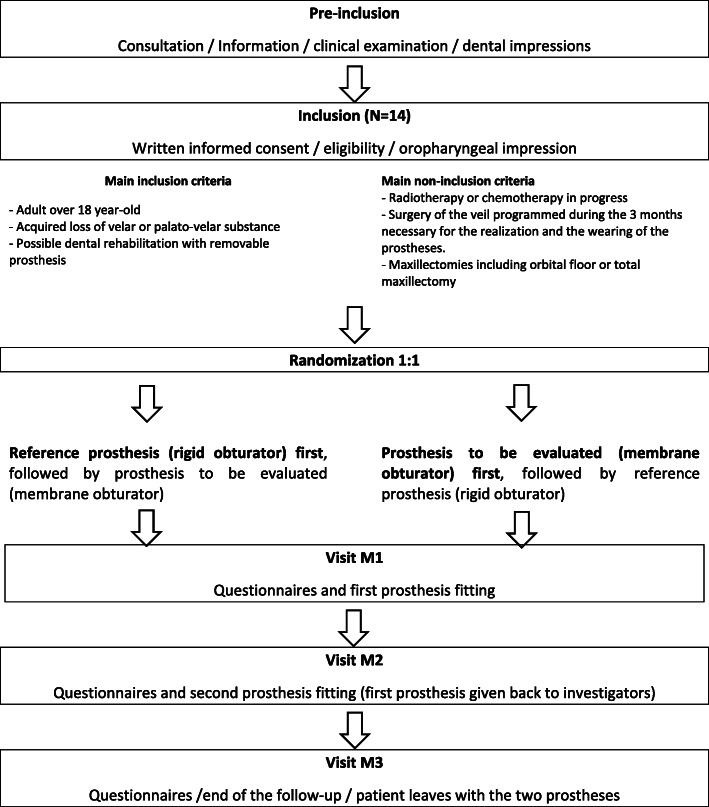
The VELOMEMBRANE trial is a superiority, open-labeled, two-way, random crossover clinical trial. Adult patients exhibiting velar or palatovelar substance loss after tumor excision and who are indicated for rigid obturator-mediated prosthetic rehabilitation will be recruited in two teaching hospitals in France. Fourteen participants will be randomly allocated to wear both prostheses for 1-month periods in either order. The new membrane obturator is a removable resin prosthesis incorporating a rigid extension that holds a dental dam to restore the soft palate. The primary outcome will be the extent of phonation-related disability (the overall score on the Voice Handicap Index [VHI]). The secondary outcomes will be the Deglutition Handicap Index and health-related quality of life scores of the European Organization for Research and Treatment of Cancer (EORTC).
High-quality evidence will be provided to document the utility of a new medical device that may greatly improve the management and quality of life of patients with acquired velar insufficiency.
ClinicalTrials.gov NCT04009811 . Registered on 4 July 2019.
口腔癌手术后形成的软腭裂可能妨碍完全腭闭合,并引发腭咽闭合不全。目前的一种治疗方法采用刚性堵塞器假体;硬腭水平的丙烯酸树脂延伸部分确保与剩余肌肉表面接触。不幸的是,气流逸出常常导致鼻音过重,影响言语清晰度,并导致吞咽问题(包括食物和液体漏入鼻气道)。我们计划测试一种新的可移动义齿,其特点是厚的牙坝作为膜堵塞器。临床试验的主要目标是比较 1 个月后佩戴新装置或传统刚性堵塞器的获得性软腭不足患者的言语障碍水平。次要目标是两种装置之间吞咽障碍和与健康相关的生活质量的比较。
VELOMEMBRANE 试验是一项优势、开放性、双向、随机交叉临床试验。在法国的两家教学医院招募因肿瘤切除后出现软腭或腭后缺损并需要刚性堵塞器介导的修复的成年患者。将 14 名参与者随机分配,以任意顺序佩戴两种义齿 1 个月。新型膜堵塞器是一种可移动的树脂假体,其中包含一个刚性延伸部分,该延伸部分固定牙坝以恢复软腭。主要结局将是发音相关残疾的程度(嗓音障碍指数[VHI]的总分)。次要结局将是吞咽障碍指数和欧洲癌症研究与治疗组织(EORTC)的健康相关生活质量评分。
将提供高质量的证据来证明一种新医疗器械的实用性,该器械可能极大地改善获得性软腭不足患者的管理和生活质量。
ClinicalTrials.gov NCT04009811。注册于 2019 年 7 月 4 日。