Department of Mathematics, Graduate School of Science, Kyoto University, Kyoto, Japan.
Institute of Mathematics, College of Science, University of the Philippines Diliman, Quezon City, Philippines.
Commun Biol. 2022 Mar 18;5(1):239. doi: 10.1038/s42003-022-03174-6.
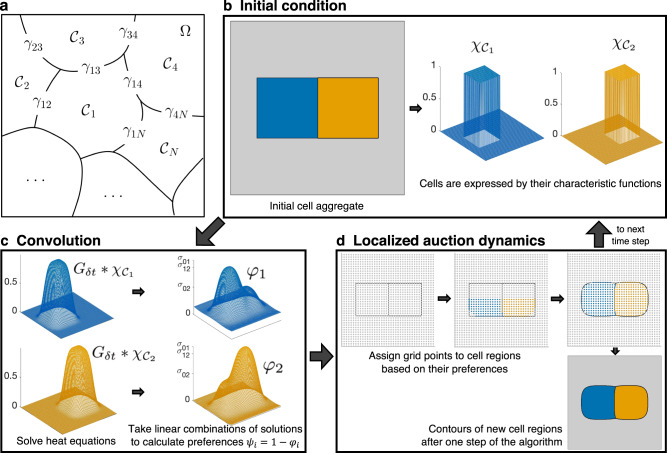
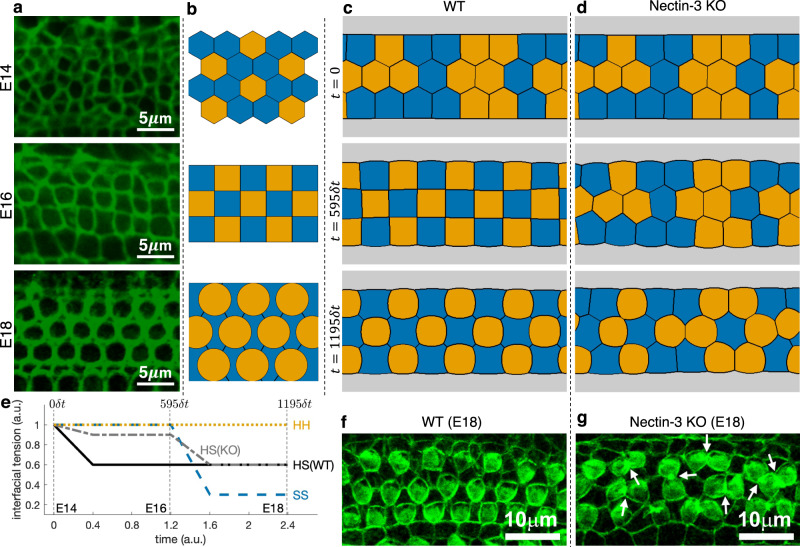
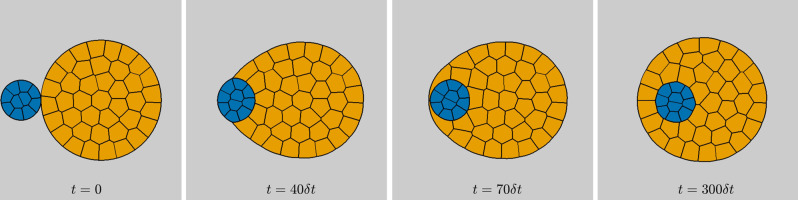
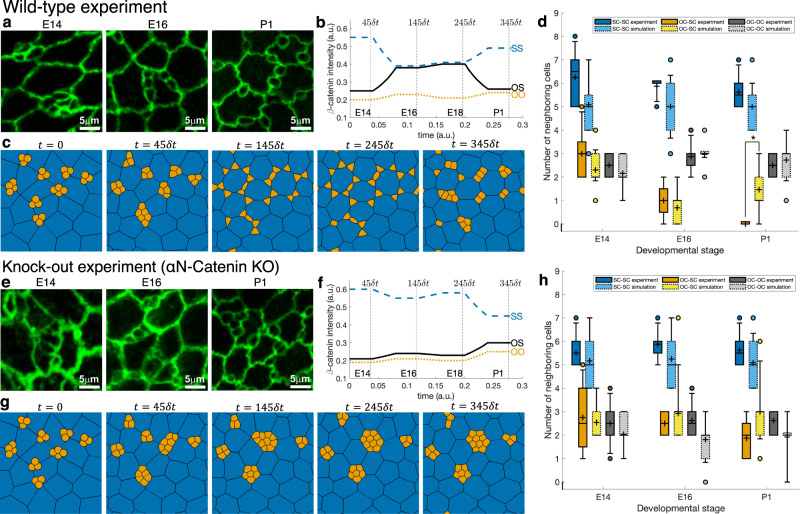
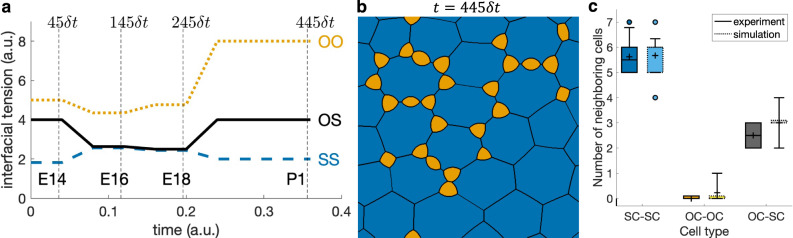
Among morphological phenomena, cellular patterns in developing sensory epithelia have gained attention in recent years. Although physical models for cellular rearrangements are well-established thanks to a large bulk of experimental work, their computational implementation lacks solid mathematical background and involves experimentally unreachable parameters. Here we introduce a level set-based computational framework as a tool to rigorously investigate evolving cellular patterns, and study its mathematical and computational properties. We illustrate that a compelling feature of the method is its ability to correctly handle complex topology changes, including frequent cell intercalations. Combining this accurate numerical scheme with an established mathematical model, we show that the proposed framework features minimum possible number of parameters and is capable of reproducing a wide range of tissue morphological phenomena, such as cell sorting, engulfment or internalization. In particular, thanks to precise mathematical treatment of cellular intercalations, this method succeeds in simulating experimentally observed development of cellular mosaic patterns in sensory epithelia.
近年来,在形态学现象中,发育感觉上皮中的细胞模式引起了人们的关注。尽管由于大量的实验工作,细胞重排的物理模型已经很成熟,但它们的计算实现缺乏坚实的数学背景,并涉及到实验无法达到的参数。在这里,我们引入了一个基于水平集的计算框架,作为一种严格研究演化细胞模式的工具,并研究了它的数学和计算特性。我们表明,该方法的一个引人注目的特点是它能够正确处理复杂的拓扑变化,包括频繁的细胞插入。将这种精确的数值方案与一个已建立的数学模型相结合,我们表明,所提出的框架具有尽可能少的参数,并且能够再现广泛的组织形态学现象,如细胞分选、吞噬或内化。特别是,由于对细胞插入的精确数学处理,这种方法成功地模拟了感觉上皮中细胞镶嵌模式的实验观察到的发育。