Department of Biochemistry and Molecular Biology, Edificio CIBUS, Universidade de Santiago de Compostela, Campus Vida, 15782, Santiago de Compostela, Galicia, Spain.
Gene Regulatory Control in Disease Group, Centre for Research in Molecular Medicine and Chronic Diseases (CiMUS), Universidade de Santiago de Compostela, Santiago, Spain.
Arch Immunol Ther Exp (Warsz). 2022 Mar 18;70(1):12. doi: 10.1007/s00005-022-00649-6.
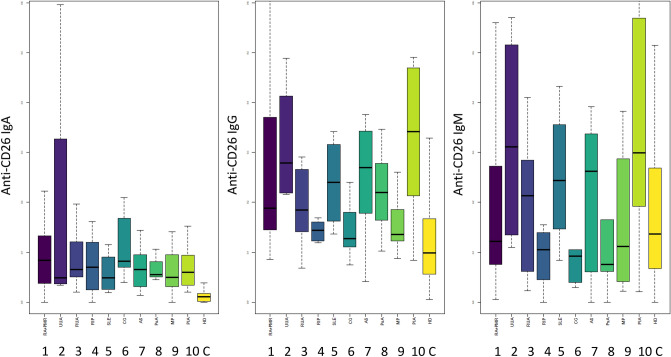
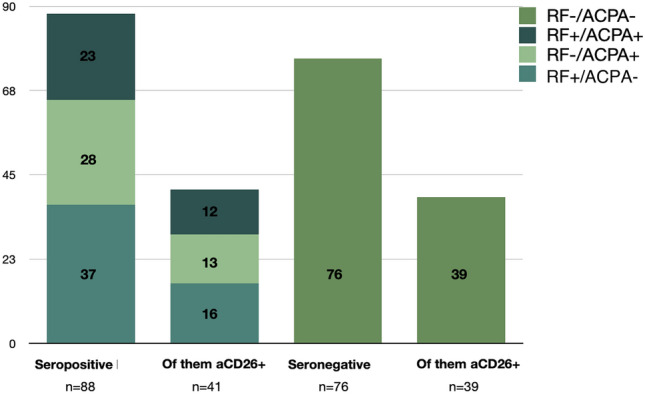
In rheumatoid arthritis (RA), the identification of biomarkers to adjust treatment intensity and to correctly diagnose the disease in early stages still constitutes a challenge and, as such, novel biomarkers are needed. We proposed that autoantibodies (aAbs) against CD26 (DPP4) might have both etiological importance and clinical value. Here, we perform a prospective study of the potential diagnostic power of Anti-CD26 aAbs through their quantification in plasmas from 106 treatment-naïve early and undifferentiated AR. Clinical antibodies, Anti-CD26 aAbs, and other disease-related biomarkers were measured in plasmas obtained in the first visit from patients, which were later classified as RA and non-RA according to the American College of Rheumatology criteria. Two different isotype signatures were found among ten groups of patients, one for Anti-CD26 IgA and other for Anti-CD26 IgG and IgM isotypes, both converging in patients with arthritis (RA and Unresolved Undifferentiated Arthritis: UUA), who present elevated levels of all three isotypes. The four UUA patients, unresolved after two years, were ACPA and rheumatic factor (RF) negatives. In the whole cohort, 51.3% of ACPA/RF seronegatives were Anti-CD26 positives, and a similar frequency was observed in the seropositive RA patients. Only weak associations of the three isotypes with ESR, CRP and disease activity parameters were observed. Anti-CD26 aAbs are present in treatment-naïve early arthritis patients, including ACPA and RF seronegative individuals, suggestive of a potential pathogenic and/or biomarker role of Anti-CD26 aAbs in the development of rheumatic diseases.
在类风湿关节炎(RA)中,确定生物标志物来调整治疗强度并在早期正确诊断疾病仍然是一个挑战,因此需要新的生物标志物。我们提出,针对 CD26(DPP4)的自身抗体(aAbs)可能具有病因学重要性和临床价值。在这里,我们通过对 106 例未经治疗的早期和未分化 RA 患者血浆中抗 CD26 aAbs 的定量,对其潜在诊断能力进行了前瞻性研究。在患者首次就诊时从血浆中测量了临床抗体、抗 CD26 aAbs 和其他与疾病相关的生物标志物,随后根据美国风湿病学会标准将其分类为 RA 和非 RA。在 10 组患者中发现了两种不同的同种型特征,一种针对抗 CD26 IgA,另一种针对抗 CD26 IgG 和 IgM 同种型,这两种特征都在关节炎患者(RA 和未解决的未分化关节炎:UUA)中汇聚,这些患者所有三种同种型的水平都升高。四年后仍未解决的四名 UUA 患者 ACPA 和类风湿因子(RF)均为阴性。在整个队列中,51.3%的 ACPA/RF 血清阴性患者为抗 CD26 阳性,在血清阳性 RA 患者中也观察到了类似的频率。仅观察到三种同种型与 ESR、CRP 和疾病活动参数之间存在微弱关联。抗 CD26 aAbs 存在于未经治疗的早期关节炎患者中,包括 ACPA 和 RF 血清阴性个体,提示抗 CD26 aAbs 在风湿性疾病发展中具有潜在的致病性和/或生物标志物作用。