Masood Syed, Pennington Edward R, Simmons Steven O, Bromberg Philip A, Shaikh Saame R, Rice Rebecca L, Gold Avram, Zhang Zhenfa, Samet James M
Curriculum in Toxicology and Environmental Medicine, University of North Carolina at Chapel Hill, Chapel Hill, NC, USA.
Oak Ridge Institute for Science and Education, Oak Ridge, TN, USA.
Redox Biol. 2022 May;51:102281. doi: 10.1016/j.redox.2022.102281. Epub 2022 Mar 15.
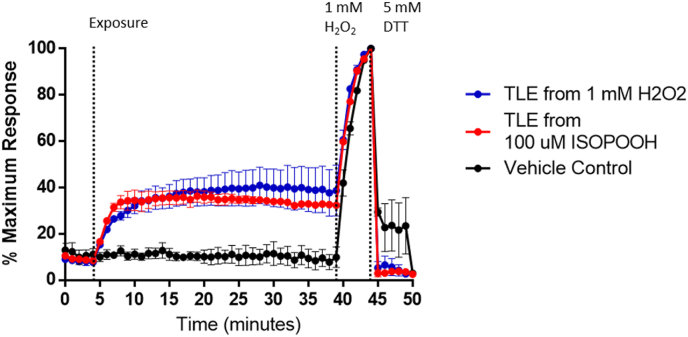
Exposure to respirable air particulate matter (PM) in ambient air is associated with morbidity and premature deaths. A major source of PM is the photooxidation of volatile plant-produced organic compounds such as isoprene. Photochemical oxidation of isoprene leads to the formation of hydroperoxides, environmental oxidants that lead to inflammatory (IL-8) and adaptive (HMOX1) gene expression in human airway epithelial cells (HAEC). To examine the mechanism through which these oxidants alter intracellular redox balance, we used live-cell imaging to monitor the effects of isoprene hydroxyhydroperoxides (ISOPOOH) in HAEC expressing roGFP2, a sensor of the glutathione redox potential (E). Non-cytotoxic exposure of HAEC to ISOPOOH resulted in a rapid and robust increase in E that was independent of the generation of intracellular or extracellular hydrogen peroxide. Our results point to oxidation of GSH through the redox relay initiated by glutathione peroxidase 4, directly by ISOPOOH or indirectly by ISOPOOH-generated lipid hydroperoxides. We did not find evidence for involvement of peroxiredoxin 6. Supplementation of HAEC with polyunsaturated fatty acids enhanced ISOPOOH-induced glutathione oxidation, providing additional evidence that ISOPOOH initiates lipid peroxidation of cellular membranes. These findings demonstrate that ISOPOOH is a potent environmental airborne hydroperoxide with the potential to contribute to oxidative burden of human airway posed by inhalation of secondary organic aerosols.
暴露于环境空气中的可吸入颗粒物(PM)与发病率和过早死亡有关。PM的一个主要来源是挥发性植物产生的有机化合物(如异戊二烯)的光氧化。异戊二烯的光化学氧化导致氢过氧化物的形成,这些环境氧化剂会导致人气道上皮细胞(HAEC)中炎症(IL-8)和适应性(HMOX1)基因表达。为了研究这些氧化剂改变细胞内氧化还原平衡的机制,我们使用活细胞成像技术监测异戊二烯羟基氢过氧化物(ISOPOOH)对表达roGFP2(一种谷胱甘肽氧化还原电位(E)传感器)的HAEC的影响。HAEC对ISOPOOH的非细胞毒性暴露导致E迅速且显著增加,这与细胞内或细胞外过氧化氢的产生无关。我们的结果表明,谷胱甘肽通过由谷胱甘肽过氧化物酶4引发的氧化还原中继被氧化,直接由ISOPOOH或间接由ISOPOOH产生的脂质氢过氧化物氧化。我们没有发现过氧化物酶体增殖物激活受体6参与的证据。用多不饱和脂肪酸补充HAEC可增强ISOPOOH诱导的谷胱甘肽氧化,提供了额外的证据表明ISOPOOH引发细胞膜的脂质过氧化。这些发现表明,ISOPOOH是一种强效的环境空气传播氢过氧化物,有可能导致吸入二次有机气溶胶对人气道造成氧化负担。