Department of Orthopedics, Mayo Clinic, Rochester, MN, USA.
Department of Neurosurgery & Brain Repair, University of South Florida, Tampa, FL, USA.
Eur J Sport Sci. 2023 May;23(5):840-850. doi: 10.1080/17461391.2022.2056520. Epub 2022 May 2.
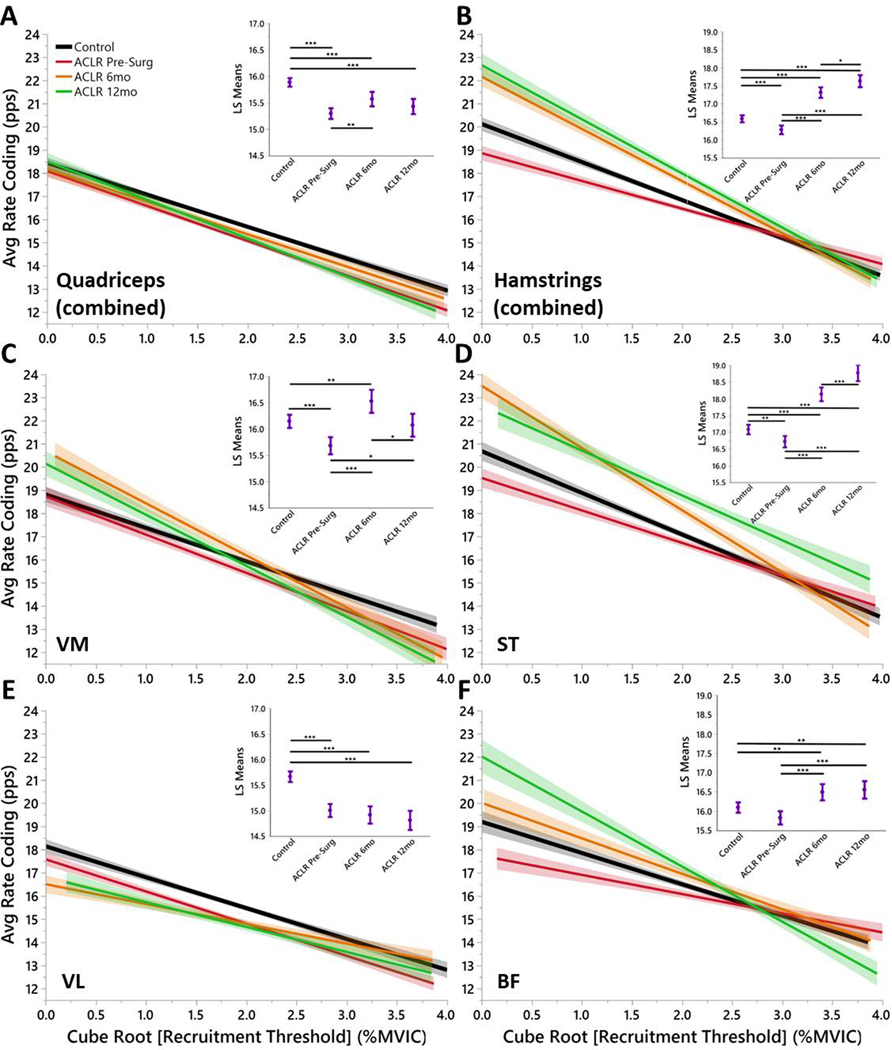
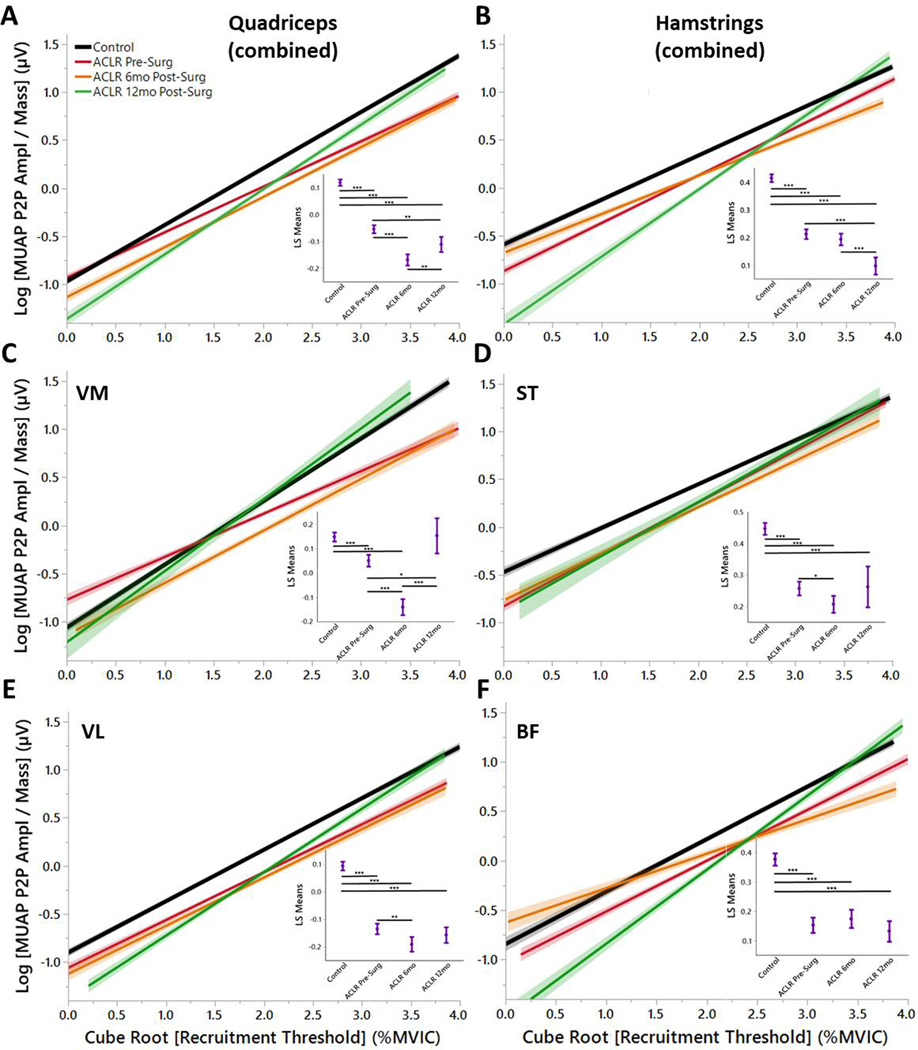
Joint trauma induces a presynaptic reflex inhibition termed arthrogenic muscle inhibition (AMI) that prevents complete activation of muscles. Reduced motor unit (MU) output is a hypothesised mechanism for persistent strength deficits. The objective of this study was to determine MU characteristics of thigh musculature and determine how they change with anterior cruciate ligament (ACL) injury compared to healthy controls. A randomised protocol of knee flexion/extension isometric contractions (10-50% maximal voluntary isometric contraction) was performed for each leg with surface EMG 5-pin array electrodes placed on the vastus medialis, vastus lateralis, semitendinosus and biceps femoris. Longitudinal assessments for average rate coding, recruitment thresholds and MU action potentials were acquired at 6-month intervals. With exception of the vastus medialis, all thigh musculature of ACL-injured demonstrated smaller MU action potential peak-to-peak amplitude. For average rate coding, ACL-injured demonstrated lower coding rates than Controls for the quadriceps (< .05) and higher rates than Controls for the hamstrings (< .05). These MU characteristics were different from Controls after ACL reconstruction up to 12 months post-surgery, yet maximal strength increased during this time frame. As thigh MU characteristics are known across phases of ACL rehabilitation, future studies can assess these patterns of motor control and their potential to determine risk of re-injury. Further, future rehabilitation can target specific intervention programmes to restore motor control.Motor unit strategies of arthrogenic muscle inhibition are characterised for the first time via decomposed EMG.Motor unit deficits of thigh musculature persist throughout all phases of ACL rehabilitation, even after return-to-sport.After ACL injury, motor unit sizes at similar recruitment thresholds were smaller than those of healthy controls.
关节创伤会引起一种称为“关节源性肌肉抑制(AMI)”的突触前反射抑制,从而防止肌肉完全激活。运动单位(MU)输出减少被认为是持续性力量缺陷的一种机制。本研究的目的是确定大腿肌肉的 MU 特征,并确定它们如何与健康对照组相比随前交叉韧带(ACL)损伤而变化。使用表面 EMG 5 针阵列电极在股直肌、股外侧肌、半腱肌和股二头肌上进行膝关节屈伸等长收缩(10-50%最大自主等长收缩)的随机方案。在 6 个月的间隔内获取平均速率编码、募集阈值和 MU 动作电位的纵向评估。除股直肌外,ACL 损伤的所有大腿肌肉的 MU 动作电位峰峰值幅度均较小。对于平均速率编码,ACL 损伤的股四头肌比对照组的编码率低(<0.05),而比对照组的腘绳肌的编码率高(<0.05)。这些 MU 特征在 ACL 重建后 12 个月内与对照组不同,但在此期间最大力量增加。由于大腿 MU 特征在 ACL 康复的各个阶段都有,因此未来的研究可以评估这些运动控制模式及其确定再次受伤风险的潜力。此外,未来的康复可以针对特定的干预计划来恢复运动控制。首次通过分解 EMG 来描述关节源性肌肉抑制的运动单位策略。ACL 康复的所有阶段,甚至在重返运动后,大腿肌肉的 MU 缺陷仍然存在。ACL 损伤后,在相似募集阈值下的 MU 大小比健康对照组小。