Department of Rehabilitation, Center of Expertise for Parkinson and Movement Disorders, Donders Institute for Brain, Cognition and Behaviour, Radboud University Medical Center, PO Box 9101, 6500 HB, Nijmegen, The Netherlands.
Department of Neurology, Center of Expertise for Parkinson and Movement Disorders, Donders Institute for Brain, Cognition and Behaviour, Radboud University Medical Center, Nijmegen, The Netherlands.
J Neurol. 2022 Aug;269(8):4264-4269. doi: 10.1007/s00415-022-11054-6. Epub 2022 Mar 20.
Hereditary spastic paraplegia (HSP) is characterized by a bilaterally spastic gait pattern. During gait, increased trunk movements are often observed. People with HSP likely generate trunk movements to improve foot clearance and step length, but there may be additional explanations. Here, we investigate whether there is an association between reduced balance performance and increased trunk movements, as an increase in trunk movements may partly reflect balance correcting strategies.
We analyzed an historic cohort of 86 people with HSP who underwent gait analysis and balance examination. Two researchers reviewed gait analyses videos and classified the observed trunk movement as (1) normal, (2) moderately increased, or (3) markedly increased, and categorized participants as 'toe walkers' (yes/no). Balance performance and spatiotemporal gait parameters were collected from the medical files. Parameters were compared between people with normal vs. moderately increased trunk movements, moderately vs. markedly increased trunk movements, and normal vs. markedly increased trunk movements.
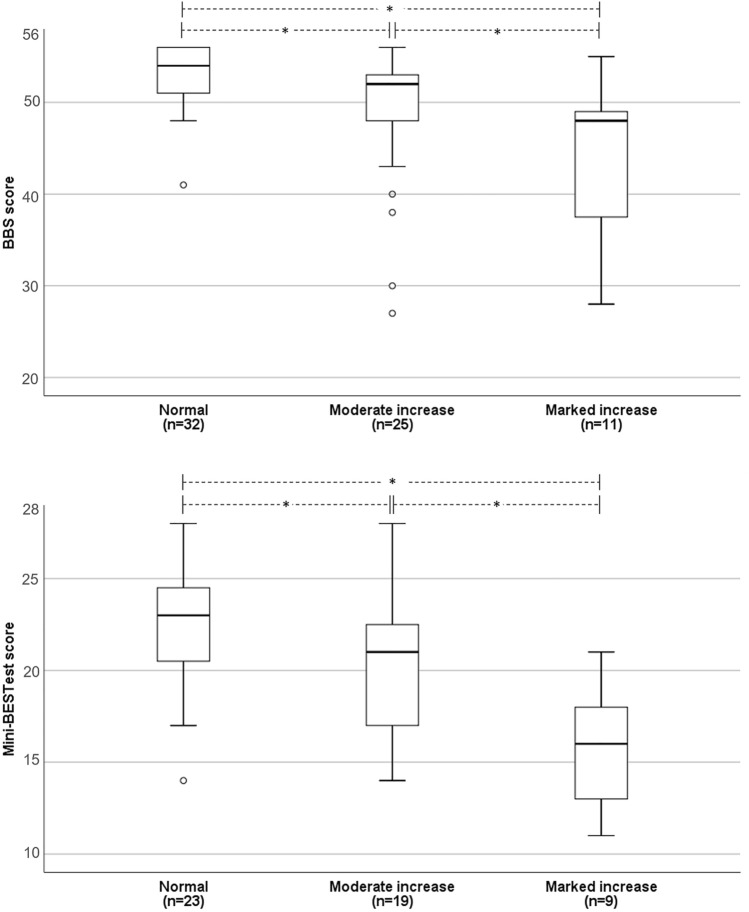
Patients with moderately increased trunk movements during gait scored lower on the Berg Balance Scale (p = 0.002) and/or the Mini Balance Evaluation Test (p = 0.043) than patients with normal trunk movements. Likewise, patients with markedly increased trunk movements performed worse on the BBS (p = 0.037) and/or the Mini-BESTest (p = 0.004) than patients with moderately increased trunk movements. Patients with markedly increased trunk movements were more often toe walkers than patients with moderately increased (68% vs. 6%; p < 0.001).
We found an association between increased trunk movements and reduced balance capacity. This may have several-not mutually exclusive-explanations. One of these explanations is that trunk movements, at least partly, reflect balance correcting strategies. With the disease progression, ankle strategies and foot placement strategies become impaired and insufficient to restore balance after intrinsic perturbations. Hip strategies are then potentially recruited to maintain balance, resulting in increased trunk movements.
遗传性痉挛性截瘫(HSP)的特征是双侧痉挛性步态。在步态中,经常观察到躯干运动增加。HSP 患者可能会产生躯干运动以改善足离地和步长,但可能还有其他解释。在这里,我们研究平衡性能下降与躯干运动增加之间是否存在关联,因为躯干运动的增加可能部分反映了平衡纠正策略。
我们分析了 86 名 HSP 患者的历史队列,这些患者接受了步态分析和平衡检查。两名研究人员回顾了步态分析视频,并将观察到的躯干运动分为(1)正常,(2)中度增加,或(3)明显增加,并将参与者分为“足尖行走者”(是/否)。平衡性能和时空步态参数从病历中收集。在正常与中度增加的躯干运动、中度与明显增加的躯干运动以及正常与明显增加的躯干运动之间比较参数。
在步态中出现中度增加的躯干运动的患者在 Berg 平衡量表(p=0.002)和/或 Mini 平衡评估测试(p=0.043)上的得分较低,而正常躯干运动的患者。同样,在 Berg 平衡量表(p=0.037)和/或 Mini-BESTest(p=0.004)上,明显增加的躯干运动的患者比中度增加的躯干运动的患者表现更差。明显增加的躯干运动的患者比中度增加的躯干运动的患者更常为足尖行走者(68%对 6%;p<0.001)。
我们发现增加的躯干运动与平衡能力下降之间存在关联。这可能有几个(并非相互排斥)解释。其中一个解释是,躯干运动至少部分反映了平衡纠正策略。随着疾病的进展,踝关节策略和足放置策略受损,不足以在内在干扰后恢复平衡。然后可能会募集髋关节策略来维持平衡,导致躯干运动增加。