Le Ray Didier, Guayasamin Mathias
Université de Bordeaux, CNRS, EPHE, INCIA, UMR 5287, Bordeaux, France.
Front Syst Neurosci. 2022 Mar 3;16:828532. doi: 10.3389/fnsys.2022.828532. eCollection 2022.
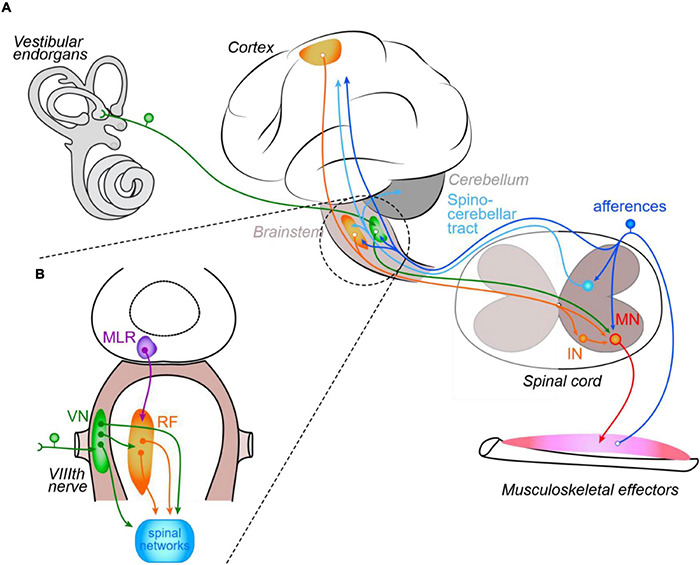
In most vertebrates, posture and locomotion are achieved by a biomechanical apparatus whose effectors are symmetrically positioned around the main body axis. Logically, motor commands to these effectors are intrinsically adapted to such anatomical symmetry, and the underlying sensory-motor neural networks are correspondingly arranged during central nervous system (CNS) development. However, many developmental and/or life accidents may alter such neural organization and acutely generate asymmetries in motor operation that are often at least partially compensated for over time. First, we briefly present the basic sensory-motor organization of posturo-locomotor networks in vertebrates. Next, we review some aspects of neural plasticity that is implemented in response to unilateral central injury or asymmetrical sensory deprivation in order to substantially restore symmetry in the control of posturo-locomotor functions. Data are finally discussed in the context of CNS structure-function relationship.
在大多数脊椎动物中,姿势和运动是由一种生物力学装置实现的,其效应器围绕主体轴对称分布。从逻辑上讲,对这些效应器的运动指令本质上适应于这种解剖学上的对称性,并且在中枢神经系统(CNS)发育过程中,潜在的感觉运动神经网络也相应地进行了排列。然而,许多发育和/或生活中的意外事件可能会改变这种神经组织,并在运动操作中急性产生不对称性,而随着时间的推移,这种不对称性通常至少会得到部分补偿。首先,我们简要介绍脊椎动物姿势运动网络的基本感觉运动组织。接下来,我们回顾一些神经可塑性的方面,这些可塑性是为了在姿势运动功能控制中实质性地恢复对称性,而对单侧中枢损伤或不对称感觉剥夺做出反应而实现的。最后,我们将在中枢神经系统结构 - 功能关系的背景下讨论这些数据。