Ibrahiem Afaf T, Fawzy Manal S, Abdulhakim Jawaher A, Toraih Eman A
Department of Pathology, Faculty of Medicine, Northern Border University, Arar, Saudi Arabia.
Department of Pathology, Faculty of Medicine, Mansoura University, Mansoura, Egypt.
Int J Gen Med. 2022 Mar 14;15:2929-2944. doi: 10.2147/IJGM.S354108. eCollection 2022.
Recently, glucose and amino acid transporters have gradually become a hot topic in thyroid gland biology and cancer research. We aimed to investigate the expressions of glucose transporter 1 (GLUT1) and glutamine transporter 2 (ASCT2) in papillary thyroid carcinoma (PTC) and their clinical significance and relation to HCV-related hepatitis.
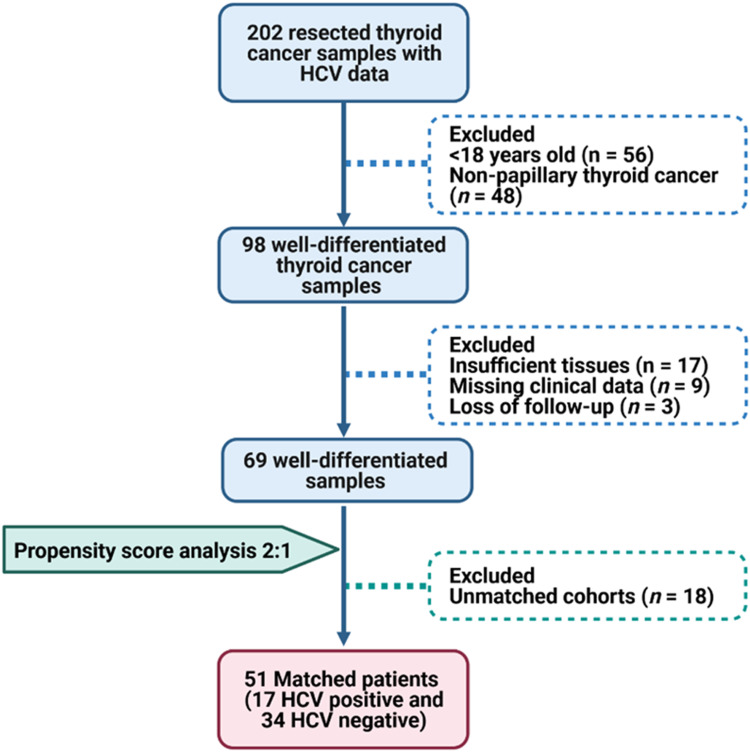
Screening 202 TC tissue samples against the selection criteria using a propensity-score matched analysis to adjust for age, sex, side of tumor, histopathological variants, TNM staging system, and the positivity for HCV yielded 51 matched (17 HCV positive and 34 HCV negative) PTC samples. The expressions of GLUT1 and ASCT2 expressions were detected by immunohistochemical staining. Kaplan-Meier survival curves were generated for disease-free and overall survival, and multivariate Cox regression analysis was applied to identify predictors for mortality.
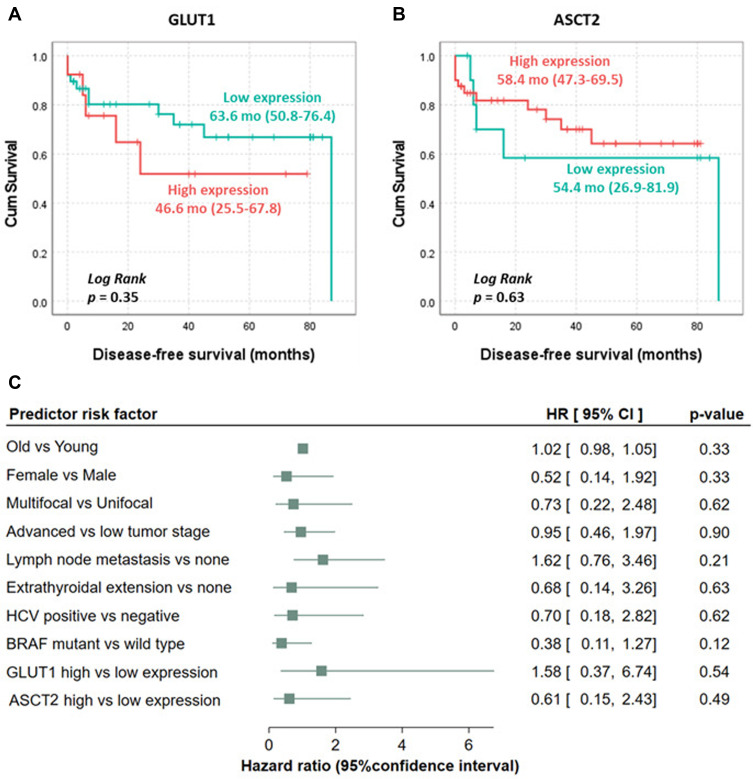
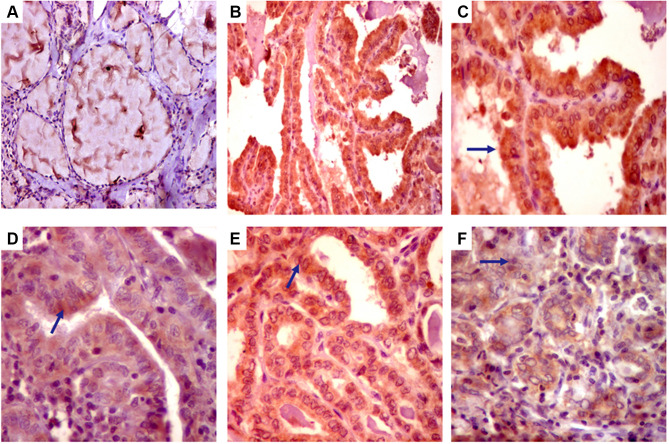
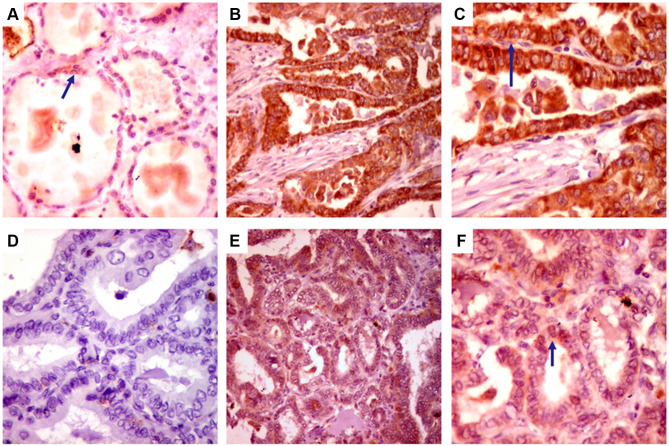
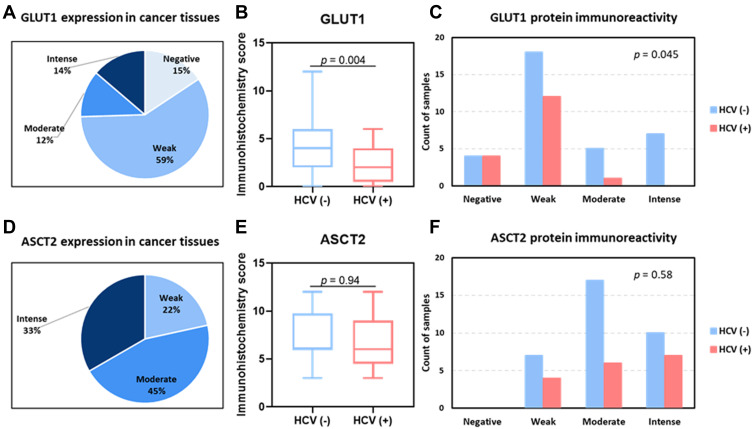
Of 51 thyroid cancer tissues, 85% showed positive GLUT1 cytoplasmic staining, and 26% had a high expression score. All thyroid cancer specimens demonstrated ASCT2 cytoplasmic staining with membranous accentuation. Of these, 78% showed a high expression score, and 22% showed weak staining. On stratifying the study cohort based on the HCV status, HCV negative cohort showed a significantly higher immunoreactivity score for GLUT1 ( = 0.004) but not ASCT2 ( = 0.94) than HCV positive group. The expressions of the studied transporters showed no significant associations with the prognostic features of PTC nor the disease-free/overall survival.
GLUT1 and ASCT2 immunohistochemical staining showed positive expression with variable intensity in nearly 85% and 100% of PTC tissue samples compared to normal ones, respectively. Furthermore, GLUT1 protein expression, not ASCT2, showed a higher immunoreactivity score in PTC patients who are negative for HCV than cancer patients with positive HCV. Meanwhile, the expression of both protein markers was not associated with the clinicopathological characteristics of the studied PTC patients. Further large-scale multicenter studies are recommended to validate the present findings.
近年来,葡萄糖和氨基酸转运蛋白逐渐成为甲状腺生物学和癌症研究的热点话题。我们旨在研究葡萄糖转运蛋白1(GLUT1)和谷氨酰胺转运蛋白2(ASCT2)在甲状腺乳头状癌(PTC)中的表达及其临床意义,以及与丙型肝炎病毒(HCV)相关肝炎的关系。
使用倾向评分匹配分析,根据年龄、性别、肿瘤部位、组织病理学变异、TNM分期系统和HCV阳性情况等选择标准,对202例甲状腺癌组织样本进行筛选,得到51例匹配样本(17例HCV阳性和34例HCV阴性)PTC样本。通过免疫组织化学染色检测GLUT1和ASCT2的表达。绘制无病生存期和总生存期的Kaplan-Meier生存曲线,并应用多因素Cox回归分析确定死亡率的预测因素。
在51例甲状腺癌组织中,85%显示GLUT1细胞质染色阳性,26%表达评分高。所有甲状腺癌标本均显示ASCT2细胞质染色且膜染色增强。其中,78%表达评分高,22%染色较弱。根据HCV状态对研究队列进行分层,HCV阴性队列中GLUT1的免疫反应性评分显著高于HCV阳性组(P = 0.004),而ASCT2则无显著差异(P = 0.94)。所研究转运蛋白的表达与PTC的预后特征以及无病生存期/总生存期均无显著相关性。
与正常组织相比,GLUT1和ASCT2免疫组织化学染色在近85%和100%的PTC组织样本中分别呈不同强度的阳性表达。此外,HCV阴性的PTC患者中GLUT1蛋白表达而非ASCT2的免疫反应性评分高于HCV阳性的癌症患者。同时,这两种蛋白标志物的表达与所研究PTC患者的临床病理特征均无关联。建议进一步开展大规模多中心研究以验证本研究结果。