Steinke Sean J, Gupta Sayak, Piechota Eric J, Moore Curtis E, Kodanko Jeremy J, Turro Claudia
Department of Chemistry and Biochemistry, The Ohio State University Columbus OH 43210 United States
Department of Chemistry, Wayne State University Detroit MI 48208 United States
Chem Sci. 2022 Feb 1;13(7):1933-1945. doi: 10.1039/d1sc05647f. eCollection 2022 Feb 16.
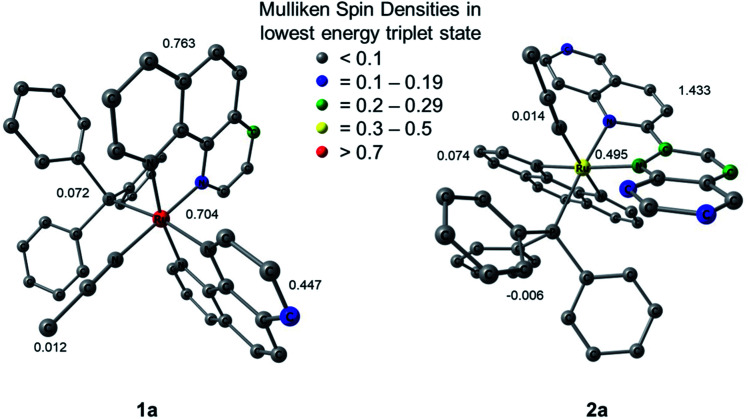
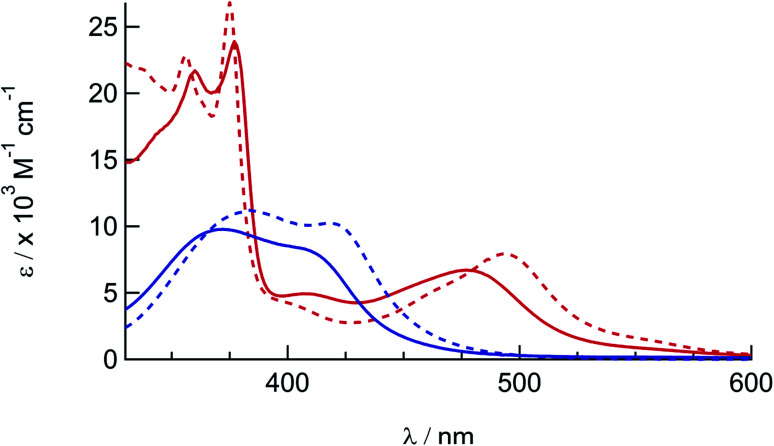
Two new tris-heteroleptic Ru(ii) complexes with triphenylphosphine (PPh) coordination, -[Ru(phen)(PPh)(CHCN)] (1a, phen = 1,10-phenanthroline) and -[Ru(biq)(phen)(PPh)(CHCN)] (2a, biq = 2,2'-biquinoline), were synthesized and characterized for photochemotherapeutic applications. Upon absorption of visible light, 1a exchanges a CHCN ligand for a solvent water molecule. Surprisingly, the steady-state irradiation of 2a followed by electronic absorption and NMR spectroscopies reveals the photosubstitution of the PPh ligand. Phosphine photoinduced ligand exchange with visible light from a Ru(ii) polypyridyl complex has not previously been reported, and calculations reveal that it results from a -type influence in the excited state. Complexes 1a and 2a are not toxic against the triple negative breast cancer cell line MDA-MB-231 in the dark, but upon irradiation with blue light, the activity of both complexes increases by factors of >4.2 and 5.8, respectively. Experiments with PPh alone show that the phototoxicity observed for 2a does not arise from the released phosphine ligand, indicating the role of the photochemically generated ruthenium aqua complex on the biological activity. These complexes represent a new design motif for the selective release of PPh and CHCN for use in photochemotherapy.
合成了两种具有三苯基膦(PPh)配位的新型三异质 Ru(II)配合物,即 -[Ru(phen)(PPh)(CHCN)](1a,phen = 1,10 - 菲咯啉)和 -[Ru(biq)(phen)(PPh)(CHCN)](2a,biq = 2,2'-联喹啉),并对其进行了光化学治疗应用的表征。在吸收可见光后,1a 将 CHCN 配体换成溶剂水分子。令人惊讶的是,2a 的稳态辐照以及电子吸收和核磁共振光谱显示了 PPh 配体的光取代。此前尚未报道过 Ru(II)多吡啶配合物的膦光诱导配体与可见光的交换,计算表明这是由激发态的 - 型影响导致的。配合物 1a 和 2a 在黑暗中对三阴性乳腺癌细胞系 MDA - MB - 231 无毒,但在用蓝光照射时,两种配合物的活性分别增加了 >4.2 倍和 5.8 倍。单独使用 PPh 的实验表明,2a 观察到的光毒性并非来自释放的膦配体,这表明光化学生成的钌水配合物对生物活性的作用。这些配合物代表了一种用于光化学治疗的选择性释放 PPh 和 CHCN 的新设计模式。