Wei James Cheng-Chung, Chang Yi-Jung, Wang Yu-Hsun, Yeh Chih-Jung
Department of Allergy, Immunology & Rheumatology, Chung Shan Medical University Hospital, Taichung, Taiwan.
Institute of Medicine, College of Medicine, Chung Shan Medical University, Taichung, Taiwan.
Clin Epidemiol. 2022 Mar 8;14:265-273. doi: 10.2147/CLEP.S346128=. eCollection 2022.
Previous research has pointed to the relationship between psoriasis and the development of gout. However, most previous studies had either small sample sizes or short study durations. Therefore, in this nationwide cohort study, we investigated the effect of psoriasis on the risk of gout development.
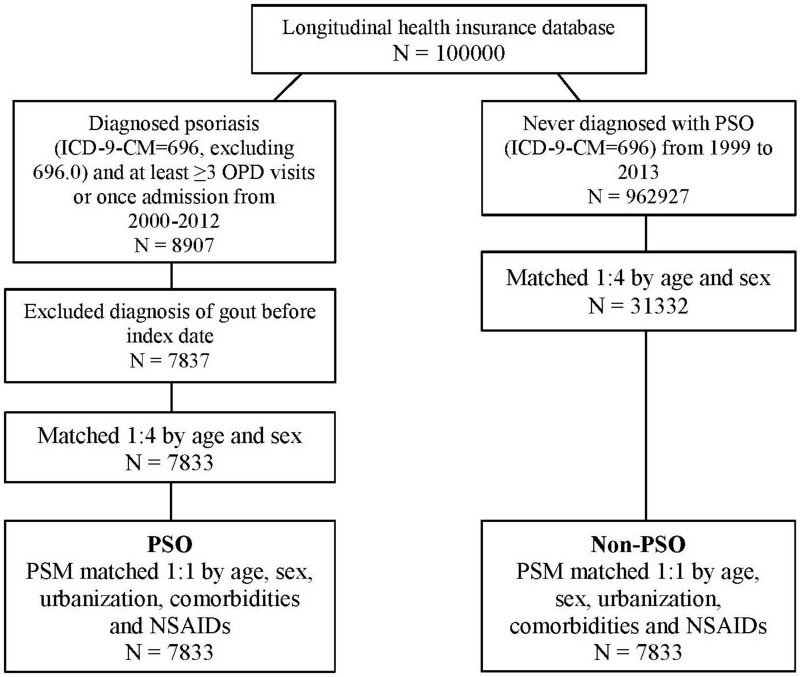
The study group included one million patients from Taiwan, whom we followed for 14 years. The participants were divided into two cohorts designated as psoriasis and non-psoriasis. A 1:4 propensity score matching test was used to compare age, sex, and index year between the two cohorts. Cox proportional hazard regression was used to determine the hazard ratios (HRs) and 95% confidence intervals (CIs) for the risk of gout. Sensitivity analyses were conducted to evaluate the HR for gout after the occurrence of psoriasis.
The incidence densities of gout in the psoriasis and non-psoriasis cohorts were 6.96 and 5.09 per 1000 person-years, respectively. After adjusting for age, sex, urbanization, comorbidities, and nonsteroidal anti-inflammatory drug (NSAID) use, the adjusted hazard ratio (aHR) with 95% CI for incidental gout in the psoriasis group was 1.38 (1.2-1.6). Moreover, the aHR (95% CI) values for gout risk in patients with psoriasis using NSAIDs and those who did not were 1.21 (1.0-1.47) and 1.65 (1.33-2.05), respectively.
This study demonstrated an association between psoriasis and risk of developing gout. Clinically, patients with psoriasis should be evaluated for incidental gout.
先前的研究指出了银屑病与痛风发病之间的关系。然而,大多数先前的研究样本量较小或研究持续时间较短。因此,在这项全国性队列研究中,我们调查了银屑病对痛风发病风险的影响。
研究组包括来自台湾的100万患者,我们对他们进行了14年的随访。参与者被分为银屑病组和非银屑病组两个队列。采用1:4倾向评分匹配试验来比较两个队列之间的年龄、性别和索引年份。使用Cox比例风险回归来确定痛风风险的风险比(HR)和95%置信区间(CI)。进行敏感性分析以评估银屑病发生后痛风的HR。
银屑病组和非银屑病组痛风的发病密度分别为每1000人年6.96例和5.09例。在调整年龄、性别、城市化、合并症和非甾体抗炎药(NSAID)使用情况后,银屑病组偶发性痛风的调整后风险比(aHR)及其95%CI为1.38(1.2 - 1.6)。此外,使用NSAIDs的银屑病患者和未使用NSAIDs的银屑病患者痛风风险的aHR(95%CI)值分别为1.21(1.0 - 1.47)和1.65(1.33 - 2.05)。
本研究证明了银屑病与痛风发病风险之间存在关联。临床上,应对银屑病患者进行偶发性痛风的评估。