Holliday Alison M, Quinlan Claire M, Schwartz Andrea Wershof
Department of Internal Medicine Resident, Brigham and Women's Hospital, Boston, MA and Clinical Fellow in Medicine at Harvard Medical School, Boston, MA, USA.
Medical Student, Harvard Medical School, Boston, MA, USA.
J Family Med Prim Care. 2022 Jan;11(1):5-9. doi: 10.4103/jfmpc.jfmpc_719_21. Epub 2022 Jan 31.
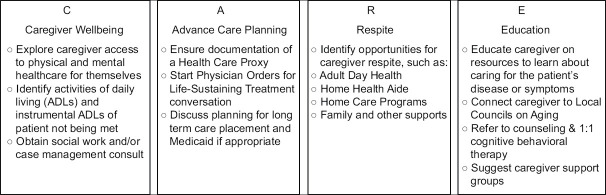
Caregivers, or persons who provide unpaid support to a loved one who could not manage to live independently or whose health or well-being would deteriorate without this help, are increasingly common. These rates have only increased with the COVID-19 pandemic forcing many to care for sick family members in the short or long term. Unfortunately, caregiving is associated with significant burden and health risks, not only for caregivers themselves but also for the care recipients of overwhelmed caregivers. These risks have also been exacerbated by the social isolation of the COVID-19 pandemic. Although interventions exist which have been proven to reduce caregiver burden, education on these interventions is lacking, partly because there has not been a memorable framework on how to care for caregivers. In this paper, an innovative framework to teach clinicians about caring for caregivers is introduced, the C.A.R.E. framework: Caregiver well-being, Advanced care planning, Respite, and Education. This simple framework will help providers become aware of caregiver needs, comfortable in addressing their needs, and able to suggest interventions proven to reduce caregiver burden. Knowledge of this framework should start with medical students so that they can incorporate this critical aspect of primary care into their clinical practice early on in their careers. If providers can simply remember to perform these four interventions, to C.A.R.E. for our caregivers, then they will make a significant impact on the lives of both our patients and their loved ones, during the present COVID-19 pandemic and thereafter.
照顾者,即那些为无法独立生活或没有这种帮助其健康或幸福就会恶化的亲人提供无偿支持的人,越来越普遍。随着新冠疫情迫使许多人在短期或长期内照顾生病的家庭成员,这些比例还在上升。不幸的是,照顾不仅给照顾者自身,也给不堪重负的照顾者的受照顾者带来了巨大负担和健康风险。新冠疫情导致的社会隔离也加剧了这些风险。尽管存在已被证明可减轻照顾者负担的干预措施,但对这些干预措施的教育却很缺乏,部分原因是没有一个关于如何照顾照顾者的令人难忘的框架。本文介绍了一个向临床医生传授如何照顾照顾者的创新框架,即C.A.R.E.框架:照顾者福祉、高级护理规划、喘息机会和教育。这个简单的框架将帮助医护人员了解照顾者的需求,自如地满足他们的需求,并能够推荐已被证明可减轻照顾者负担的干预措施。对这个框架的了解应该从医学生开始,这样他们就能在职业生涯早期将初级护理的这一关键方面纳入临床实践。如果医护人员能简单地记住执行这四项干预措施,即关爱我们的照顾者,那么他们将在当前的新冠疫情期间及之后对我们的患者及其亲人的生活产生重大影响。