Sinnott Bridget, Ray Cara, Weaver Frances, Gonzalez Beverly, Chu Elizabeth, Premji Sarah, Raiford Mattie, Elam Rachel, Miskevics Scott, Parada Stephen, Carbone Laura
Charlie Norwood Veterans Affairs Medical Center Augusta GA USA.
Center of Innovation for Complex Chronic Healthcare (CINCCH), Health Services Research & Development, Department of Veterans Affairs Hines VA Hospital Hines IL USA.
JBMR Plus. 2022 Jan 5;6(3):e10595. doi: 10.1002/jbm4.10595. eCollection 2022 Mar.
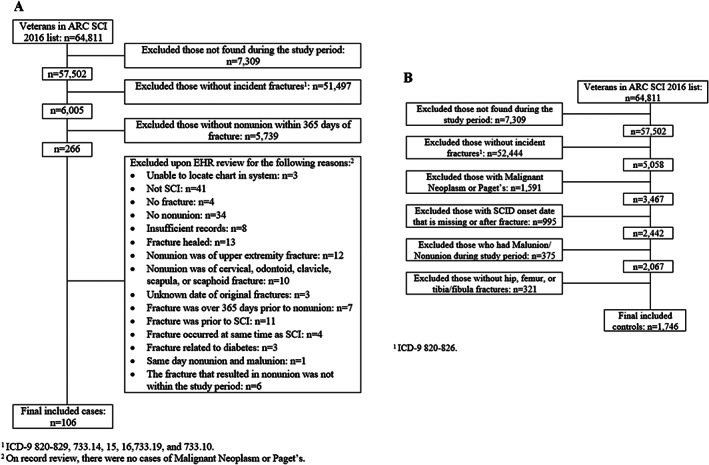
We used Veterans Health Administration (VHA) national administrative data files to identify a cohort (fiscal years 2005-2014) of veterans with spinal cord injuries and disorders (SCID) to determine risk factors for and consequences of lower extremity fracture nonunions. Odds ratios (OR) for fracture nonunion were computed using multivariable-adjusted logistic regression models. We identified three risk factors for nonunion: (i) older age (OR = 2.29; 95% confidence interval [CI] 1.21-4.33), (ii) longer duration of SCID (OR = 1.02; 95% CI 1.00-1.04), and (iii) fracture site (distal femur), with OR (comparison distal femur) including distal tibia/fibula (OR = 0.14; 95% CI 0.09-0.24), proximal tibia/fibula (OR = 0.19; 95% CI 0.09-0.38), proximal femur (OR = 0.10; 95% CI 0.04-0.21), and hip (OR = 0.13; 95% CI 0.07-0.26). Nonunions resulted in multiple complications, with upwards of 1/3 developing a pressure injury, 13% osteomyelitis, and almost 25% requiring a subsequent amputation. Our data have identified a high-risk population for fracture nonunion of older veterans with a long duration of SCID who sustain a distal femur fracture. In view of the serious complications of these nonunions, targeted interventions in these high-risk individuals who have any signs of delayed union should be considered. © 2021 The Authors. published by Wiley Periodicals LLC on behalf of American Society for Bone and Mineral Research. This article has been contributed to by US Government employees and their work is in the public domain in the USA.
我们使用退伍军人健康管理局(VHA)的全国行政数据文件,确定了一个队列(2005 - 2014财年)的脊髓损伤和疾病(SCID)退伍军人,以确定下肢骨折不愈合的风险因素和后果。使用多变量调整逻辑回归模型计算骨折不愈合的比值比(OR)。我们确定了三个不愈合的风险因素:(i)年龄较大(OR = 2.29;95%置信区间[CI] 1.21 - 4.33),(ii)SCID病程较长(OR = 1.02;95% CI 1.00 - 1.04),以及(iii)骨折部位(股骨远端),与包括胫腓骨远端(OR = 0.14;95% CI 0.09 - 0.24)、胫腓骨近端(OR = 0.19;95% CI 0.09 - 0.38)、股骨近端(OR = 0.10;95% CI 0.04 - 0.21)和髋部(OR = 0.13;95% CI 0.07 - 0.26)的股骨远端进行比较。骨折不愈合导致多种并发症,超过1/3发生压疮,13%发生骨髓炎,近25%需要后续截肢。我们的数据确定了患有长期SCID且股骨远端骨折的老年退伍军人是骨折不愈合的高危人群。鉴于这些不愈合的严重并发症,对于有任何延迟愈合迹象的高危个体,应考虑采取针对性干预措施。© 2021作者。由Wiley Periodicals LLC代表美国骨与矿物质研究学会出版。本文由美国政府雇员贡献,其在美国属于公共领域。