Hayawi Kadhim, Mathew Sujith, Venugopal Neethu, Masud Mohammad M, Ho Pin-Han
Zayed University, Abu Dhabi, UAE.
United Arab Emirates University, Abu Dhabi, UAE.
Soc Netw Anal Min. 2022;12(1):43. doi: 10.1007/s13278-022-00869-w. Epub 2022 Mar 12.
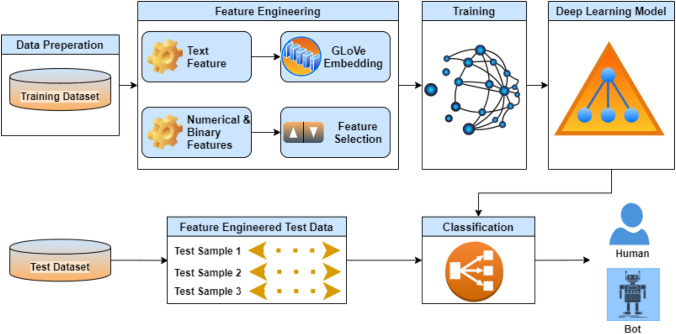
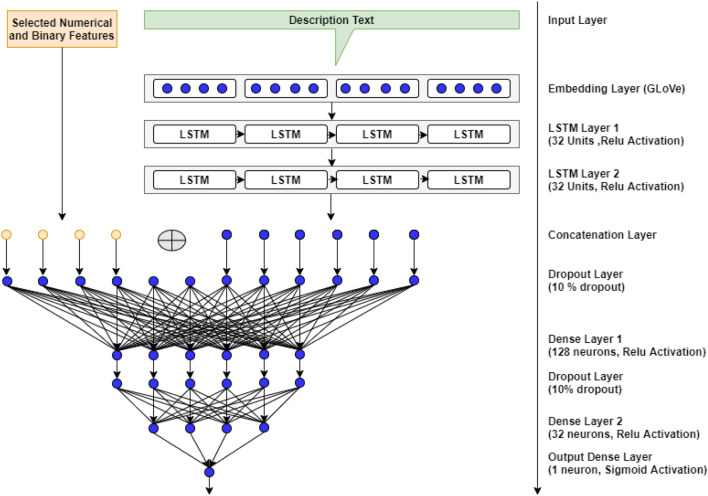
Use of online social networks (OSNs) undoubtedly brings the world closer. OSNs like Twitter provide a space for expressing one's opinions in a public platform. This great potential is misused by the creation of bot accounts, which spread fake news and manipulate opinions. Hence, distinguishing genuine human accounts from bot accounts has become a pressing issue for researchers. In this paper, we propose a framework based on deep learning to classify Twitter accounts as either 'human' or 'bot.' We use the information from user profile metadata of the Twitter account like description, follower count and tweet count. We name the framework 'DeeProBot,' which stands for Deep Profile-based Bot detection framework. The raw text from the description field of the Twitter account is also considered a feature for training the model by embedding the raw text using pre-trained Global Vectors (GLoVe) for word representation. Using only the user profile-based features considerably reduces the feature engineering overhead compared with that of user timeline-based features like user tweets and retweets. DeeProBot handles mixed types of features including numerical, binary, and text data, making the model hybrid. The network is designed with long short-term memory (LSTM) units and dense layers to accept and process the mixed input types. The proposed model is evaluated on a collection of publicly available labeled datasets. We have designed the model to make it generalizable across different datasets. The model is evaluated using two ways: testing on a hold-out set of the same dataset; and training with one dataset and testing with a different dataset. With these experiments, the proposed model achieved AUC as high as 0.97 with a selected set of features.
在线社交网络(OSN)的使用无疑使世界变得更加紧密。像推特这样的在线社交网络为人们在公共平台上表达观点提供了空间。然而,机器人账户的创建却滥用了这种巨大潜力,这些账户传播虚假新闻并操纵舆论。因此,区分真实的人类账户和机器人账户已成为研究人员面临的紧迫问题。在本文中,我们提出了一个基于深度学习的框架,用于将推特账户分类为“人类”或“机器人”。我们使用推特账户用户资料元数据中的信息,如描述、关注者数量和推文数量。我们将这个框架命名为“DeeProBot”,即基于深度资料的机器人检测框架。推特账户描述字段中的原始文本也被视为一种特征,通过使用预训练的全局向量(GLoVe)进行词嵌入来训练模型。与基于用户推文和转发等用户时间线的特征相比,仅使用基于用户资料的特征大大减少了特征工程的工作量。DeeProBot处理包括数值、二进制和文本数据在内的混合类型特征,使模型具有混合性。该网络采用长短期记忆(LSTM)单元和全连接层进行设计,以接受和处理混合输入类型。我们在一组公开可用的标记数据集上对提出的模型进行了评估。我们设计该模型使其能够在不同数据集上通用。模型通过两种方式进行评估:在同一数据集的留出集上进行测试;以及使用一个数据集进行训练并在另一个不同数据集上进行测试。通过这些实验,所提出的模型在一组选定特征下实现了高达0.97的AUC。