de Heide John, van der Graaf Marisa, Holl Marijn J, Bhagwandien Rohit E, Theuns Dominic A M J, de Wit André, Zijlstra Felix, Szili-Torok Tamas, Lenzen Mattie J, Yap Sing-Chien
Department of Cardiology, Erasmus MC, University Medical Center Rotterdam, Rotterdam, the Netherlands. All authors take responsibility for all aspects of the reliability and freedom from bias of the data presented and their discussed interpretation.
Int J Cardiol Heart Vasc. 2022 Mar 16;39:101005. doi: 10.1016/j.ijcha.2022.101005. eCollection 2022 Apr.
Direct oral anticoagulants (DOACs) are the preferred choice of oral anticoagulation in patients with atrial fibrillation (AF). Randomized trials have demonstrated the efficacy and safety of DOAC in patients undergoing a cardiac implantable electronic device procedure (CIED); however, there is limited real-world data.
To evaluate the outcome of patients undergoing an elective CIED procedure in a tertiary referral center with an interrupted DOAC or continued vitamin K antagonist (VKA) regimen.
This was a retrospective single-center study of consecutive patients with AF undergoing an elective CIED procedure between January 2016 and June 2019. The primary endpoint was a clinically significant pocket hematoma < 30 days after surgery. The secondary endpoint was any systemic thromboembolic complication < 30 days after surgery.
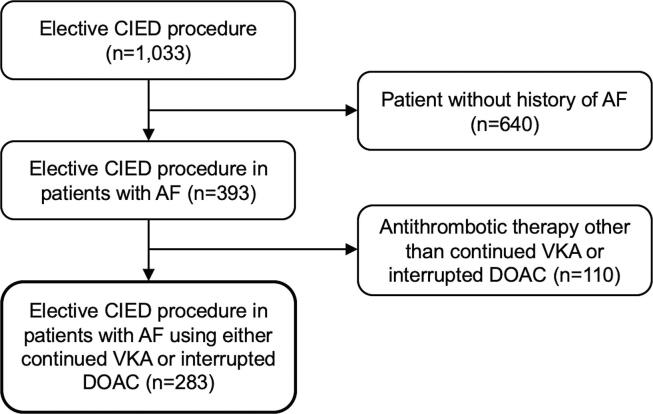
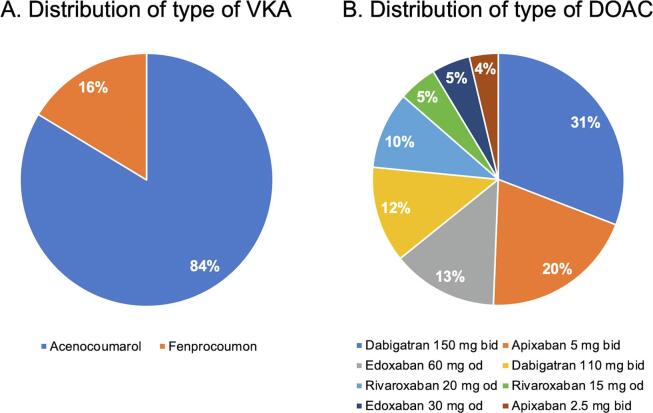
Of a total of 1,033 elective CIED procedures, 283 procedures were performed in patients with AF using oral anticoagulation. One-third of the procedures were performed under DOAC (N = 81, 29%) and the remainder under VKA (N = 202, 71%). The DOAC group was younger, had less chronic renal disease, more paroxysmal AF and a lower HAS-BLED score. The VKA group more often underwent a generator change only in comparison to the DOAC group. Clinically significant pocket hematoma occurred in 5 patients (2.5%) in the VKA group and did not occur in the DOAC group ( = 0.33). There were no thromboembolic events reported.
In patients with AF undergoing an elective CIED procedure, the risk of a pocket hematoma and a systemic thromboembolic event is comparably low when using either continued VKA or interrupted DOAC.
直接口服抗凝剂(DOACs)是心房颤动(AF)患者口服抗凝治疗的首选。随机试验已证明DOAC在接受心脏植入式电子设备手术(CIED)患者中的有效性和安全性;然而,真实世界的数据有限。
评估在三级转诊中心接受择期CIED手术的患者采用DOAC中断或维生素K拮抗剂(VKA)持续治疗方案的结果。
这是一项对2016年1月至2019年6月期间接受择期CIED手术的连续性AF患者进行的回顾性单中心研究。主要终点是术后<30天出现具有临床意义的囊袋血肿。次要终点是术后<30天出现任何全身性血栓栓塞并发症。
在总共1033例择期CIED手术中,283例手术是在使用口服抗凝剂的AF患者中进行的。其中三分之一的手术在DOAC治疗下进行(N = 81,29%),其余在VKA治疗下进行(N = 202,71%)。DOAC组患者更年轻,慢性肾病更少,阵发性AF更多,HAS - BLED评分更低。与DOAC组相比,VKA组更常仅更换发生器。VKA组有5例患者(2.5%)出现具有临床意义的囊袋血肿,DOAC组未出现(P = 0.33)。未报告血栓栓塞事件。
在接受择期CIED手术的AF患者中,持续使用VKA或中断使用DOAC时,囊袋血肿和全身性血栓栓塞事件的风险相对较低。